Best Claude Model in 2026: I Tested All Four, Here Is the Honest Ranking
The best Claude model in 2026 is Claude Opus 5 for complex coding, reasoning, and any work you cannot afford to get wrong. For most people most of the time, Claude Sonnet 5 is the smarter pick, because it costs 60 percent less and handles ordinary work almost as well. Use Claude Haiku 4.5 for cheap high volume tasks, and Claude Fable 5 only when you can prove it beats Opus on your own job.
If that is all you needed, you are done. If you want to know why, and which model fits your exact task, keep reading.
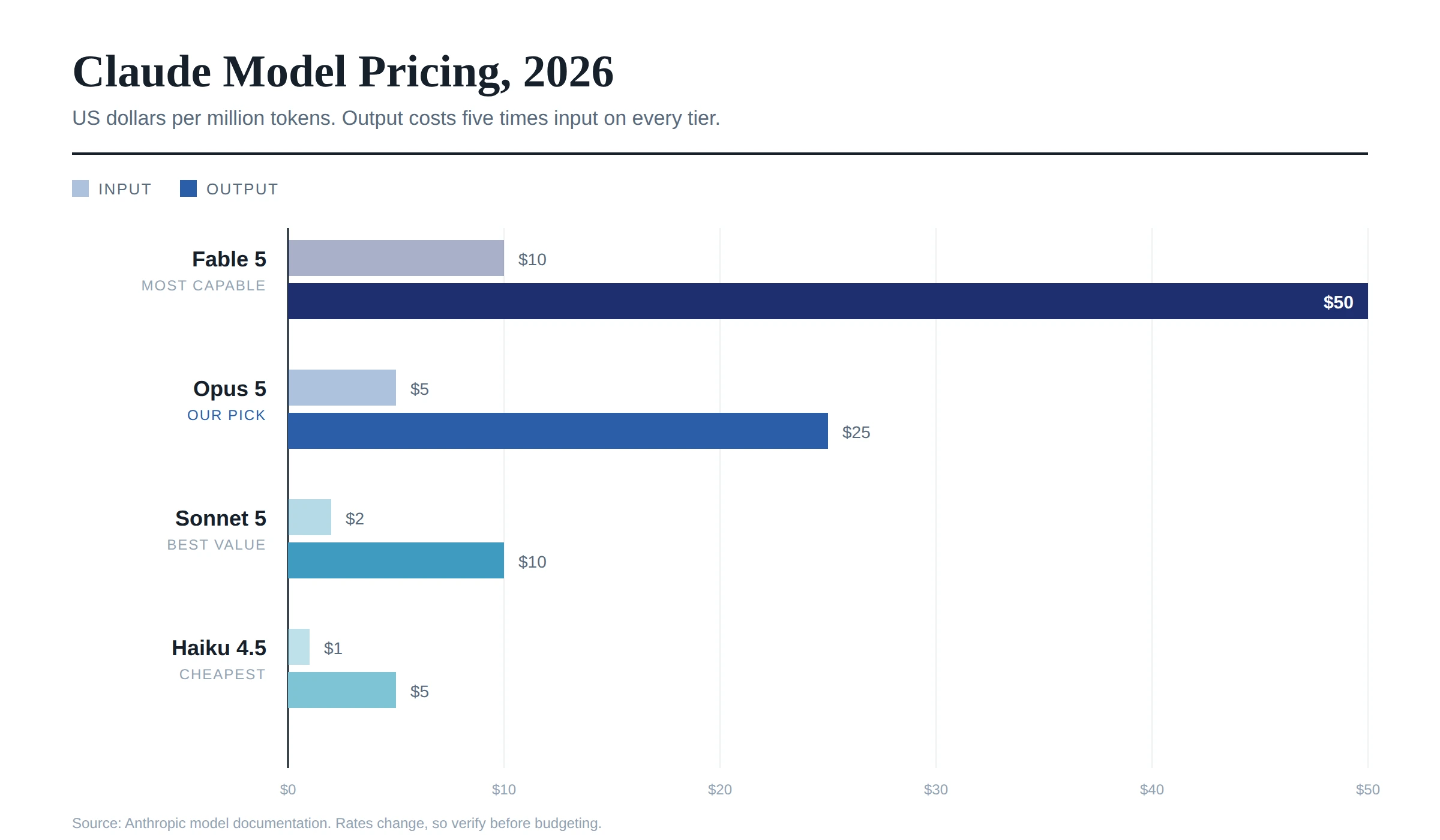
Output tokens on Claude Fable 5 cost ten times what they cost on Claude Haiku 4.5. Fifty dollars per million against five. On input it is the same multiple, ten dollars against one.
That is the whole problem in one line. Most people pick whatever sits at the top of the dropdown, assume bigger means better, and never think about it again. Then the invoice arrives.
So we did the work properly. We ran the four generally available models on real jobs, coding, writing, research, and long document work, and checked every specification against Anthropic's own pricing documentation rather than the rate cards other sites are still quoting.
How we checked this: every price, context window, and knowledge cutoff below was verified against Anthropic's published model documentation on 24 August 2026. This lineup changed four times in the first eight months of 2026, so if you are reading this well after that date, treat the numbers as a starting point and confirm them.
Here is the full answer. This is the best Claude model in 2026, ranked, with honest pros, cons, and a clear verdict on each.
What Makes a Claude Model the Best
Let me keep this plain.
The best Claude model is not the most expensive one. It is the cheapest one that still gets your job right on the first try.
That is it.
Think of it like hiring. You do not put your most senior engineer on password resets. You do not put an intern on the database migration. The skill has to match the job, or you waste money in one direction and quality in the other.
Claude models work the same way. Anthropic ships four of them on purpose, and each one is built for a different kind of work.
The Four Current Claude Models
Anthropic uses a naming system that is easier than it looks.
Haiku is the small fast one. Sonnet is the balanced one. Opus is the heavy one for hard problems. Fable sits above Opus as the most capable model Anthropic releases publicly.
The number after the name is the generation. As of 2026 the current lineup is Claude Fable 5, Claude Opus 5, Claude Sonnet 5, and Claude Haiku 4.5.
There is a fifth name you may see, Claude Mythos 5. It shares Fable 5's specs but it is invitation only through a program called Project Glasswing. There is no signup page, so for almost everyone reading this it is not a real option.
If your model policy still says Opus 4.8 or Sonnet 4.6, you are on legacy models. They still run, but they are no longer the ones to build on.
How We Ranked These
We scored each model on six things.
Reasoning quality. Does it get hard, multi step problems right, or does it produce a confident answer that falls apart on inspection?
Coding. Real work, not snippets. Multi file edits, debugging, and long agent runs that have to stay coherent.
Writing. Voice, structure, and whether the draft needs a full rewrite or a light edit.
Speed. How long you sit waiting, which matters far more in production than in a chat window.
Price. Cost per million tokens, and more importantly, cost per finished task.
Context and limits. How much you can feed it, and how much it can write back.
Now the ranking.
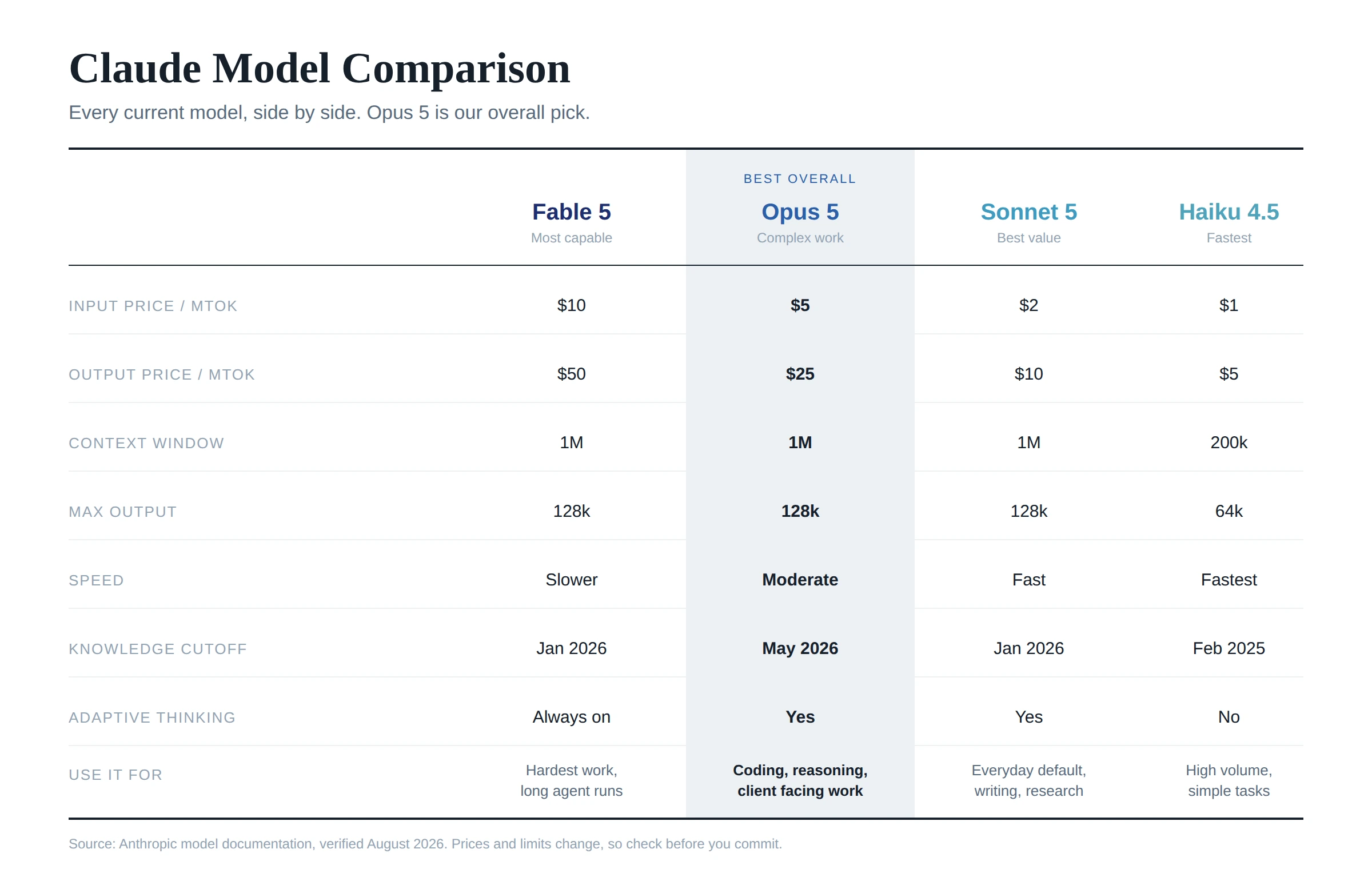
Quick Comparison Table
Rank | Model | Best for | Price per million tokens | Context window | Speed |
|---|---|---|---|---|---|
1 | Claude Opus 5 | Complex coding, agents, hard reasoning | 5 dollars in, 25 dollars out | 1 million | Moderate |
2 | Claude Sonnet 5 | Everyday default for most people | 2 dollars in, 10 dollars out | 1 million | Fast |
3 | Claude Fable 5 | The hardest work, long agent runs | 10 dollars in, 50 dollars out | 1 million | Slower |
4 | Claude Haiku 4.5 | High volume, low cost, low latency | 1 dollar in, 5 dollars out | 200,000 | Fastest |
 Prices and limits change often. Always check Anthropic's own models and pricing documentation before you commit a budget.
One line in that table deserves more attention than it usually gets. Opus 5 has the most recent knowledge of any current Claude model, and Haiku 4.5 has the oldest by more than a year.
Now the detail.
1. Claude Opus 5: Best Overall
Best for: complex agentic coding, enterprise work, and reasoning you cannot afford to get wrong.
We are putting Opus 5 first, and Anthropic agrees. Its own documentation tells you to start here if you are unsure, and to move up to Fable 5 only when you need the absolute ceiling.
Opus 5 is the current Opus generation, and it replaced Opus 4.8 at exactly the same price. You get better output for the same money, which does not happen often.
It has one quiet advantage nobody talks about. Its knowledge runs later than any other model in the family, through May 2026, while Fable 5 and Sonnet 5 stop around January 2026. For anything touching recent tools, libraries, or events, that gap is real.
You also get a 1 million token context window, up to 128,000 tokens of output, and adaptive thinking, which lets the model spend more effort on the hard parts of a question and less on the easy parts.
Pros
Best balance of capability and cost in the lineup.
The newest knowledge of any current Claude model.
Strong on multi file coding and long agent runs.
Half the token price of Fable 5.
Cons
Slower than Sonnet 5, and five times the price.
Overkill for routine work, which is exactly how people overspend.
Verdict: the best Claude model overall, and the right default for developers, analysts, and anyone doing work that gets published or shipped without a second pair of eyes.
2. Claude Sonnet 5: Best Value and Best Daily Driver
Best for: almost everybody, almost all of the time.
Here is where we will argue with the ranking above. Opus 5 is the better model. Sonnet 5 is the one most of you should actually be using.
Sonnet 5 costs 2 dollars in and 10 dollars out per million tokens. That is 60 percent cheaper than Opus 5 on both sides. It runs the same 1 million token context window and the same 128,000 token output ceiling. It is noticeably faster. And on ordinary work, the quality difference is small enough that you will struggle to spot it.
It is also the default model on Anthropic's free and Pro plans, which means most people are already using it without choosing it.
Our rule is simple. Run Sonnet 5 as the default and escalate only when it visibly struggles. Teams that do this instead of defaulting to Opus routinely cut their spend by more than half without anyone noticing a drop in output.
Pros
Best price to performance ratio in the Claude family.
Full 1 million token context at a mid tier price.
Fast enough for production and for live chat.
Available on the free plan.
Cons
Falls behind on genuinely hard multi step reasoning.
Knowledge cutoff is earlier than Opus 5.
Verdict: the best Claude model for the money, and the correct starting point for students, writers, marketers, and most developers.
3. Claude Fable 5: The Most Capable, With One Catch Worth Understanding
Best for: the hardest knowledge work and long running autonomous agents.
Fable 5 is the most capable model Anthropic releases to the public. It sits above Opus 5, not below it. It runs adaptive thinking permanently and is built for agents that have to stay on task a long time without drifting. It is third on this list only because capability is not the same as value.
It costs 10 dollars in and 50 dollars out per million tokens. That is double Opus 5 on both sides, so on an output heavy job the gap is large.
The more interesting reason to hesitate is not the price. Fable 5 ships with safeguards that route certain requests to a lower tier model instead, and Anthropic has been open about this: the safeguards are tuned conservatively, they trigger in fewer than 5 percent of sessions, and they will sometimes catch harmless requests. Reporting indicates the areas most likely to trigger them include cybersecurity and biology.
Read what that means in practice. You can pay double for Fable 5 and, on a small share of requests, receive an answer from a cheaper model anyway. For a chat user that is a minor annoyance. For anyone building a product on the API, especially in security tooling, it is a design consideration you need to plan around rather than discover in production.
Note that published accounts differ on exactly which model handles the fallback, so we have not named one.
Pros
The highest capability ceiling available without an invitation.
Adaptive thinking always on.
Built for long horizon agent work.
Cons
The most expensive model, by a wide margin on output.
Slower than everything else in the lineup.
A small share of requests are answered by a less capable model, and you cannot fully predict which.
Verdict: the right call when a job is genuinely hard enough to justify paying double. If your work sits in security or biology, test the fallback behaviour before you commit to it.
4. Claude Haiku 4.5: Cheapest and Fastest
Best for: volume. Classification, extraction, routing, tagging, and simple summaries.
Haiku 4.5 is one generation behind the rest, but it is still the current Haiku, and it is the fastest model Anthropic ships. At 1 dollar in and 5 dollars out, it is a tenth of Fable 5's price.
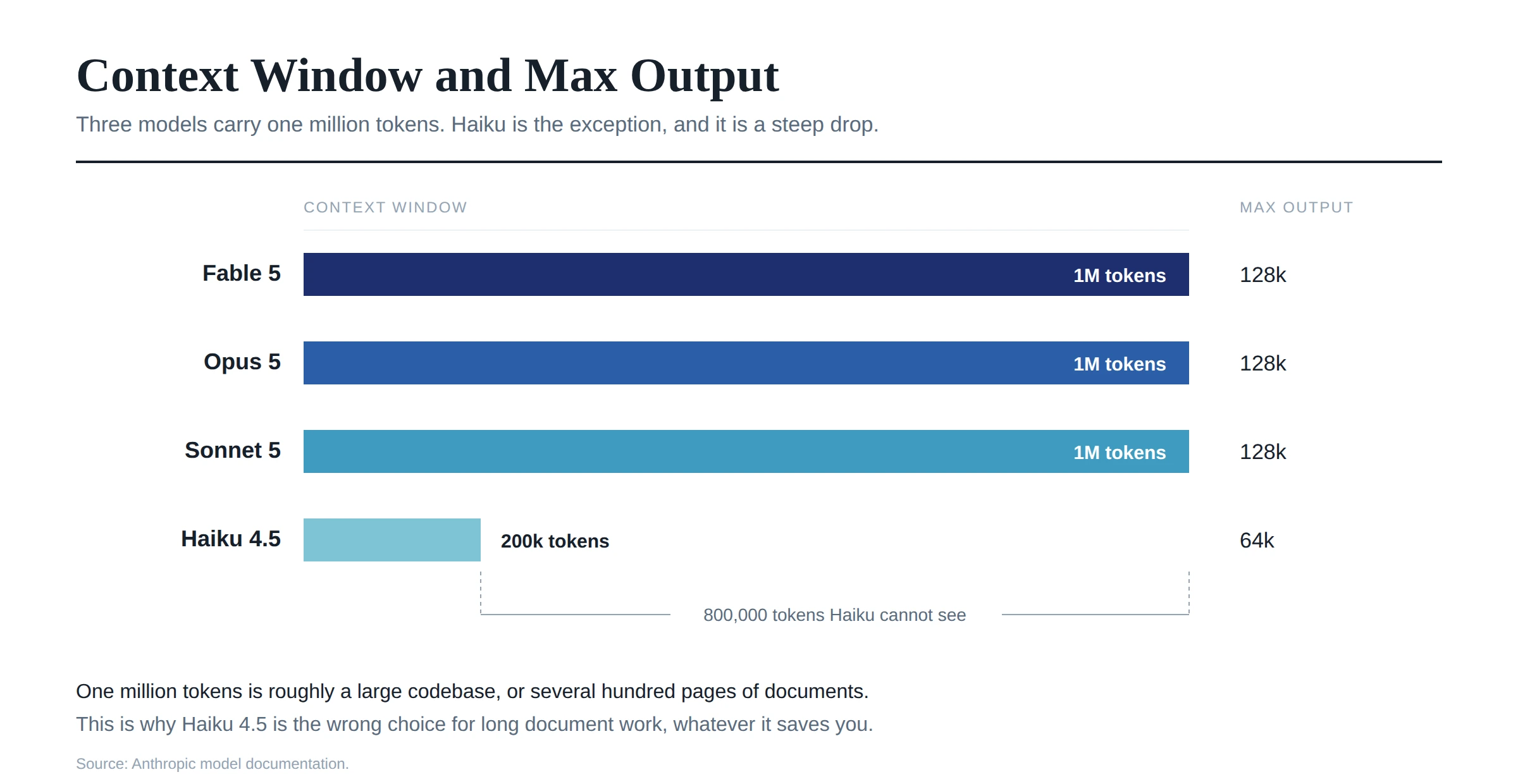
The trade offs are clear. Its context window is 200,000 tokens rather than 1 million, its output ceiling is 64,000 tokens, and its knowledge runs to early 2025, which is much older than the rest.
None of that matters for the work it is meant to do. If you are labelling ten thousand support tickets, you do not need frontier reasoning. You need speed and a small bill.
Pros
The cheapest Claude model available.
The fastest response times in the family.
Genuinely good at simple, well defined tasks.
Cons
Smallest context window of the four.
Oldest knowledge in the lineup.
Not suitable for complex reasoning or long documents.
Verdict: the best Claude model for high volume production work, and a poor choice for anything that requires judgement.
Best Claude Model by Use Case
This is the section most people actually want.
Best Claude model for coding: Opus 5. It leads on multi file edits, debugging across a repository, and long agent runs. Use Sonnet 5 for day to day pair programming and save Opus for the hard tickets.
Best Claude model for writing: Sonnet 5 for volume and business copy. Opus 5 or Fable 5 when voice and nuance matter, such as a keynote, a landing page, or anything going out under your name.
Best Claude model for reasoning: Opus 5. Adaptive thinking is the difference between an answer that sounds right and an answer that is right.
Best Claude model for research: Opus 5 when depth matters, Sonnet 5 when you are working through a lot of sources on a budget. Fable 5 for the largest document sets.
Best Claude model for long context: any of Opus 5, Sonnet 5, or Fable 5. All three carry a 1 million token window. Haiku 4.5 caps at 200,000, so keep it away from big documents.
 Best Claude model for agents: Fable 5 for long autonomous runs, Opus 5 for planning steps, Haiku 4.5 for cheap sub steps. Mixing tiers inside one agent is normal and it is where the real savings are.
Best Claude model for students: Sonnet 5. It is free, it is capable, and it handles essays, summaries, and study work without a subscription.
Best Claude model for business: Opus 5 for analysis, strategy, and anything client facing. Sonnet 5 for internal drafts and everyday work.
Cheapest, Fastest, and Smartest
 Three short answers.
Cheapest Claude model: Haiku 4.5, at 1 dollar in and 5 dollars out.
Fastest Claude model: Haiku 4.5 again. Sonnet 5 is the fastest model that still handles complex work.
Smartest Claude model: Fable 5 on paper. Opus 5 in practice, once you divide capability by price.
Claude Opus vs Sonnet vs Haiku
If you remember one thing from this article, make it this.
Opus is for problems. Sonnet is for work. Haiku is for volume.
Opus vs Sonnet comes down to whether the task is hard enough to justify paying two and a half times more per token. If a competent junior could do it, use Sonnet.
Sonnet vs Haiku comes down to whether judgement is involved. If the task has a single correct answer and a clear rule, Haiku will do it faster and cheaper.
Four Mistakes That Cost People Money
Defaulting to the top model. Running Opus or Fable on everything is the single most common way teams overspend on Claude API pricing.
Ignoring output tokens. Output costs five times input on every tier. Long answers are where your bill actually comes from, so cap response length where you can.
Skipping prompt caching. If you resend the same system prompt or document context, caching cuts that input cost by up to 90 percent.
Staying on legacy models. Opus 4.8 and Sonnet 4.6 still run, but the current generation performs better at the same price. There is rarely a reason to stay.
Frequently Asked Questions
What is the best Claude model?
Claude Opus 5 is the best Claude model overall for hard work. Claude Sonnet 5 is the best choice for most people day to day, because it delivers close to Opus quality at a much lower price.
Which Claude model should I use?
Start on Sonnet 5. Move to Opus 5 when Sonnet visibly struggles. Drop to Haiku 4.5 for simple high volume tasks. Reach for Fable 5 when a job is hard enough to justify paying double, keeping in mind that a small share of requests are answered by a lower tier model.
What is the difference between Claude models?
Capability, speed, price, and context. Haiku is fastest and cheapest with a 200,000 token window. Sonnet balances speed and intelligence. Opus handles complex reasoning and agentic coding. Fable sits at the top for the hardest work.
Is Claude Opus better than Claude Sonnet?
Yes on capability, especially on multi step reasoning and complex coding. But Opus 5 costs two and a half times more per token and runs slower, so it is only the better choice when the task is genuinely hard.
Is Claude Sonnet better than Claude Haiku?
For anything involving judgement, yes, and it has five times the context window. For classification, extraction, and routing, Haiku is faster and cheaper and the quality gap barely shows.
Which Claude model is cheapest?
Claude Haiku 4.5, at 1 dollar per million input tokens and 5 dollars per million output tokens.
Which Claude model is fastest?
Claude Haiku 4.5. Sonnet 5 is the fastest model that still handles complex tasks well.
What is the best Claude model for long documents?
Opus 5, Sonnet 5, or Fable 5. All three support a 1 million token context window, which is roughly a large codebase or several hundred pages.
Does the free plan give me the best Claude model?
No, but it gives you a very good one. Sonnet 5 is the default on the free plan, and for most everyday work it is enough.
Our Final Verdict
If you want one answer, here it is.
Claude Opus 5 is the best Claude model in 2026. It has the strongest balance of reasoning, coding, and price in the lineup, and it carries the most recent knowledge of any current model.
But we would still tell you to open Sonnet 5 tomorrow morning and leave it there. Run it as your default, escalate to Opus 5 when a task fights back, drop to Haiku 4.5 for the boring high volume jobs, and treat Fable 5 as a specialist you call in rather than a model you live in.
That routing habit will save you more money than picking any single winner ever could.
For the exact current specifications, model IDs, and rates, Anthropic publishes everything on its official models overview page. And if you are still deciding between platforms rather than models, our deepseek vs chatgpt vs gemini comparison covers that side of the question.