Best AI for Python Coding in 2026: What the Benchmarks Hide
The short answer: for serious Python work, Claude Opus 5.5 is the current default at 4 dollars and 20 dollars per million tokens, with GPT-6 Astra the alternative and Kimi K3 or GLM-5.3 the open-weight picks. For everyday scripting, cheaper models are genuinely good enough.
But when I went to check how those rankings are produced, I found something nobody seems to mention, and once you see it the whole exercise looks different.
Every "best coding model" ranking you have read is built on SWE-bench. SWE-bench is 100 percent Python. Nearly half of it is one repository.
That is good news and bad news, and both halves are worth your time.
The Leaderboards Are Already Python Leaderboards
When I went looking at how the benchmark is built, I found SWE-bench draws on 2,294 real GitHub issues across twelve open source repositories, every one of them Python. SWE-bench Verified, the 500-task subset the labs actually quote, draws from the same twelve.
Here is how those 500 tasks break down.
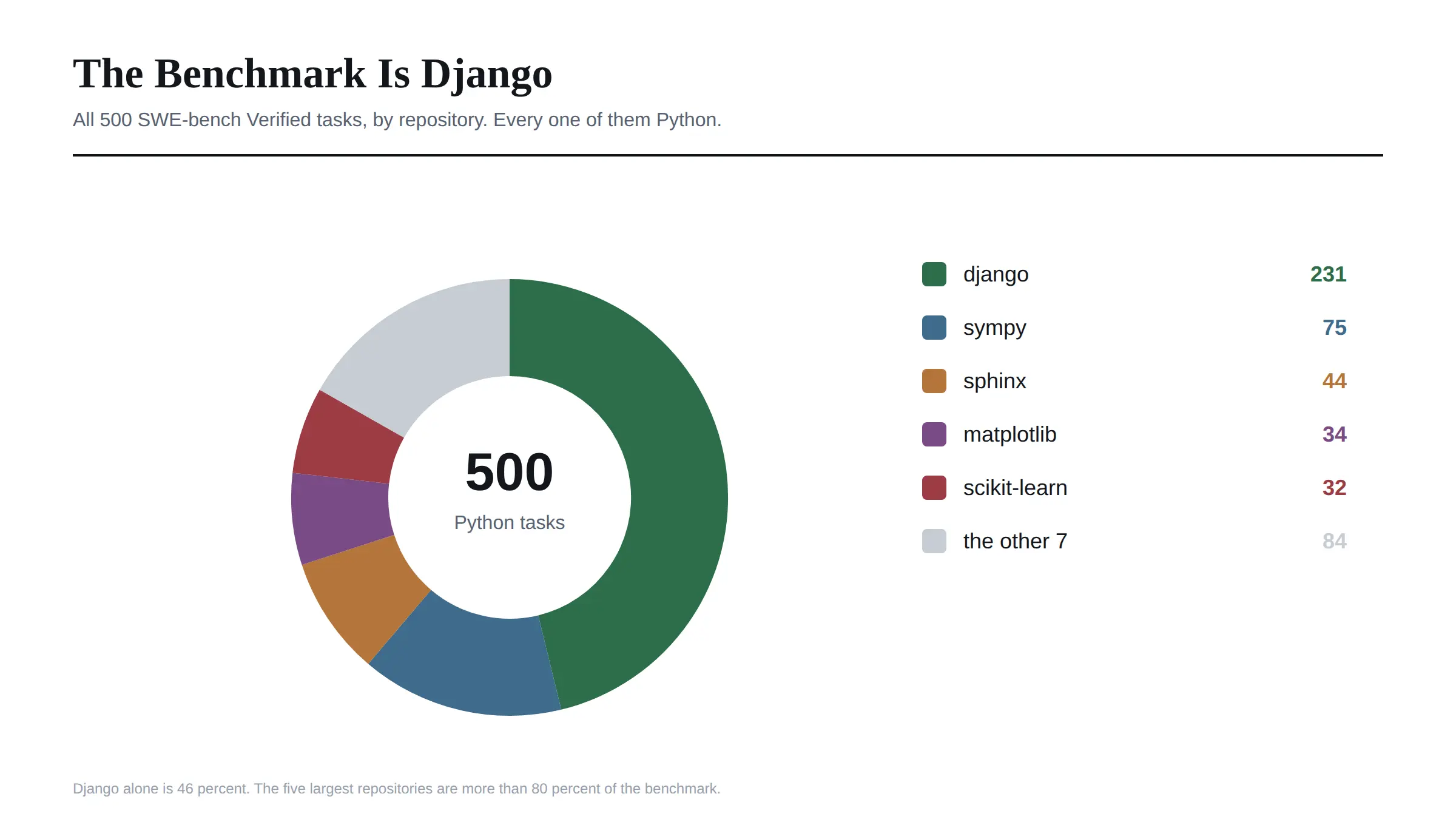 Django supplies 231 of the 500 tasks. SymPy adds 75, Sphinx 44, Matplotlib 34 and scikit-learn 32. Those five repositories are more than 80 percent of the benchmark. At the other end, Seaborn contributes two tasks and Flask contributes one.
So when a model announcement claims a SWE-bench score, it is reporting how well that model fixes bugs in Django, a computer algebra system, a documentation generator, a plotting library and a machine learning library.
That is the good news. If you write Python, the headline benchmark is more relevant to you than to anyone writing Go or TypeScript. Those rankings were never general. They were always about your language.
Worth knowing that SWE-bench Pro, the newer benchmark, did add other languages. One analysis of its task pool found 65 Python instances alongside 48 Go, 26 JavaScript and 11 TypeScript. So Pro is genuinely multi-language, while Verified never was.
What Those Scores Actually Measure
Now the bad news, and I think this is the part that should change how much weight you give a leaderboard.
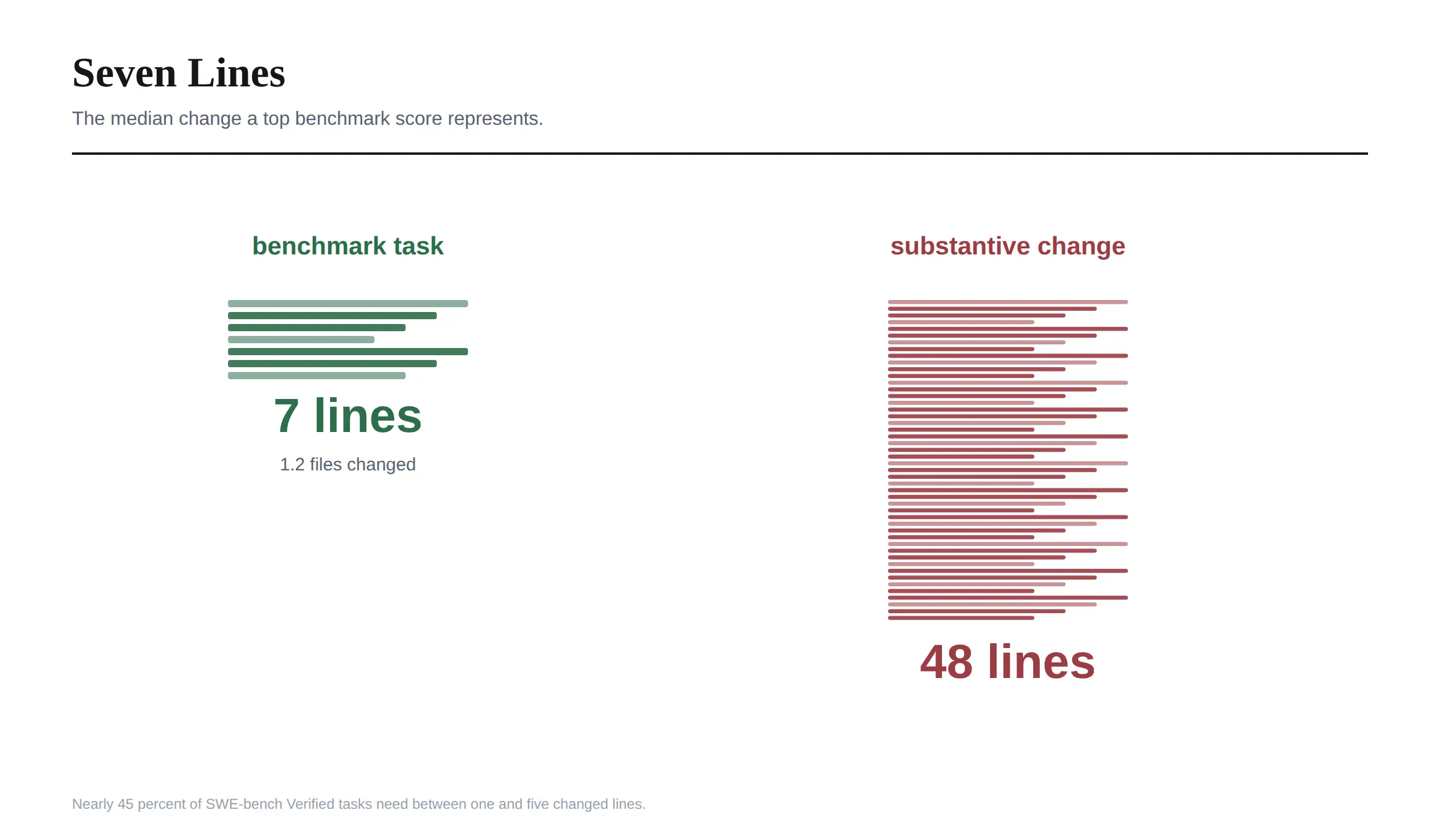 The median SWE-bench Verified fix is seven changed lines. Nearly 45 percent of the tasks need between one and five lines. The average task touches 1.2 Python files.
That is not what most Python work looks like. It is a benchmark of small, local, well-specified bug fixes in famous libraries, and it is excellent at exactly that.
There is a second problem. More than 94 percent of SWE-bench issues predate the training cutoffs of current models, which means the models may well have seen the fixes during training. One independent analysis put it plainly: the benchmark tests fixing simple bugs in a small set of well-known repositories, and contamination raises real questions about whether it generalises to closed-source code.
The benchmark has also saturated. Seven models now score 95 percent or better, and the independent Vals AI board stopped running it in September 2026 because it no longer separates frontier models.
So the honest reading is this. A high SWE-bench score tells you a model can patch small bugs in popular Python libraries. It tells you very little about whether it can build your Django feature or debug your pandas pipeline.
What the Benchmarks Cannot See
These are the Python-specific failure modes I would weigh instead, none of which appear on any leaderboard.
Library API drift. Pandas 2.x and NumPy 2.0 changed behaviour that models learned from years of older code. Models still reach for df.append, which was removed, or assume NumPy aliases that no longer exist. This is the single most common Python-specific failure I see reported, and a higher benchmark score does not fix it.
Environment confusion. Python's packaging story is genuinely hard, and models are inconsistent about virtual environments, pip against uv against conda, and which interpreter is actually running. A model that writes perfect code and tells you to install it in the wrong environment has not helped you.
Hallucinated packages. This one is a security problem rather than an annoyance. Models invent plausible package names, and attackers have started registering those names on PyPI so that the hallucinated import installs real malware. The practice is sometimes called slopsquatting. Always check that a suggested package genuinely exists and is the one you meant, especially for anything unfamiliar.
Notebook state. Jupyter is stateful in a way models reason about poorly. Suggestions assume a clean linear run, while your actual kernel has variables from cells you deleted an hour ago. Data science work suffers from this much more than application code.
Type hints and modern syntax. Models trained heavily on older Python will write code that works but reads like 2019. If your codebase uses strict typing, pattern matching or the newer syntax, expect to correct style constantly.
None of these are measured anywhere, and all of them cost you more time than the gap between the second and third model on a leaderboard.
The Best AI for Python Coding, by Job
Given all that, I would stop looking for one best model and pick by task. These are the current options with the figures I could verify.
Hard debugging and large refactors. Claude Opus 5.5 at 4 dollars and 20 dollars per million tokens leads Terminal-Bench 4.0 at 66.4 percent in Anthropic's own table, with GPT-6 Astra at 57.9 percent. Both numbers are vendor-reported at different effort settings, so treat the ordering as indicative rather than exact.
Everyday scripts and routine app code. You do not need a frontier model. Claude Sonnet 5 at 2 and 10 dollars, or GPT-6 Sol at the same rate, handle ordinary Python comfortably. The quality gap on a 40-line utility is small and the price gap is five times.
Data science and notebooks. This is where I would weight context window over raw score. Working with a large dataframe schema, several notebook cells and library documentation at once rewards a million-token window more than two benchmark points. Gemini and the Claude models both offer that.
High-volume batch work. Test generation, docstring passes, CI review bots. DeepSeek V4.1 Flash runs at 0.30 and 1.20 dollars at peak, roughly a seventeenth of Opus output pricing, and is more than adequate for mechanical Python.
Quick edits. Claude Haiku 4.5 at 1 and 5 dollars is the cheapest per solved point on the only standardised leaderboard, at roughly 13 cents of output per SWE-bench Pro point.
Self-hosted or private. Kimi K3 and GLM-5.3 both publish weights and both score above 93 percent on the archived Verified board. If your Python cannot leave your network, these are genuinely close to frontier capability.
The Free and Local Route
If you are learning Python, or your budget is zero, the picture is better than it has ever been.
Open weights are the strongest free option. Kimi K3 and DeepSeek V4.1 Flash both publish on Hugging Face, though Kimi K3 at 2.8 trillion parameters needs serious hardware to serve.
Running them locally is also easier than it used to be. The project most people still call oobabooga now ships as a double-click desktop app, and I went through what changed in our guide to oobabooga and TextGen. For Python specifically, a local model handles scripts and boilerplate well and struggles with anything requiring repository-wide reasoning.
Hosted free tiers work for evaluation rather than daily use. Google's Gemini API has a free tier with rate limits, and the cheapest hosted options now cost so little that self-hosting mostly pays off when the data cannot leave your network rather than on price alone.
Model or Tool? They Are Different Decisions
One thing almost every ranking conflates, and it matters more for Python than people expect.
The model is the engine. The tool around it, the harness, decides what the model can see: which files, which errors, which test output, how much of your repository.
The evidence for this is unusually clear. On SWE-bench Pro, vendors running their own tuned harnesses report scores around 20 points higher than Scale's standardised leaderboard produces for comparable models. Same models, same benchmark, different scaffolding.
For Python work that means your editor integration, your retrieval setup and whether the model can actually run pytest matter as much as which model you picked. A mid-tier model that can see your traceback beats a frontier model guessing from a single file.
If you are choosing at team scale, the tool layer is also where the money goes, and I broke down one example of that in our look at GitHub Copilot Enterprise pricing.
How I Would Actually Test This
Benchmarks will not answer your question. A one-hour test will.
Take three real tasks from your own codebase. Not toy problems: a bug you actually fixed, a feature you actually built, a refactor you actually did. Ones where you know the right answer.
Run each through two candidate models. Count how many times you had to correct a library call, how many times the environment advice was wrong, and whether any suggested package does not exist.
That last count is the one I would weight most heavily, because it is both a quality signal and a security signal.
Then look at the token cost per completed task rather than the per-token price. A cheaper model that needs three attempts is not cheaper.
Frequently Asked Questions
What is the best AI for Python coding?
I would pick Claude Opus 5.5 as the strongest current default for difficult Python work, with GPT-6 Astra the main alternative. For everyday scripting, cheaper models such as Claude Sonnet 5 or GPT-6 Sol are more than adequate, and the open-weight picks are Kimi K3 and GLM-5.3.
Is Claude or ChatGPT better for Python?
On vendor-reported coding benchmarks Claude Opus 5.5 currently leads, and it costs less per token than OpenAI's flagship. GPT-6 Astra leads on human-voted frontend work. For most Python tasks the difference is smaller than the difference your tooling makes.
Are coding benchmarks actually about Python?
SWE-bench and SWE-bench Verified are entirely Python, drawn from twelve repositories, with Django alone supplying 231 of the 500 Verified tasks. SWE-bench Pro added Go, JavaScript and TypeScript, so it is genuinely multi-language.
What is the best free AI for Python coding?
Open weights you run yourself, principally Kimi K3 and DeepSeek V4.1 Flash, both on Hugging Face. Hosted free tiers such as Gemini's work for evaluation but are rate limited for daily use.
Which AI is best for data science in Python?
Prioritise context window over benchmark position, because notebook work means holding a dataframe schema, several cells and library documentation at once. Be aware that models reason poorly about notebook state, since they assume a clean linear run.
Why does AI write outdated pandas or NumPy code?
Because training data is dominated by years of older code. Pandas 2.x and NumPy 2.0 removed and changed things models still reach for, and a higher benchmark score does not fix it.
Can AI write production-ready Python?
For small, well-specified changes, often yes. The benchmark that looks most impressive measures a median fix of seven lines, so treat anything larger as a draft that needs review rather than finished work.
Is it safe to install packages an AI suggests?
Check first. Models invent plausible package names, and attackers register those names on PyPI so the hallucinated install delivers malware. Verify any unfamiliar package exists and is the one you intended.
What is the cheapest AI for Python coding?
Among hosted options, DeepSeek V4.1 Flash at 0.30 and 1.20 dollars per million tokens at peak, dropping off-peak. For cost per solved task on a standardised board, Claude Haiku 4.5 leads at roughly 13 cents of output per point.
Does the coding tool matter more than the model?
Often, yes. Vendor harnesses score around 20 points above standardised scaffolding on the same benchmark with comparable models. Retrieval, context handling and the ability to run your tests move results as much as swapping models.
Where That Leaves You
I would still use the leaderboards, because for Python they are more relevant than their authors realise. Just read them for what they are, which is a measure of fixing seven-line bugs in Django and friends.
Then decide on the things the benchmarks never test. Whether the model knows current pandas. Whether it understands your environment. Whether it invents packages.
Pick one strong model for hard work and one cheap one for volume, and route between them rather than searching for a single winner. Everyone running this seriously at the moment seems to have arrived at the same conclusion.
And spend an hour testing on your own code before committing. The difference between the top three models is smaller than the difference a decent harness makes, and both are smaller than the cost of picking from a leaderboard that was never measuring your work in the first place.
Benchmark composition figures come from the SWE-bench dataset and independent analysis of what it evaluates. Model scores and prices were checked on 21 September 2026 and are vendor-reported unless stated, so verify before budgeting.