GitHub Copilot Enterprise Pricing: The 39 Dollar Seat That Costs 60
The number you need: GitHub Copilot Enterprise pricing is 39 dollars per user per month. The number you will actually pay is closer to 60, because Copilot Enterprise cannot be bought on its own. It requires GitHub Enterprise Cloud underneath it, which GitHub lists from 21 dollars per user.
Copilot Business, by contrast, is 19 dollars and runs on any organisation plan, including Team at 4 dollars.
That gap is the single most important fact on this page, and most pricing articles mention it in passing or not at all.
There is a second thing they get wrong, and it is bigger. Several pages still describe Copilot billing in premium requests. GitHub retired those on 1 June 2026. If an article tells you Enterprise includes 1,000 premium requests a month, it is describing a system that no longer exists.
So I rebuilt the invoice from GitHub's own documentation. Five lines, and only the first one is on the pricing page.
Line One: The Seat
Thirty nine dollars per user per month for Copilot Enterprise. Nineteen for Copilot Business. Those two numbers are the only part of the bill I could read off a pricing page.
Neither offers an annual discount. That surprised me, because the individual Pro plan does, at 100 dollars a year against 120 monthly. The organisational plans are month to month at list, so the only way to pay less is to negotiate.
For context, the full ladder in 2026 runs Free at nothing, Pro at 10 dollars, Pro+ at 39, Max at 100, Business at 19 per user and Enterprise at 39 per user. The individual tiers are billed per person. Business and Enterprise are billed per seat and unlock organisation management.
What Enterprise adds over Business is codebase-aware chat grounded in your own repositories, Copilot across github.com, knowledge bases, and a larger credit allowance. Business already includes the governance pieces most buyers assume are Enterprise only, including policy controls, audit logs, content exclusion, single sign-on and IP indemnity.
Line Two: The Licence You Did Not Know You Were Buying
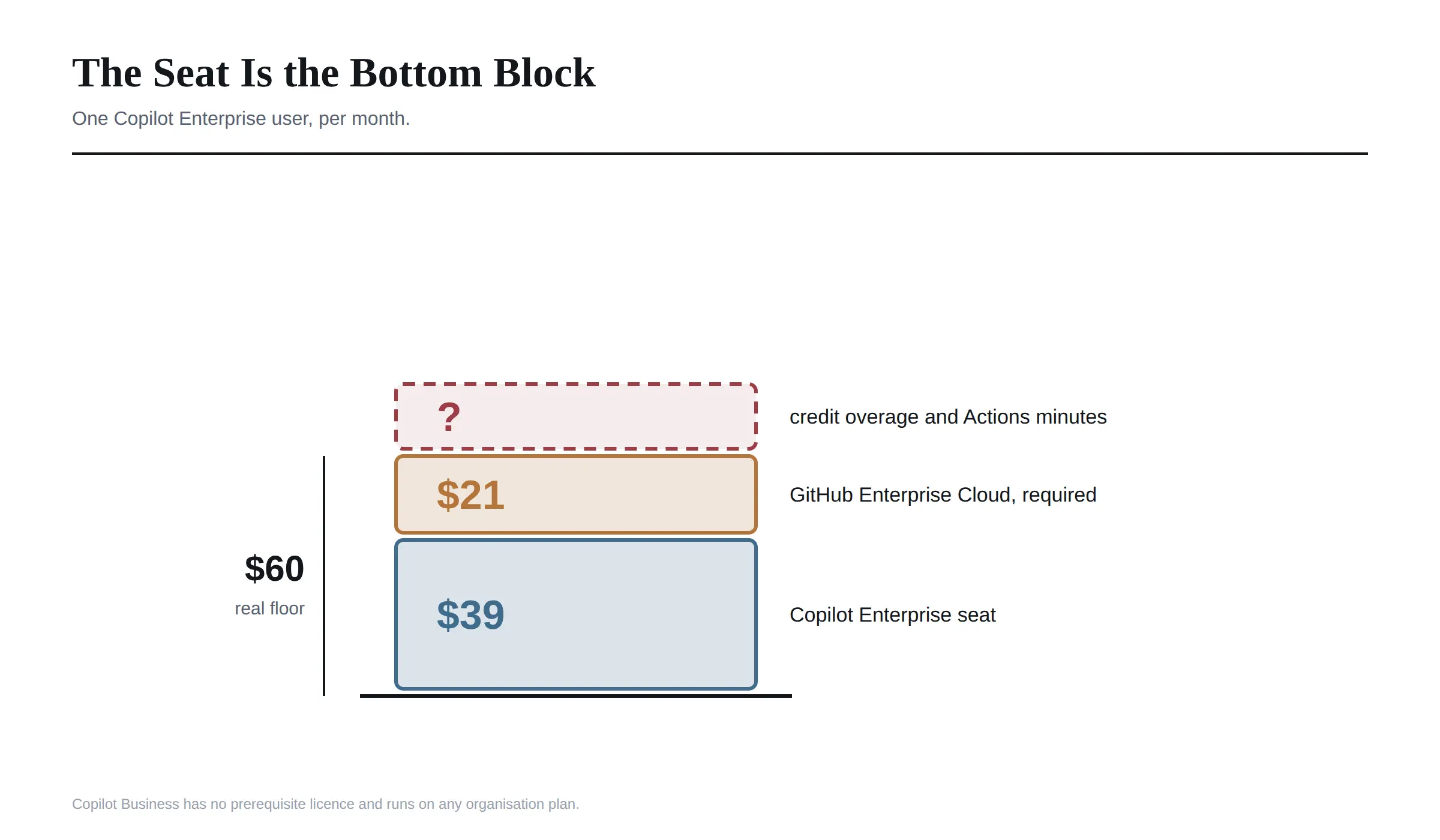 Copilot Enterprise is sold only to organisations on GitHub Enterprise Cloud. That is a separate product with its own per user bill, listed from 21 dollars.
So the honest floor is 60 dollars per user per month, or 720 a year. For a hundred developers that is 72,000 dollars annually before a single credit of usage.
Copilot Business has no such requirement. It runs on any organisation plan. If you are already on GitHub Team at 4 dollars, Business lands at 23 all in.
The comparison that matters is like for like. If you are already paying for Enterprise Cloud anyway, Business on top is 40 dollars and Enterprise is 60. The real premium for Enterprise is 20 dollars per user per month, not 20 dollars against 19.
I will come back to whether that 20 is worth paying, because the arithmetic is more interesting than it looks.
Line Three: Credits, and the September Cliff
This is the part that changed, and I do not think anyone budgeted for it.
On 1 June 2026, GitHub replaced premium requests with GitHub AI Credits. One credit equals one cent. Usage is now measured by token consumption at per model rates rather than by counting requests.
Each seat includes credits equal to its price. A Business seat includes 19 dollars, or 1,900 credits. An Enterprise seat includes 39 dollars, or 3,900 credits.
Those credits pool at the billing entity level. An enterprise with 100 Business users gets one shared pool of 190,000 credits rather than 100 separate buckets. They do not roll over between months.
Now the cliff.
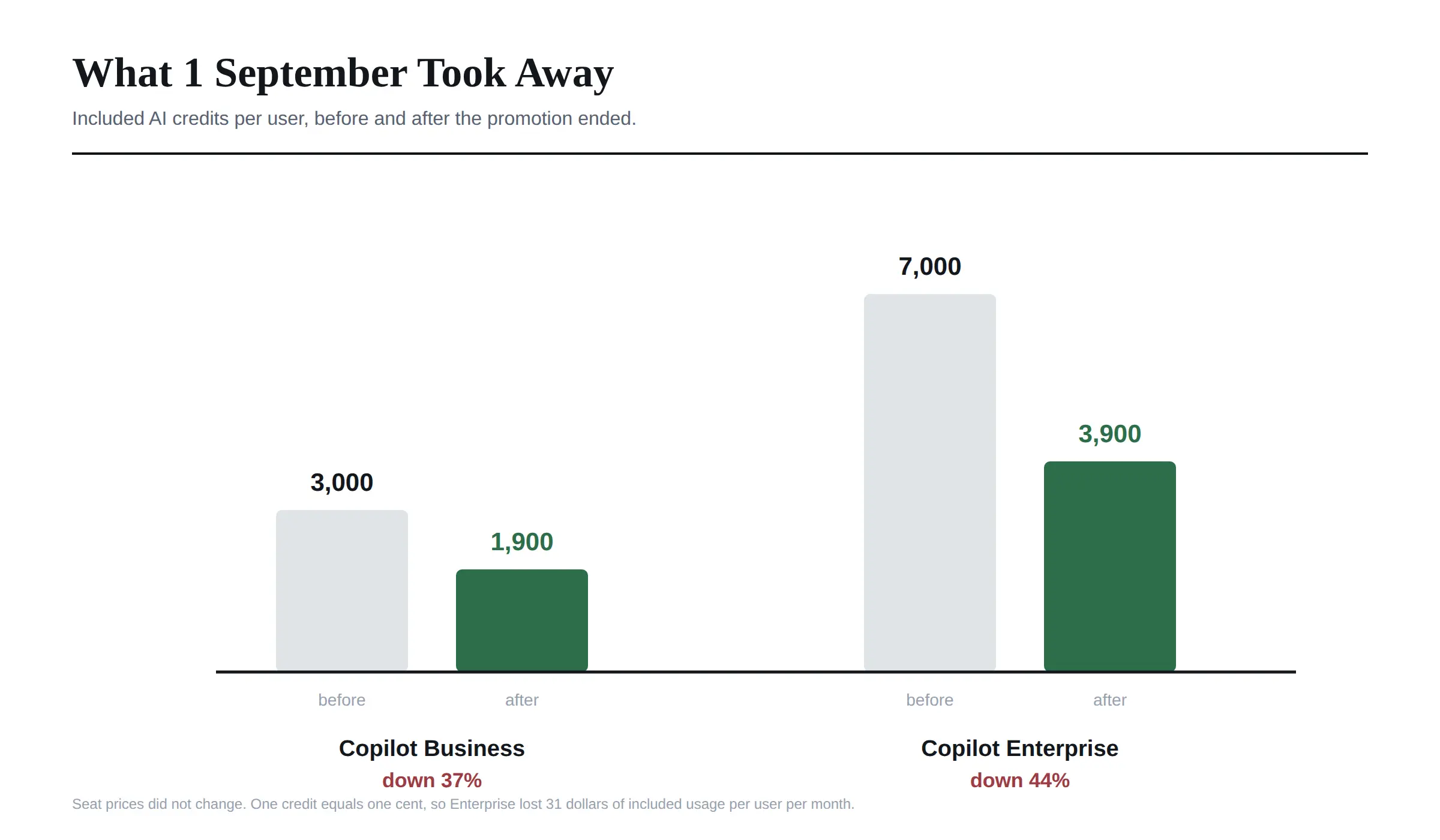 To ease the transition, GitHub gave existing customers promotional credits for June, July and August. Business received 3,000 credits a month and Enterprise 7,000, well above the standard amounts.
On 1 September that promotion ended and the standard allowances resumed. Business dropped from 3,000 to 1,900, a fall of 37 percent. Enterprise dropped from 7,000 to 3,900, a fall of 44 percent.
The sticker price never moved. But an Enterprise seat lost 3,100 credits of included usage, which is 31 dollars of value per user per month. Across a hundred seats that is 3,100 dollars a month, or 37,200 dollars a year, appearing as overage on a bill that used to come in under budget.
If your Copilot spend jumped in September and nobody could explain it, that is why. Enterprise lost proportionally more than Business, which is worth knowing if you chose Enterprise partly for the headroom.
Line Four: Overage, Which Is Switched On by Default
When the pooled credits run out, what happens depends on a policy setting, and the default is not the cautious one.
If additional usage is allowed, work continues at published per credit rates and the spend lands on your organisation. To prevent that, an administrator has to explicitly disable the AI credits paid usage policy in your AI Controls settings. If it is disabled, usage is blocked until the next cycle refreshes.
So overage is opt out rather than opt in. For a finance team that matters a great deal.
Budgets are set in dollars while usage displays in credits, at the fixed rate of one credit to one cent, so a 10 dollar budget covers 1,000 credits. I would set a budget on day one rather than discovering the ceiling in arrears.
One quirk worth knowing. If you subscribed through GitHub Mobile on iOS or Android, you cannot purchase additional credits at all.
Line Five: The Charge That Is Not in Credits
Code completions and next edit suggestions are not billed in credits. They remain unlimited on every paid plan, which I think is genuinely generous and worth saying clearly, because it is the feature most developers use most.
What does consume credits is everything agentic: Copilot Chat, Copilot CLI, the cloud agent, Copilot Spaces and code review.
Code review is the one to watch, because it is billed twice. The token consumption draws down AI credits, and the agentic infrastructure behind it consumes GitHub Actions minutes, which are attributed to the repository and from there to your enterprise.
So a team that leans heavily on automated code review will see two separate lines move, and only one of them appears in Copilot reporting.
Who Actually Needs a Seat
One thing I would settle before counting tiers at all: Copilot is licensed per assigned seat, not per employee, and seats can be reassigned.
A two hundred person engineering organisation rarely has two hundred people writing code daily. Product managers, designers, analysts and managers often hold a GitHub login without touching an editor.
Assigning a seat to everyone because it is simpler is the most expensive mistake available here, and at 60 dollars a head it compounds fast. Fifty unused Enterprise seats are 36,000 dollars a year.
I would audit active usage quarterly and reclaim seats, because the pooled credit model means an idle seat still contributes its credits to the pool, which makes the waste genuinely invisible on a usage report.
Is Enterprise Worth Twenty Dollars More Than Business?
Here is the calculation I had not seen anywhere, and it makes the decision much simpler.
On the same GitHub Enterprise Cloud foundation, Enterprise costs 20 dollars more per user per month than Business.
An Enterprise seat includes 3,900 credits. A Business seat includes 1,900. The difference is 2,000 credits, which is exactly 20 dollars of usage.
The entire price premium is returned as credits. If your developers would have burned those 2,000 extra credits anyway as overage, Enterprise costs you nothing extra and the codebase-aware features come free. If they would not, you are paying 20 dollars a head for 20 dollars of credits you will not use, plus features you may not need.
That turns a vague feature comparison into one measurable question: does your average developer consume more than 1,900 credits a month? Your usage reporting can answer that in about five minutes, and it is a far better basis for the decision than a feature grid.
What Companies Actually Pay
List price is the starting position, not the settlement, and I would treat it that way. Since neither organisational plan has an annual discount, negotiation is the only lever, and published benchmarks suggest it works.
One analysis puts real rates well below list. Copilot Business lands around 222 to 228 dollars per user per year in the 1 to 500 seat band, and 168 to 216 above 500 seats. Copilot Enterprise lands around 367 to 453 per user per year between 100 and 1,000 seats, and 336 to 432 above 1,000.
Compare those to list. Enterprise at 39 dollars monthly is 468 a year, so even the top of the benchmark range sits under list, and the bottom is nearly 30 percent below it.
If you are buying more than a hundred seats and paying list, you are probably paying too much.
What Most GitHub Copilot Enterprise Pricing Pages Still Get Wrong
I checked ten articles ranking for this term. The split is stark and it matters.
Several still describe premium requests, including one that claims its prices were re-verified on 1 September 2026 while listing 1,000 premium requests for Enterprise. Premium requests were retired for Business and Enterprise three months before that date.
Others quote the promotional credit amounts of 3,000 and 7,000 without noting they expired on 1 September, which overstates your included usage by a third or more.
And most mention the Enterprise Cloud prerequisite only in passing, if at all, which understates the real cost by 21 dollars per user per month.
None of that is malicious. This product changed its entire billing model mid year and then quietly changed the allowances again three months later. It is simply a reminder to date-check anything you read about Copilot pricing, including this.
If you want to understand how token based billing behaves generally, I worked through a full month of it in our Gemini API pricing breakdown, where the same pattern shows up: the rate card is the easy part and the consumption is where the surprises live.
Frequently Asked Questions
How much does GitHub Copilot Enterprise cost?
Thirty nine dollars per user per month, plus GitHub Enterprise Cloud from 21 dollars per user, which is required. I would budget 60 dollars per user per month as the practical floor.
What is the difference between Copilot Business and Enterprise?
Enterprise adds codebase-aware chat grounded in your repositories, Copilot across github.com, knowledge bases, and 3,900 included credits against 1,900. Business already includes policy controls, audit logs, single sign-on and IP indemnity.
Does Copilot Enterprise require GitHub Enterprise Cloud?
Yes. It is sold only to organisations on GitHub Enterprise Cloud. Copilot Business has no such requirement and runs on any organisation plan, including Team.
What are GitHub AI Credits?
The billing unit for Copilot usage since 1 June 2026, replacing premium requests. One credit equals one cent, and usage is measured by token consumption at per model rates.
Are Copilot credits pooled across the organisation?
Yes. Each seat contributes its included credits to a shared pool at the billing entity level, so 100 Business users share 190,000 credits rather than holding individual allowances. Credits do not roll over.
Why did my Copilot bill go up in September 2026?
The promotional credit allowance ended on 1 September. Enterprise fell from 7,000 to 3,900 credits per user and Business from 3,000 to 1,900, so more usage became overage even though the seat price was unchanged.
What happens when Copilot AI credits run out?
By default usage continues at published rates and is charged to your organisation. To stop that, an administrator must explicitly disable the AI credits paid usage policy, after which usage is blocked until the next cycle.
Does GitHub Copilot offer annual billing discounts?
Not for Business or Enterprise. Only the individual Pro plan has an annual rate. For organisations, the discount has to come from negotiation.
Is Copilot Enterprise worth double the Business price?
The 20 dollar premium over Business on the same foundation returns exactly 20 dollars of extra credits. It is worth it if your developers consume more than 1,900 credits a month, and questionable if they do not.
How much does Copilot cost for 100 developers?
On Enterprise at list, 72,000 dollars a year including the required Enterprise Cloud licences. On Business with the same foundation, 48,000. Benchmarks suggest negotiated rates land meaningfully below both.
How I Would Approach the Purchase
Pull your usage reporting before you choose a tier. The whole Business versus Enterprise question collapses into whether your average developer burns more than 1,900 credits a month, and you already have that number.
Budget on 60 dollars per user for Enterprise rather than 39, and make sure whoever signs off understands the Enterprise Cloud line is not optional.
Set a spending budget in the AI Controls settings on the first day, because overage is enabled unless somebody turns it off.
And if you are buying at any scale, do not accept list. Neither organisational plan discounts for annual commitment, which means the published benchmarks below list exist for one reason only, and that is because other buyers asked.
Figures here come from GitHub's billing documentation and its usage-based billing announcement, checked on 21 September 2026. This product has changed its billing model twice this year, so verify the current allowances before committing a budget.