Fathom Pricing 2026: The 5-Summary Cap and the Team Plan Quirk
The current numbers: Fathom pricing has four public tiers. Free at nothing, Premium at 20 dollars per user monthly or 16 on annual billing, Team at 19 monthly or 15 annual, and Business at 34 monthly or 25 annual. Team and Business both need at least two seats. Enterprise is quoted.
Now the part that made this article worth writing. While researching it I found several pages ranking for this term quoting a completely different set of plans, with a Team Edition at 29 dollars and a Team Edition Pro at 39.
Those plans are not on the current pricing page. If you are budgeting from one of those articles, you are budgeting from a structure Fathom has moved on from.
Here is what is actually true, and the three things the pricing page does not spell out.
Which Fathom Pricing Figures Are Current, and How I Know
I checked nine pages covering this topic. They split into two camps.
One group quotes Free, Premium, Team and Business at 20, 19 and 34 dollars monthly. The other quotes Free, Premium, Team and Team Edition Pro at 19, 29 and 39.
The tie-breaker is which sources recorded when they looked. One review documented checking Fathom's official page on 18 July 2026 and saw 20, 19 and 34 monthly, with 16, 15 and 25 on annual billing. Another recorded a direct check on 18 June 2026 and got identical numbers. Five more independent pages match.
The outliers are older, and both belong to direct competitors selling alternatives. So I would treat the four-tier structure at 20, 19 and 34 as current, and everything quoting a Team Edition Pro as out of date.
That is worth knowing before you read any comparison article on this tool.
Question One: Do You Run More Than Five Meetings a Month?
This is the question that decides whether Fathom costs you anything at all, and I found the answer surprises people.
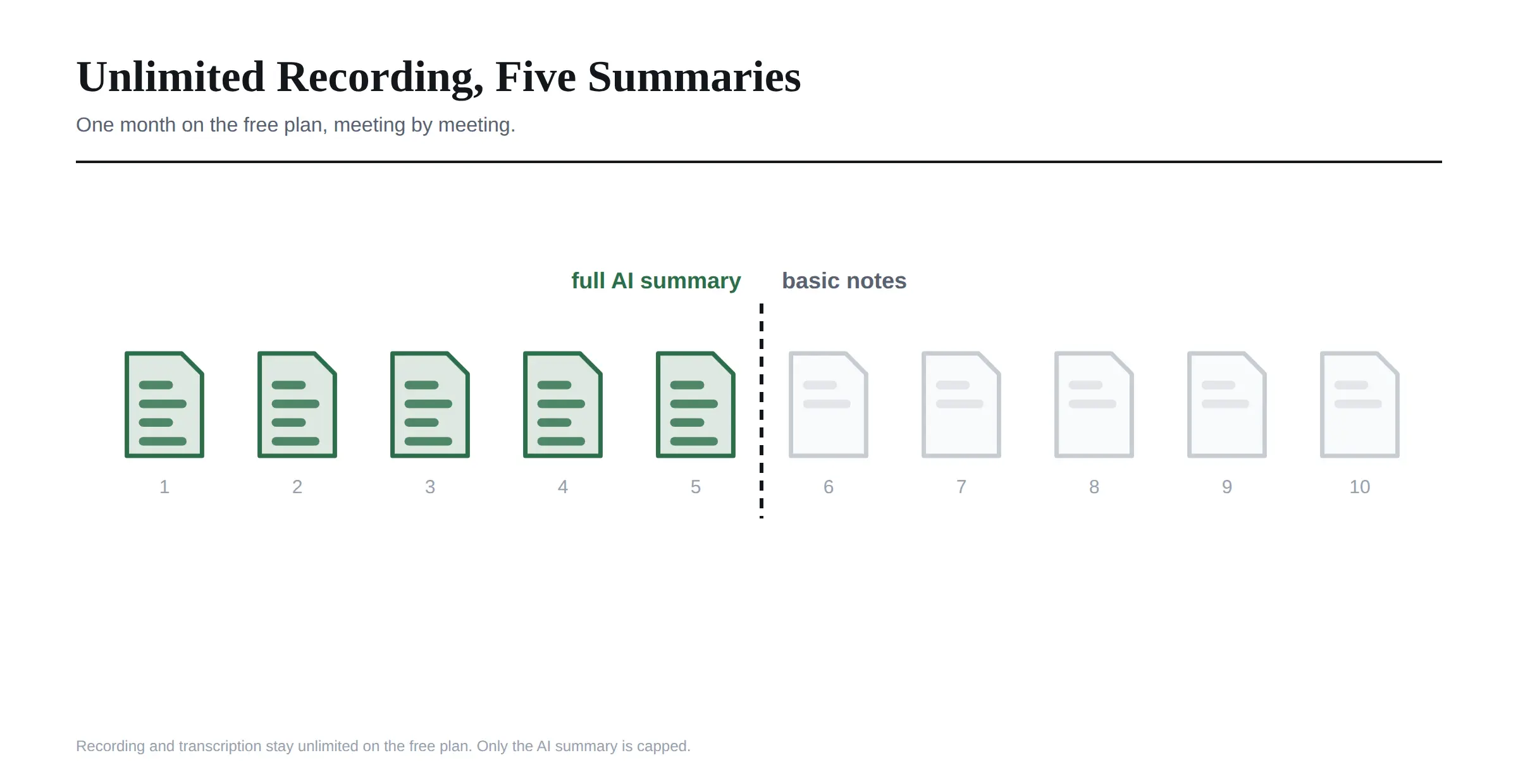 Fathom's free plan advertises unlimited recording and unlimited transcription, and that part is genuine. There is no meeting cap, no minute cap and no storage cap on recording itself.
What is capped is the AI. You get advanced AI summaries on the first five calls each month. After that you still get a transcript and basic chronological notes, but the summary quality drops to a simpler template.
So the honest way to read the free plan is this. Recording is unlimited. Thinking is not.
For someone taking four or five calls a month, Fathom genuinely stays free forever, and it is one of the more generous free tiers in this category. For anyone running daily calls, the free plan is a trial with no expiry date rather than a permanent solution.
That single number, five, is what moves you onto a paid plan.
Question Two: Is There More Than One of You?
Here is the quirk, and every source I checked agrees on it.
Premium costs 16 dollars per user on annual billing. Team costs 15. The team plan is cheaper per seat than the individual plan.
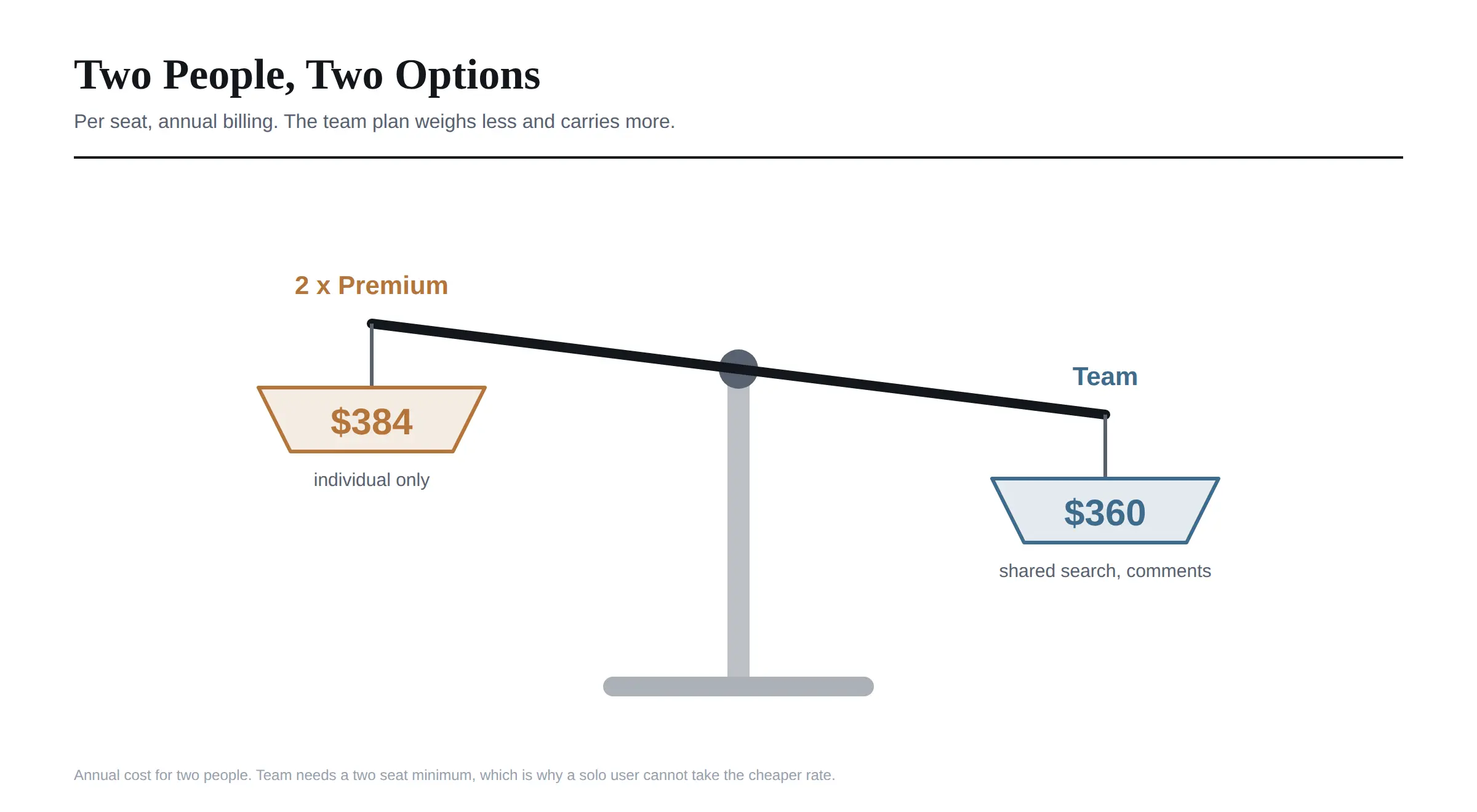 That looks like a pricing mistake and it is not. Team carries a two seat minimum, so Fathom can price it aggressively to win whole accounts rather than individuals. A solo user cannot take the cheaper rate, because they cannot buy a single Team seat.
The practical consequence is clean. If you are on your own, Premium at 16 dollars annually is your plan. If there are two or more of you, Team is both cheaper per head and better, since it adds shared search, collaboration, comments, mentions and keyword alerts.
For two people that is 360 dollars a year on Team against 384 on two Premium licences. Not a fortune, but you would be paying more for less, which is a silly way to lose 24 dollars.
I found exactly the same pattern reviewing Jamie, the bot-free note taker, where the Team plan also undercuts the individual one. It seems to be a deliberate pattern in this category rather than a coincidence.
Question Three: Does Your CRM Need to Know?
Business at 25 dollars annually, or 34 monthly, is the sales plan. It is a big step up from Team, so it is worth being clear about what the extra buys.
The headline addition is CRM field sync, pushing meeting data into HubSpot, Salesforce or Close automatically rather than by hand. Business also adds the deeper integrations, compliance controls and administrative granularity that larger revenue teams need.
The jump from Team to Business is 10 dollars per seat per month on annual billing. For a ten person team that is 1,200 dollars a year, purely for the integration and compliance layer.
I would test whether you genuinely need automatic CRM sync before paying that. Plenty of teams find that pasting a summary into a deal record twice a week is fine, and 1,200 dollars a year buys a lot of pasting.
One thing worth checking on your own quote. CRM sync appears in some feature tables as limited to three users per email domain, which would matter a great deal to a larger team. I could not confirm whether that restriction still applies, so ask.
Question Four: Will You Commit for a Year?
Annual billing saves money on every tier, but not equally, and I found the differences larger than they look.
Plan | Monthly | Annual | You save |
|---|---|---|---|
Premium | 20 | 16 | 20 percent |
Team | 19 | 15 | 21 percent |
Business | 34 | 25 | 26 percent |
All figures in US dollars per user per month.
The Business discount is the most aggressive at about 26 percent, which tells you something about who Fathom most wants locked in for twelve months.
If you are unsure whether Fathom suits your workflow, take a month or two on monthly billing first. The extra four dollars a month is cheap insurance against committing to a year of a tool you abandon in March.
What It Actually Costs, by Team Size
Here is the ladder I could not find published in full anywhere. All figures on annual billing, which is the rate most people end up paying.
People | Best plan | Per month | Per year |
|---|---|---|---|
1 | Premium | 16 | 192 |
2 | Team | 30 | 360 |
5 | Team | 75 | 900 |
10 | Team | 150 | 1,800 |
10 | Business | 250 | 3,000 |
20 | Team | 300 | 3,600 |
20 | Business | 500 | 6,000 |
In US dollars.
Two things stand out when you lay it out like this.
The per seat model scales linearly with no volume break in the published pricing, so a twenty person team pays exactly twice a ten person team. Larger organisations should ask about volume pricing rather than accept the list rate.
It also means the free plan is doing a lot of quiet work in Fathom's business. A ten person company where only three people take regular client calls does not need ten seats. Three on Team and seven on Free is 540 dollars a year rather than 1,800, and everyone still gets recordings and transcripts.
I would map who genuinely needs AI summaries before buying seats for the whole company. In my experience that number is always smaller than the headcount.
And the gap between Team and Business doubles as you grow. At ten people it is 1,200 dollars a year. At twenty it is 2,400. That is the single biggest decision in Fathom pricing once you are past the free plan.
What You Are Actually Paying For
Worth pausing on this, because the plan names do not make it obvious.
Every tier includes the recording engine, the transcription and the storage. Those are not what you are buying.
Premium buys thinking. Unlimited AI summaries, AI generated action items, follow up emails, more than fifteen expert summary templates including sales frameworks, and the Ask Fathom assistant for querying your own call history.
Team buys sharing. A shared library, comments and mentions on recordings, keyword alerts, and search across the whole team's calls rather than only your own.
Business buys plumbing. CRM field sync, the deeper integration set, compliance controls and finer admin permissions.
I find that a cleaner way to decide than a feature grid. If the pain is that you forget what was agreed, you need Premium. If the pain is that your colleague cannot find the call you mentioned, you need Team. If the pain is that someone is retyping notes into Salesforce every evening, you need Business.
What Unlocks at Each Tier
Since the plan names are vague, I put together what actually gates where.
Feature | Free | Premium | Team | Business |
|---|---|---|---|---|
Unlimited recording | Yes | Yes | Yes | Yes |
AI summaries | 5 a month | Unlimited | Unlimited | Unlimited |
Summary templates | No | Yes | Yes | Yes |
AI action items | No | Yes | Yes | Yes |
Ask Fathom assistant | No | Yes | Yes | Yes |
Follow up emails | No | Yes | Yes | Yes |
Rename the bot | No | Yes | Yes | Yes |
Team search and playlists | No | No | Yes | Yes |
Single sign-on | No | No | Yes | Yes |
Custom vocabulary | No | No | Yes | Yes |
CRM field sync | No | No | No | Yes |
Deal views and coaching | No | No | No | Yes |
Custom data retention | No | No | No | Yes |
Two rows are worth pausing on. Single sign-on sits on Team, which is unusually generous, since plenty of tools hold it back for enterprise. And custom data retention is Business only, which matters if you have a policy requiring recordings to be deleted on a schedule.
The Cost That Is Not on the Price List
Fathom uses a bot. It joins your call as a visible participant named after you, and everyone on the call can see it.
Premium and above let you rename that bot and strip the Fathom branding. No tier lets you remove it. If you are on client calls or sales calls, there is always an extra attendee in the room.
I would weigh that properly rather than treat it as a detail. Some people find a visible recorder useful, because it doubles as a consent notice and nobody can later claim they did not know. Others find it kills the tone of a first call with a prospect.
If the bot is the problem rather than the price, no Fathom plan solves it, and you are looking at a different category of tool. I went through that category in our review of Jamie, which captures audio from your own device and never appears in the participant list. Granola takes the same approach at around 14 dollars a seat.
That is a genuine fork in the road, and it has nothing to do with how much you are willing to spend.
Three Things the Pricing Page Does Not Spell Out
The two seat minimum sets a real floor. Team looks like 19 dollars and the minimum purchase is 38 a month at monthly rates. Business looks like 34 and the floor is 68. Nobody buys one seat of either.
Premium has no team billing at all. It is genuinely individual. If three people each want Premium, that is three separate subscriptions with no shared library and no admin view, which is usually worse value than moving everyone to Team.
Multiple email domains can get expensive. One user review flagged that using Fathom across several email accounts or external domains adds cost quickly, because seats attach to domains. Worth raising if you are an agency working inside client systems.
There is also the money back guarantee, which deserves more attention than it gets. One detailed review states plainly that Fathom offers 90 days on Premium, Team and Business, and notes that Otter, Fireflies, Granola and tl;dv offer nothing comparable.
I could only trace that to a single publisher, so I would confirm it directly before relying on it. If it is accurate, it is the strongest thing in Fathom's commercial offer and almost nobody leads with it. Ninety days covers a full quarter of meetings, which is more than enough to find out whether the tool fits.
How the Price Compares
Against the rest of the category, Fathom sits in the middle on price and near the top on free tier generosity.
The free plan is the strongest argument. Unlimited recording and transcription with no expiry beats most rivals, several of which cap recording minutes or impose trial periods.
On paid rates, cheaper options exist. Fireflies starts around 10 dollars a seat, Granola around 14, and Otter's paid tier sits near 17. Fathom Premium at 16 annually is in the same band, and Business at 25 is above most of them, though still far below dedicated conversation intelligence tools such as Gong, which run past 100 dollars a seat.
The free tiers are where Fathom pulls ahead. Fireflies caps free storage at 800 minutes, Otter caps free users at 300 minutes a month, and tl;dv deletes free recordings after three months. Fathom's free recording is genuinely unlimited and does not expire, which is why so many solo users never pay anything.
Worth knowing who writes these comparisons, though. Of the nine pages I read on Fathom pricing, most belong to companies selling a competing note taker, and several close by recommending their own product at a lower price. Their numbers were mostly accurate, and their conclusions were never going to favour Fathom.
Frequently Asked Questions
How much does Fathom cost?
Free at zero, Premium at 20 dollars per user monthly or 16 annually, Team at 19 monthly or 15 annually, and Business at 34 monthly or 25 annually. Team and Business need two seats minimum.
Is Fathom really free?
Yes, with unlimited recording and transcription and no expiry. The limit is on AI summaries, which are capped at five calls a month before dropping to basic notes.
What happens after five AI summaries on Fathom?
You keep recording and transcribing without restriction, but further meetings get a simpler chronological note rather than the advanced AI summary.
Why is Fathom Team cheaper than Premium?
Because Team requires at least two seats. Fathom prices it aggressively to win whole accounts, so the per seat rate of 15 dollars annually undercuts the individual Premium rate of 16.
Does Fathom have a seat minimum?
Team and Business both require two seats. Premium is individual only with no team billing, and Free is a single user.
How much is Fathom for a team of ten?
On annual billing, 1,800 dollars a year on Team or 3,000 on Business. The difference is CRM sync, deeper integrations and compliance controls.
What does Fathom Business add over Team?
CRM field sync into tools such as HubSpot, Salesforce and Close, plus the fuller integration set, compliance controls and admin granularity aimed at revenue teams.
Does Fathom offer a money back guarantee?
One source reports a 90 day money back guarantee on paid plans. I could not corroborate it elsewhere, so confirm with Fathom before relying on it.
Is Fathom cheaper than Otter or Fireflies?
Not always on the paid rate, where several rivals undercut it. Fathom's advantage is the free plan, which allows unlimited recording where many competitors cap minutes.
Should I pay monthly or annually for Fathom?
Annual saves 20 to 26 percent depending on tier, with Business getting the largest discount. If you are still deciding whether the tool fits, a month or two on monthly billing is worth the small premium.
Where I Would Land
If you take a handful of calls a month, stay on Free and ignore everything above. It is a genuinely good free plan and it does not run out.
If you are one person taking calls daily, Premium at 16 dollars annually is fair, and the five summary cap will have made that decision for you already.
If there are two or more of you, go straight to Team. It costs less per person than Premium and gives you more, and there is no scenario where buying separate Premium licences makes sense.
And only move to Business if automatic CRM sync is genuinely solving a problem someone currently does by hand. At ten people that upgrade is 1,200 dollars a year, which deserves a proper reason rather than a tidy feature list.
I verified these figures against multiple independently dated checks of Fathom's pricing page on 21 September 2026. Fathom has restructured its plans at least once this year, so confirm the current tiers on its own site before committing.