Deepgram Pricing 2026: API Costs, Plans and Free Credit
Deepgram pricing is pay as you go, with a free $200 credit to start and no credit card needed. Speech-to-text costs $0.0043 a minute for pre-recorded audio with Nova-3 ($0.26 an hour) and $0.0048 a minute for live streaming on a current promotional rate ($0.0077 normally).
Text-to-speech costs $0.015 to $0.045 per 1,000 characters depending on the voice model. The Voice Agent API costs $0.050 to $0.163 a minute. The Growth plan starts at $4,000 a year in prepaid credit and cuts most rates by about 9% to 20%.
A developer friend sent me a screenshot of Deepgram's pricing page last week.
"Is this cheap or not? I genuinely cannot tell."
I understood why. The page has three plans, four products, three billing units, promotional prices with lines through them, and a voice agent table with six tiers.
Per minute. Per 1,000 characters. Per 1,000 tokens. Per WebSocket connection minute.
None of that tells you what your actual bill will be.
So I worked it out properly. I went through every line of Deepgram's pricing page and its FAQ in October 2026. Then I opened Deepgram's own playground and ran real tests: a 7 minute phone call through Nova-3, and the same 927 character script through all three of its voice models, so I could see what a minute of speech really costs.
Here is everything I found.
How Much Does Deepgram Cost?
Here is the whole Deepgram price list in one place, on the Pay As You Go plan.
Product | Model or tier | Price | Billing unit |
|---|---|---|---|
Speech-to-text, pre-recorded | Nova-3 Monolingual | $0.0043 | per audio minute |
Speech-to-text, pre-recorded | Nova-3 Multilingual | $0.0052 | per audio minute |
Speech-to-text, pre-recorded | Whisper Large | $0.0048 | per audio minute |
Speech-to-text, streaming | Nova-3 Monolingual | $0.0048 (promo), $0.0077 regular | per audio minute |
Speech-to-text, streaming | Nova-3 Multilingual | $0.0058 (promo), $0.0092 regular | per audio minute |
Speech-to-text, streaming | Flux English | $0.0065 (promo), $0.0077 regular | per audio minute |
Speech-to-text, streaming | Flux Multilingual | $0.0078 | per audio minute |
Text-to-speech | Aura-1 | $0.015 | per 1,000 characters |
Text-to-speech | Aura-2 | $0.030 | per 1,000 characters |
Text-to-speech | Flux TTS | $0.045 | per 1,000 characters |
Voice Agent API | Standard | $0.075 | per connection minute |
Voice Agent API | Advanced | $0.163 | per connection minute |
Audio Intelligence | Summarization | $0.0003 in, $0.0006 out | per 1,000 tokens |
That is the menu. The rest of this article is about what it means for your bill.
Deepgram Pricing Plans
Deepgram has three plans. All of them use usage-based billing. You never pay per seat.
You can check the live numbers on Deepgram's official pricing page. I took everything below from that page in October 2026.
Pay As You Go
This is where everyone starts.
Free $200 credit when you sign up
No credit card required
No minimums and no expiration on the credit
Up to 50 REST and 150 WebSocket connections for speech-to-text
Up to 45 connections for text-to-speech and for voice agents
Community and Discord support
Once the $200 is gone, you pay the rates in the table above. You can turn on auto-reload so your balance tops itself up.
Growth Plan
The Growth plan is a prepaid annual commitment.
Starts at $4,000 a year, paid up front as credits
Lower rates on nearly every product
Higher concurrency limits: 225 streaming connections instead of 150, and 60 for text-to-speech and voice agents instead of 45
Deepgram says it saves "up to 20%." I compared every line myself, and most savings are smaller than that.
Product | Pay As You Go | Growth | Real saving |
|---|---|---|---|
Nova-3 pre-recorded | $0.0043/min | $0.0036/min | 16% |
Nova-3 streaming (promo) | $0.0048/min | $0.0042/min | 12.5% |
Aura-2 | $0.030/1K chars | $0.027/1K chars | 10% |
Flux TTS | $0.045/1K chars | $0.0405/1K chars | 10% |
Voice Agent Standard | $0.075/min | $0.068/min | 9% |
Voice Agent BYO LLM + TTS | $0.050/min | $0.041/min | 18% |
Summarization | $0.0003/1K tokens | $0.00024/1K tokens | 20% |
So for most products, plan on a 9% to 16% saving, not 20%.
One more thing I noticed. Deepgram's FAQ says Growth comes with "priority support." But the plan table right above it lists the same support for both plans: Community and Discord. If support matters to you, ask sales to confirm it in writing.
Enterprise Pricing
Enterprise is custom pricing through sales. It is for teams with very high volume, custom models, self-hosting on your own servers, or a HIPAA business associate agreement. Deepgram only signs that agreement on Enterprise.
The Overage Rule Nobody Explains
If you are on Growth and use up your prepaid credits, Deepgram does not drop you back to Pay As You Go prices. It keeps charging your Growth rates plus a 10% overage fee, billed every Monday for the week before. You need a card on file. Without one, the API starts returning errors once your credits run out.
That sounds like a penalty. But I did the math, and Growth plus 10% is still equal to or cheaper than Pay As You Go on every product I checked.
Product | Pay As You Go | Growth plus 10% overage |
|---|---|---|
Nova-3 pre-recorded | $0.0043/min | $0.0040/min |
Nova-3 streaming (promo) | $0.0048/min | $0.0046/min |
Aura-2 | $0.030/1K chars | $0.0297/1K chars |
Voice Agent Standard | $0.075/min | $0.0748/min |
So running over on Growth is not a disaster. You can also avoid the fee by renewing early. Buying a new Growth plan resets your credits.
Deepgram Speech-to-Text Pricing
Speech-to-text is Deepgram's main product. It turns audio into text through its speech recognition API.
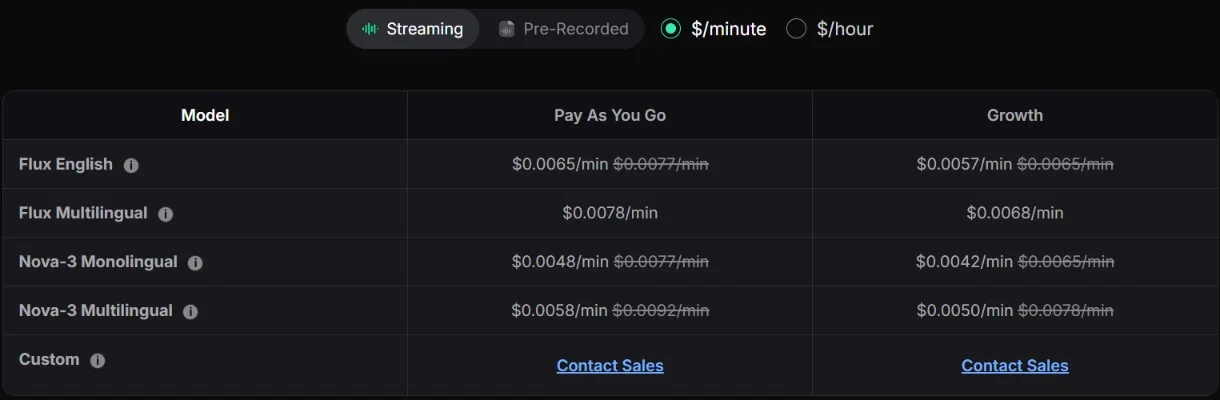 There are two ways to send audio, and they are priced differently.
Pre-recorded audio transcription is for files you already have. Calls, meetings, podcasts, videos. You upload the file and get the full transcript back.
Streaming speech-to-text is real-time transcription. Audio goes in live and words come back as people speak. This is for live captions and voice agents.
Here is the cost per audio minute and per hour on Pay As You Go.
Model | Mode | Per minute | Per hour |
|---|---|---|---|
Nova-3 Monolingual | Pre-recorded | $0.0043 | $0.26 |
Nova-3 Multilingual | Pre-recorded | $0.0052 | $0.31 |
Whisper Large | Pre-recorded | $0.0048 | $0.29 |
Nova-3 Monolingual | Streaming | $0.0048 (promo) | $0.29 |
Nova-3 Multilingual | Streaming | $0.0058 (promo) | $0.35 |
Flux English | Streaming | $0.0065 (promo) | $0.39 |
Flux Multilingual | Streaming | $0.0078 | $0.47 |
Monolingual vs multilingual. Monolingual means one language per file. Multilingual transcription handles speakers switching languages, and it costs about 20% more.
Nova-3 vs Flux. Nova-3 is the general model for transcription. Flux is built for voice agents. It has turn detection built in, which means it can tell when a person has finished speaking. If you are not building a voice agent, you probably do not need to pay the Flux premium.
Watch Out for the Promo Prices
Most streaming prices on the page are marked as "limited-time promotional rates," with the regular price crossed out. There is no end date shown.
When the promo ends, Nova-3 streaming goes from $0.0048 to $0.0077 a minute. That is 60% more.
My advice: if you are planning a budget for next year, use the regular price. Treat the promo as a bonus, not a promise.
Speech-to-Text Add-On Prices
Some features cost extra. Others are free.
Add-on | What it does | Price (Pay As You Go) |
|---|---|---|
Smart formatting | Adds punctuation, dates and numbers | Included |
Speaker diarization (pre-recorded) | Labels who said what | Included |
Speaker diarization (streaming) | Same, but live | $0.0020/min |
PII redaction | Removes card numbers, phone numbers and other personal data | $0.0020/min |
Entity detection | Pulls out names, places, companies and dates | $0.0017/min |
Keyterm prompting | Helps it spell your product names and jargon | $0.0013/min |
Add-ons stack on top of the base rate. Nova-3 pre-recorded with redaction and entity detection comes to $0.0080 a minute. That is almost double the headline price.
Two Billing Rules That Change Your Bill
Per-second billing. Deepgram says it bills by the exact second. A 14 second clip is billed as 14 seconds, not rounded up to a minute. That is a real saving if you send lots of short clips.
Multichannel audio is billed per channel. This one catches people out. If you record calls in stereo, with the agent on one channel and the customer on the other, a 10 minute call is billed as 20 minutes. Deepgram's own FAQ says this directly.
Many call recording systems save stereo by default. If you do not need the channels separated, mixing down to mono before you upload cuts that part of your bill in half.
How I Tested Deepgram (and What It Showed)
I wanted real numbers, not just the price list. Deepgram has a public playground that works without an account. It gives you a small trial: 60 minutes of speech-to-text and 6,000 characters of text-to-speech.
Speech-to-Text Test
I ran Deepgram's sample customer service phone call through Nova-3, pre-recorded, with smart formatting and topic detection turned on.
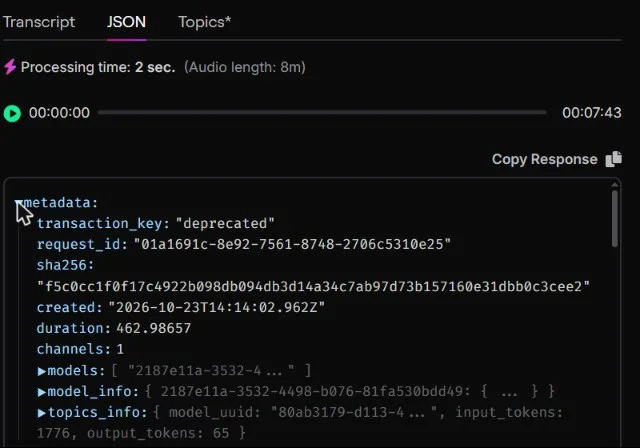 Here is what came back:
Audio length: 7 minutes 43 seconds (462.99 seconds)
Processing time: 2 seconds
Channels: 1
Topic detection usage: 1,776 input tokens and 65 output tokens
At Pay As You Go rates, that call costs about $0.033 to transcribe. On Growth it is about $0.028.
Two things stood out.
First, speed. Nearly 8 minutes of audio came back fully transcribed in 2 seconds.
Second, the playground's trial counter dropped from 60 minutes to 52 minutes. So the counter rounds up to whole minutes. Deepgram says paid API usage is billed by the second, so the playground counter is not how your invoice works. But it is a good reminder to check your real usage in the console, not a rounded display.
Topic detection used about 1,800 tokens for the whole call. Deepgram does not print a separate price for topic detection on its pricing page. At the summarization rate, that many tokens would cost well under a tenth of a cent. Audio intelligence will not be the expensive part of your bill.
Text-to-Speech Test
This test answers the question every other pricing guide skips. Deepgram charges text-to-speech per 1,000 characters. But you care about minutes of audio. How many characters is a minute of speech?
So I wrote a 927 character script, a normal customer support reply of 186 words, and ran it through all three voice models at normal speed.
Model | Voice | Characters billed | Audio length | Characters per minute |
|---|---|---|---|---|
Flux TTS | Hannah | 927 | 48 seconds | about 1,160 |
Aura-2 | Thalia | 927 | 52 seconds | about 1,070 |
Aura-1 | Asteria | 927 | 47 seconds | about 1,180 |
Every run took exactly 927 characters off the trial. The response metadata showed dg-char-count: 927. So billing is based on the text you send, not the audio you get back.
Now turn that into money.
Deepgram Text-to-Speech Pricing
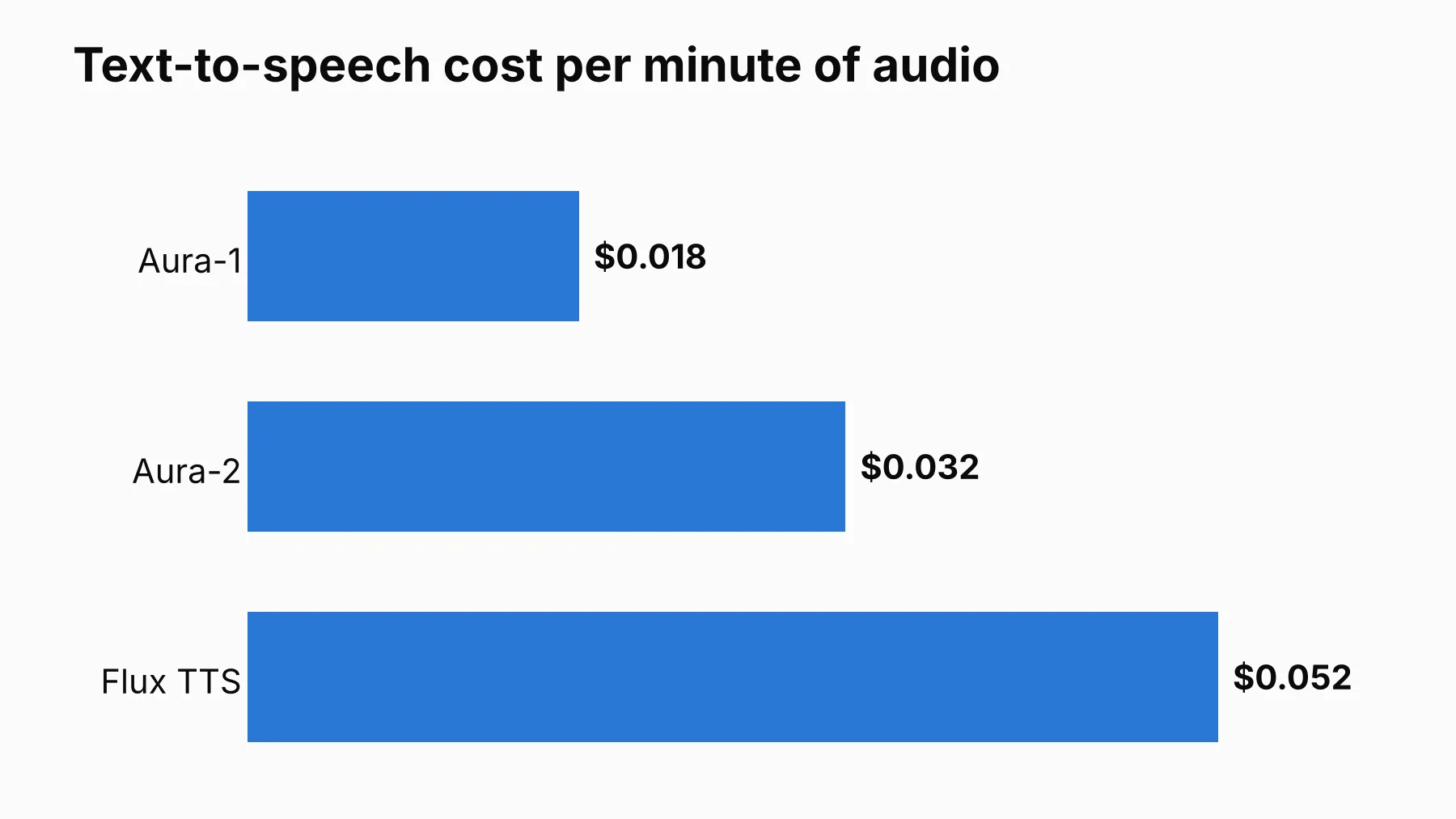
Model | Price per 1,000 characters | Cost per minute of audio (my test) | Cost per hour of audio |
|---|---|---|---|
Aura-1 | $0.015 | about $0.018 | about $1.07 |
Aura-2 | $0.030 | about $0.032 | about $1.93 |
Flux TTS | $0.045 | about $0.052 | about $3.13 |
A rough rule from my test: one minute of speech is about 1,100 characters. Your number will move a little with the voice, the speed setting and how many short words you use.
Which model to pick:
Aura-1 is the cheapest. It is the older model and does not support speed or expressiveness controls for English.
Aura-2 is the middle option. It has more voices (41 English voices in the playground) and natural-sounding voices for most uses.
Flux TTS is the newest. It is built for live conversations and lets you change speed and expressiveness. It also costs 50% more than Aura-2.
Flux TTS offer: until December 31, 2026, Deepgram adds $1 of credit for every $1 you spend on Flux TTS, up to $500. That roughly halves your first $500 of Flux TTS spending.
Deepgram Voice Agent API Pricing
The Voice Agent API is the all-in-one option for conversational AI. Deepgram runs the whole speech-to-text and text-to-speech pipeline, connects it to an LLM, and handles interruptions and turn-taking.
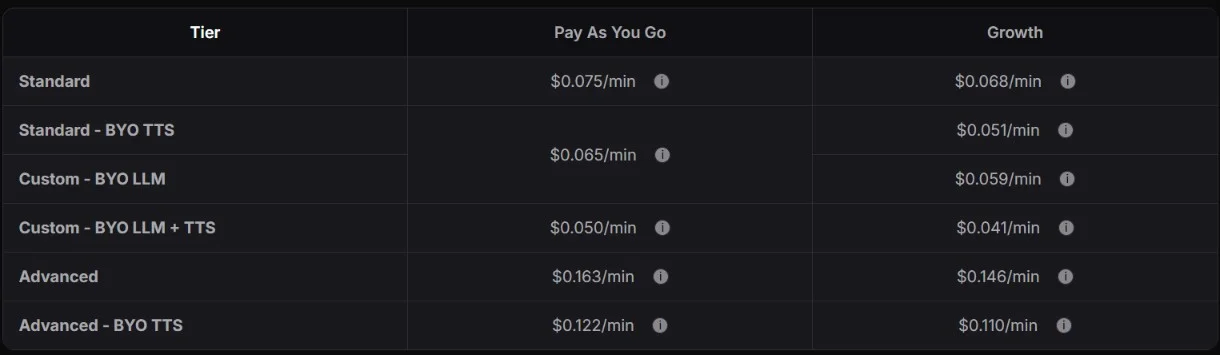
Tier | Pay As You Go | Growth | Cost per hour (Pay As You Go) |
|---|---|---|---|
Standard | $0.075/min | $0.068/min | $4.50 |
Standard, bring your own TTS | $0.065/min | $0.051/min | $3.90 |
Custom, bring your own LLM | $0.065/min | $0.059/min | $3.90 |
Custom, bring your own LLM and TTS | $0.050/min | $0.041/min | $3.00 |
Advanced | $0.163/min | $0.146/min | $9.78 |
Advanced, bring your own TTS | $0.122/min | $0.110/min | $7.32 |
A small detail worth knowing. On Deepgram's page, "Standard BYO TTS" and "Custom BYO LLM" share one merged price cell on Pay As You Go: $0.065. Several pricing guides misread that table. Some leave the BYO LLM tier without a Pay As You Go price, and some swap its two prices. It does have one. It is $0.065 on Pay As You Go and $0.059 on Growth.
What You Are Actually Billed For
When I hovered over the info icon next to each price, Deepgram's note said the price is "calculated based on websocket connection time."
That means you pay for every minute the line is open. Not just the minutes someone is talking. Hold music, long pauses and a caller who forgets to hang up all count. Make sure your agent closes the connection when the call ends.
Bring Your Own LLM Means a Second Bill
The cheaper "bring your own" tiers are not free of that cost. They move it somewhere else. If you bring your own LLM, you still pay that model provider for every input token and output token. A busy agent can easily add a cent or more per minute in LLM costs.
If you are thinking about Google's models for that part, we broke down Gemini API pricing with one workload priced eight ways, which makes it easy to estimate the LLM side.
The Voice Agent price also does not include phone calls. If callers dial a real number, your telephony provider bills you separately.
Audio Intelligence Pricing
Audio intelligence covers summarization, topic detection, sentiment analysis and intent recognition.
Summarization: $0.0003 per 1,000 input tokens and $0.0006 per 1,000 output tokens on Pay As You Go
Topic detection, sentiment analysis, intent recognition: listed on the pricing page with no price shown
These are billed on top of the transcription. But as my test showed, a 7 minute call used under 2,000 tokens. Even at thousands of calls a month, this stays a small line on your bill.
Does Deepgram Offer Free Credits?
Yes. Every new account gets $200 in free credit. You do not need a credit card, and the credit does not expire.
Deepgram does not have a permanent free plan. The $200 is a one-time credit. Once it is used up, you pay normal rates.
Here is how far $200 goes on each product.
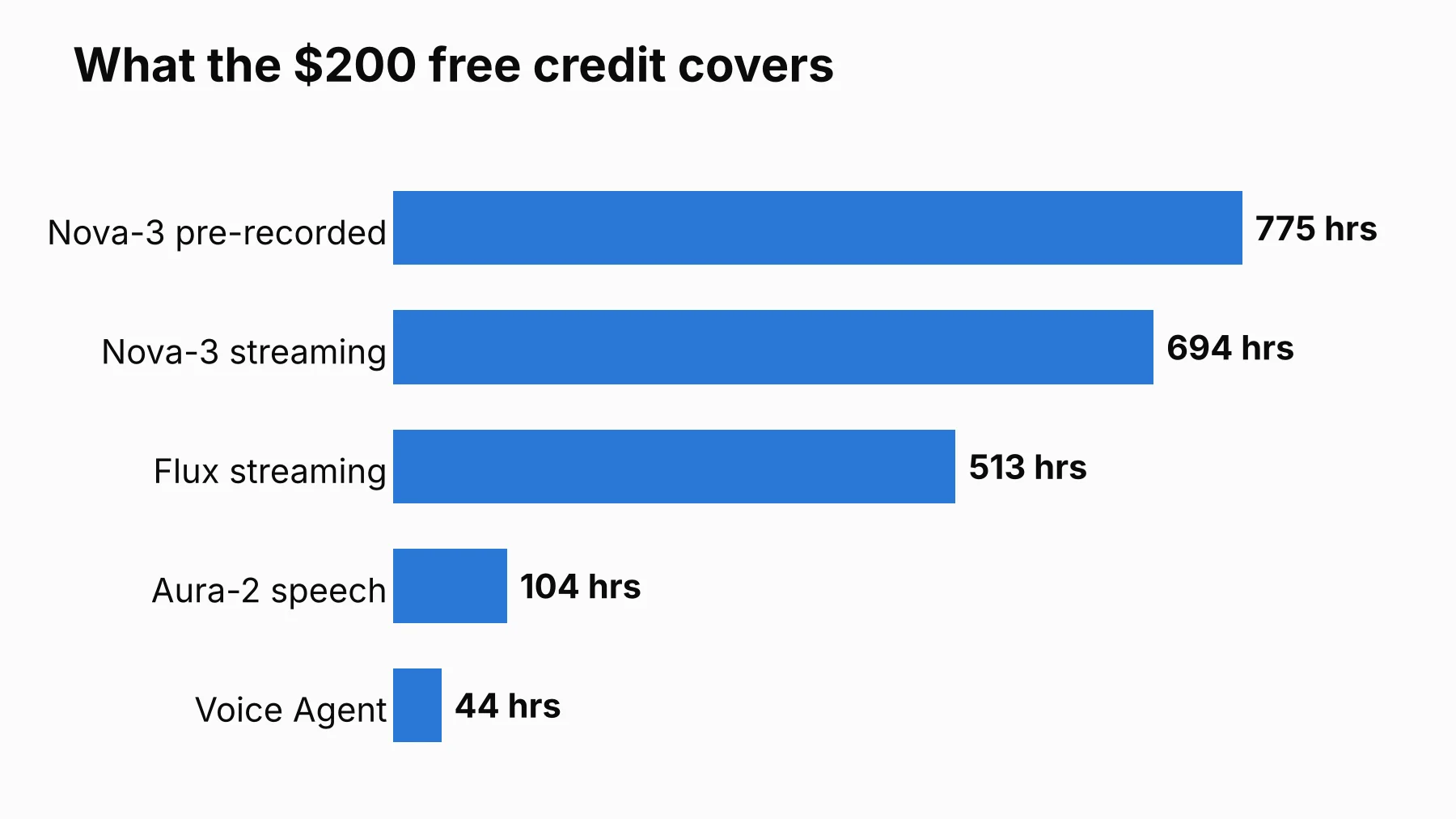
What you use it for | How much $200 covers |
|---|---|
Nova-3 pre-recorded transcription | about 46,500 minutes (775 hours) |
Nova-3 streaming (promo rate) | about 41,700 minutes (694 hours) |
Flux streaming (promo rate) | about 30,800 minutes (513 hours) |
Aura-2 voice generation | about 6.7 million characters (about 104 hours of speech) |
Voice Agent API, Standard | about 2,670 minutes (44 hours) |
For transcription, $200 is a lot. Most people can build and test a full product on it. For voice agents, 44 hours goes faster than you would think once real users start calling.
What Affects Your Deepgram API Costs?
After going through all of this, these are the things that move your bill the most:
Streaming vs pre-recorded. Streaming costs 12% to 80% more than pre-recorded, depending on the promo. If you do not need live results, send files.
The promo ending. Streaming prices could rise 60% overnight. Budget at the regular price.
Stereo audio. Two channels means double the minutes.
Add-ons. Redaction plus entity detection nearly doubles Nova-3 pre-recorded.
Model choice for voices. Flux TTS costs about three times as much as Aura-1 per minute of speech.
Open connections. Voice agents bill for connection time, including silence.
Concurrency limits. Pay As You Go caps you at 150 live streams. Above that, extra requests can be queued or rejected, which can push you to Growth or Enterprise before your volume does.
Deepgram Pricing Examples
Here is what real workloads cost. Deepgram does not have a full pricing calculator for this. The only calculator on its pricing page sizes text-to-speech concurrency, and it asks for your email before it shows a result. So I did the cost estimation by hand. I used Pay As You Go prices unless I say otherwise, and I show the assumptions so you can change them.
1. A meeting notes app 100 hours a month of pre-recorded meetings, Nova-3, speaker labels on. 6,000 minutes × $0.0043 = $25.80 a month. Diarization is included for pre-recorded, so that is the full cost.
2. A call center checking quality 10,000 calls a month, 6 minutes each, recorded in stereo, with PII redaction. 60,000 minutes × 2 channels = 120,000 billed minutes. 120,000 × ($0.0043 + $0.0020) = $756 a month. Mix the recordings to mono first, and it drops to about $378. Same calls. Half the bill.
3. Live captions for webinars 300 hours a month of streaming Nova-3. 18,000 minutes × $0.0048 = $86.40 a month at today's promo rate. At the regular $0.0077 rate, it would be $138.60.
4. An AI phone receptionist 200 calls a day, 4 minutes each, 30 days, Voice Agent Standard. 24,000 minutes × $0.075 = $1,800 a month on Pay As You Go. On Growth it is $1,632 a month. At about $19,600 a year, this team should be on Growth. Phone call charges from your telephony provider come on top.
5. An app that reads articles out loud 2,000 minutes of generated speech a month with Aura-2. Using my test result of about 1,070 characters per minute, that is about 2.1 million characters. 2,140 × $0.030 = about $64 a month.
When Does Growth Pay Off?
Growth needs at least $4,000 up front for the year. Deepgram calls these prepaid credits for the year, so plan as if anything you do not use is lost.
Simple rule: only move to Growth when your yearly Pay As You Go spend is clearly above $4,000. Below that, you are paying for credit you may not use just to save 10% to 16%. Above that, the savings and the higher concurrency limits are worth it, and as I showed above, even going over your credit is not a penalty.
Deepgram vs AssemblyAI, OpenAI and Other API Providers
Deepgram is often called the cheap option. For pre-recorded transcription, my comparison shows that is no longer true.
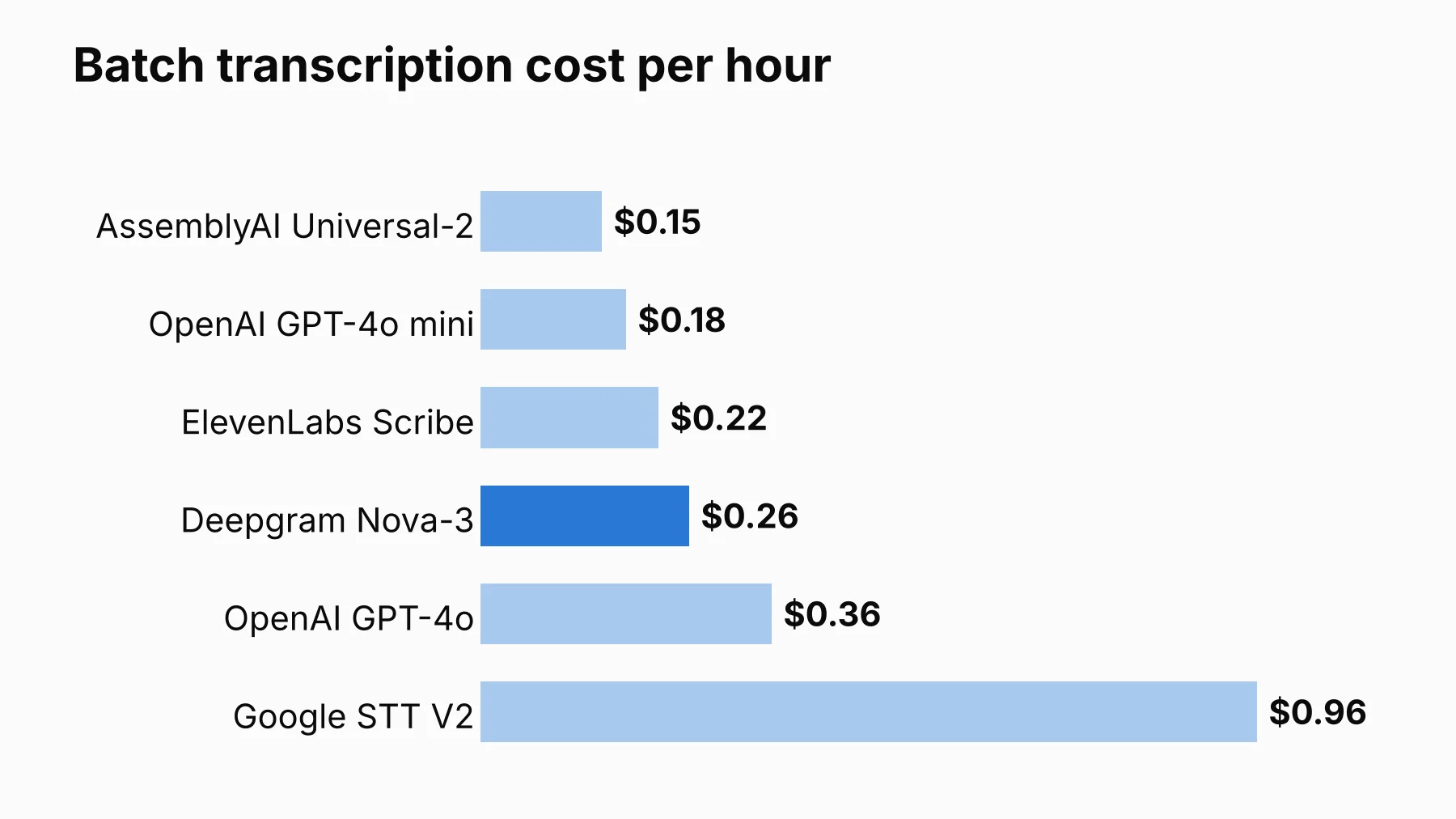
Provider and model | Pre-recorded price | Streaming price | Notes |
|---|---|---|---|
Deepgram Nova-3 | $0.26/hr | $0.29/hr promo, $0.46/hr regular | Diarization free on pre-recorded, $200 credit |
AssemblyAI Universal-2 | $0.15/hr | $0.15/hr (Universal-Streaming) | Diarization $0.02/hr extra on pre-recorded |
AssemblyAI Universal-3.5 Pro | $0.21/hr | $0.45/hr (3.6 Pro Realtime) | Newer, more accurate model |
OpenAI GPT-4o mini transcribe | $0.18/hr | $1.02/hr (gpt-live-transcribe) | Live model is a different product |
OpenAI GPT-4o transcribe | $0.36/hr | ||
ElevenLabs Scribe v2 | $0.22/hr | ||
Google Speech-to-Text V2 | $0.96/hr standard, $0.18/hr dynamic batch | Batch mode is slower |
All prices are list prices from each provider's pricing page in October 2026.
What this tells me:
For cheap batch transcription, AssemblyAI Universal-2 and OpenAI's mini model cost less than Deepgram per hour.
For streaming, Deepgram's promo rate beats OpenAI's live transcription by a wide margin, and sits between AssemblyAI's two streaming models.
For add-ons, it is mixed. Deepgram includes diarization free on pre-recorded audio. AssemblyAI charges less for PII redaction ($0.08 an hour vs Deepgram's $0.12 an hour).
Deepgram vs ElevenLabs for voices. ElevenLabs charges $0.04 per 1,000 characters for its Flash and Turbo voices and $0.08 for its Multilingual and v3 voices. Deepgram's Aura-2 is cheaper at $0.030. Flux TTS at $0.045 is close to ElevenLabs Flash.
A lower price per hour does not always mean a lower bill. Accuracy matters too. If a cheaper model makes more mistakes, you pay for that in fixes. Run your own audio through two or three providers before you decide. Most of them, Deepgram included, give you enough free usage to do that.
Is Deepgram Worth the Cost?
Let me keep this plain.
Deepgram is worth it if:
You need real-time transcription or voice agents, where its streaming prices and speed are strong
You send lots of short clips and benefit from per-second billing
You want speaker labels on pre-recorded audio without paying extra
You want to build and test for months on the $200 credit before paying anything
Look elsewhere if:
You only transcribe recorded files in bulk and price per hour is all that matters. AssemblyAI Universal-2 or OpenAI's mini model are cheaper.
You record in stereo and cannot mix to mono. Your bill doubles.
You need HIPAA but cannot afford an Enterprise contract.
My verdict: Deepgram is no longer the cheapest transcription API, but it is one of the best value platforms for real-time voice work. Just budget at the regular streaming price, not the promo.
Frequently Asked Questions
Is Deepgram free?
Deepgram is not permanently free, but every new account gets a $200 credit with no credit card and no expiry date. That covers about 775 hours of Nova-3 pre-recorded transcription. After that, you pay per use.
How much does Deepgram charge per minute?
Deepgram charges $0.0043 a minute for pre-recorded Nova-3 transcription and $0.0048 a minute for streaming Nova-3 at the current promo rate ($0.0077 normally). Voice agents cost $0.050 to $0.163 a minute. All prices are on the Pay As You Go plan.
How much does Deepgram cost per hour?
Nova-3 costs about $0.26 an hour for pre-recorded audio and $0.29 an hour for streaming at the promo rate. Flux streaming costs about $0.39 an hour. The Standard Voice Agent costs $4.50 an hour.
Does Deepgram charge for real-time transcription?
Yes. Real-time streaming is billed per minute of audio, and it costs more than pre-recorded. Nova-3 streaming is $0.0048 a minute on the current promotion, against $0.0043 for pre-recorded files.
How does Deepgram's Growth plan work?
You prepay at least $4,000 a year in credits. In return you get lower rates, usually 9% to 16% off, and higher concurrency limits. If you use up your credits, extra usage is billed at Growth rates plus 10%, every week.
How is Deepgram text-to-speech billed?
Text-to-speech is billed per 1,000 characters of input text. Aura-1 is $0.015, Aura-2 is $0.030 and Flux TTS is $0.045. In my test, one minute of speech used about 1,100 characters, so Aura-2 works out to about $0.032 per minute of audio.
Does Deepgram charge for silence?
For transcription, Deepgram bills the exact length of the audio by the second, so silence inside a file is part of that length. For the Voice Agent API, you are billed for the whole time the connection is open, including pauses and hold time.
Does Deepgram offer discounts for high-volume usage?
Yes. The Growth plan gives prepaid discounts of up to 20%. For millions of minutes a month, the Enterprise plan offers custom volume discounts, custom models and self-hosting.