Poe AI Review 2026: Pricing, Points and Is It Worth It?
Poe AI is an app from Quora that lets you chat with GPT, Claude, Gemini, image and video models, and thousands of user-made bots from one account. The free plan is very small. Paid plans run from $4.99 to $249.99 a month, and the popular $19.99 plan gives you 660,000 points.
When I checked the live rate cards, that worked out to about 630 short answers from GPT-6 Astra, 1,410 from Claude Opus 5.5, or 2,820 from Claude Sonnet 5.5 a month. Poe is worth it if you switch between models a lot. If you mostly use one AI, that company's own $20 plan is the better buy.
I kept running into the same problem.
I would write a draft in Claude. Then I would want GPT's take on it. Then I would wonder what Gemini thought.
Three tabs. Three logins. And if I wanted the best version of each, three bills of around $20.
That is exactly the problem Poe says it solves. One app, every major model, one subscription.
So I went through it properly. I opened Poe, clicked into every major bot, and wrote down the live point rates from each one's Rates panel in October 2026. I checked every plan on the pricing page, read the help center and the privacy policy, and then ran the numbers myself to see what your money actually buys.
Here is everything I found.
What Is Poe AI?
Poe AI is a multi-model AI platform made by Quora, the question and answer company.
The name stands for Platform for Open Exploration. It opened to the public in early 2023.
Poe does not build its own AI. It is an AI model aggregator. It plugs into large language models (LLMs) and other generative AI tools from different companies and puts them all inside one chatbot interface.
Think of it like a food court.
You do not need to walk into five different restaurants. You sit at one table and order from whichever counter you want. Poe is the table. OpenAI, Anthropic, Google and the rest are the counters.
On Poe you can talk to:
Official bots run by the big AI companies, like GPT, Claude, Gemini and Grok
Image, video and audio models, like Nano Banana, GPT Image, Veo, Runway, Kling and Seedance
User-created bots that other people built on top of those models, and there are millions of them
You can use it on the web, on iOS and Android, and with desktop apps for Mac and Windows. Your chats sync across all of them.
Who Owns Poe AI?
Poe is owned and run by Quora, Inc. Its CEO is Adam D'Angelo.
One thing worth knowing for 2026: in April, D'Angelo announced layoffs at Quora and said Poe had been relying on Quora to fund its growth and now needed to stand on its own financially.
Why does that matter to you? Because it helps explain the pricing changes later in this review. A platform that has to pay its own way tends to give away less for free.
How Does Poe AI Work?
Poe works on one simple idea: every message costs points.
You get a pool of compute points. Each bot shows how many points it charges. When you send a message, the points come out of your pool.
That is it.
Cheap models cost a few points. Top models cost a lot more. Image and video generation cost the most.
This is very different from ChatGPT or Claude, where you pay $20 and get message limits that reset every few hours. On Poe, you are spending from a wallet. When the wallet is empty, you either wait for it to refill, upgrade, or buy more.
Here is the basic flow:
You pick a bot, say Claude or GPT
You type your question
Poe sends it to that company's model
The answer comes back and Poe takes the points
You can switch models in the middle of a conversation. That is one of the nicest parts of Poe. You can ask GPT a question, then pull Claude into the same chat to check the answer.
Key Features of Poe AI
 1. Access to Many AI Models in One Place
This is the main reason people use Poe.
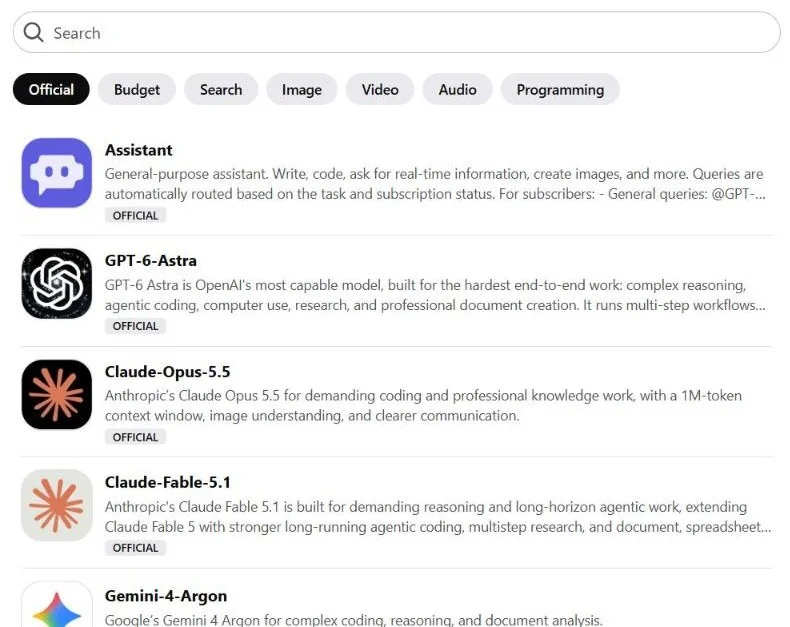
When I opened the Explore page in October 2026, the official text bots at the top were GPT-6 Astra, Claude Opus 5.5, Claude Fable 5.1 and Gemini 4 Argon, with Claude Sonnet 5.5, GPT-6 Luna, Grok 4.7, Kimi K3 and Mistral Large 4 close behind. There is also a default Assistant bot that picks a model for you.
One small thing I noticed: Poe's subscription page still advertises older models like GPT-5.5 and Claude Opus 4.7. The bots themselves are newer than the sales page. New models clearly show up fast, even if the marketing does not keep up.
So AI model selection becomes a dropdown instead of a new subscription. You can compare AI responses from different companies on the same question in seconds.
2. Custom AI Bots
You can build your own bot without writing code.
Poe has two types:
Prompt-based bots. You pick a base model and write plain instructions. For example, "You are a friendly Spanish tutor. Always correct my grammar." That becomes your personalized chatbot.
API bots. These are for developers who want to run their own code on every message. More work to set up, but much more flexible.
You can keep a bot private or share it with a link. If you make it public, other people can find it and use it.
3. Bot Creator Earnings
This is something ChatGPT and Claude do not offer in the same way.
If you build a public bot, you can set a price per message. Other users pay that price in points, and Poe pays you in real dollars. For most people this will be pocket money, not a salary. But for a creator, it means the subscription can partly pay for itself.
4. Text, Image, Video and Audio Generation
Poe is a multimodal AI platform. One account covers:
Content generation and text summarization
AI image creation
AI video creation
Audio and music generation
The catch is the cost. The video section alone had more than 30 official models when I looked, from Veo 3.1 and Runway Gen 4.5 to Kling v3 and Seedance 2.0. And video is where points vanish. More on that in the points section.
5. Coding Assistance and Research
Poe works well for programming help because you can test the same coding question on several models and keep the best answer. Some bots can also run code, and some have web search for fresher answers.
Poe also has Apps, sometimes called canvas apps. You describe a small tool, like a calculator or a quiz, and Poe builds a working app you can use and share. It is a lot like Claude's artifacts or ChatGPT's canvas.
For coding, the real advantage is testing. When one model gets stuck on a bug, you can paste the same problem into another model in the same chat instead of starting over somewhere else.
6. Group Chats
You can add friends or teammates to a chat with AI bots in it. Up to 200 people can join one chat.
Bots only reply when someone mentions them, and the person who triggers the reply pays the points. Normal human messages are free.
7. Memory and Temporary Chats
Poe added an optional Memory feature that remembers your preferences across chats. It is off by default.
There is also a temporary chat mode for quick questions you do not want saved. Those chats are deleted within 24 hours.
8. A Developer API
Poe also has an API that works like OpenAI's, so developers can call Poe's models from their own apps using the same points.
One Feature Poe Took Away
Poe used to have a Knowledge Base feature that let bots read files you uploaded and keep them around. Poe shut it down in May 2026, and the stored files were deleted.
You can still do file uploads inside a normal chat. But if you were planning to build a bot that "knows" a stack of your documents, that option is gone. Many older reviews still list it as a feature.
Poe AI Pricing in 2026: Is It Free?
Yes, Poe has a free tier. But it is small. Very small.
Here are the current subscription plans. I checked them on Poe's own plans page in October 2026, in both monthly and yearly billing.
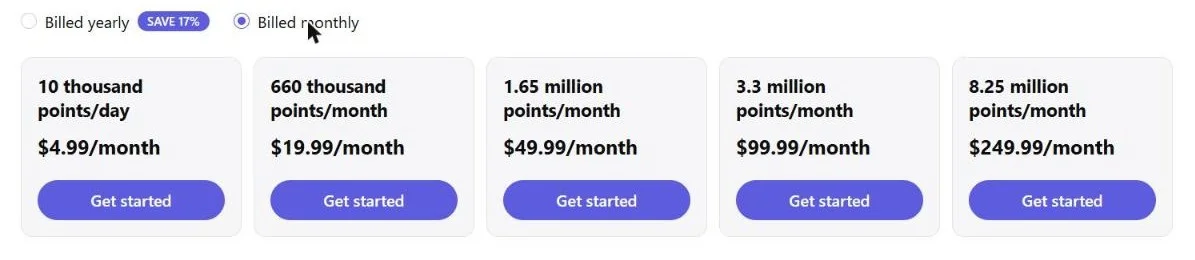 Poe does not give these plans names on its pricing page. They are just listed by points and price, so that is how I list them too.
Monthly price | Yearly price | Points |
|---|---|---|
Free | Free | Small daily allowance (about 300 a day) |
$4.99 | $49.99 | 10,000 a day |
$19.99 | $199.99 | 660,000 a month |
$49.99 | $499.99 | 1.65 million a month |
$99.99 | $999.99 | 3.3 million a month |
$249.99 | $2,499.99 | 8.25 million a month |
A few things the pricing page does not tell you clearly:
The free plan is about 300 points a day. Poe does not publish this number anymore. Its help center only says free users get points daily and they reset every 24 hours. Several independent trackers put it at around 300 points a day since late March 2026, down from about 3,000. A single short GPT-6 Astra answer costs about 1,050 points by my count, so the free tier cannot cover even one. On a very cheap model like GPT-6 Luna, about 13 points an answer, it would stretch to a couple dozen short replies, if that bot is open to free users.
The $19.99 plan used to give more. Trackers recorded it at 1 million points a month until around July 2026. It now shows 660,000 for the same price. Lots of reviews still say "1 million points." That number is out of date.
Paying yearly saves about 17%. That is the only real discount in the lineup.
Unused points do not roll over. If you have a quiet month, those points are gone. The only exception is add-on points, which you can buy at $30 per million and which last a year.
The $4.99 plan is the cheapest per point, with a catch. If you use your full 10,000 points every single day, you get about 300,000 points a month. That works out to roughly $16.63 per million points, against about $30 per million on the $19.99 plan. But you cannot save points up. Ten thousand is your daily ceiling, which is only about 9 short GPT-6 Astra answers or 21 from Claude Opus 5.5.
You can share one plan. Poe lets a subscriber invite a small group of family, friends or teammates to use their points. You cannot do that with a personal ChatGPT Plus or Claude Pro plan.
How Does the Poe AI Points System Work?
This is the part that confuses most people, so let me keep it plain.
Each bot charges points based on how much text it reads and how much it writes. Reading is cheaper. Writing is more expensive. Image and video bots charge per image or per second instead. Poe's own points FAQ explains this, and it is worth a read before you subscribe: How points work on Poe.
Every bot has a Rates button. Click it and you see exactly what it charges. Here is what that looked like for Claude Opus 5.5 when I opened it:
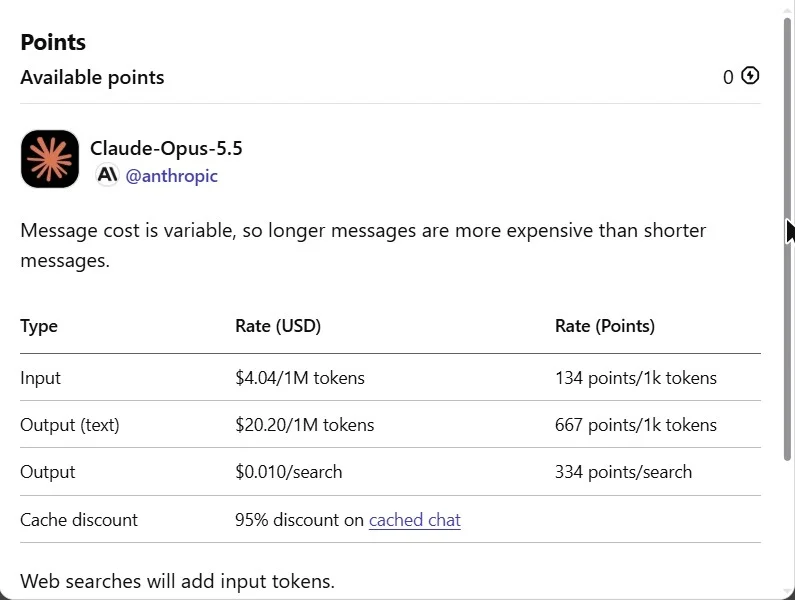 I opened the Rates panel on the main bots one by one and wrote down the numbers. Then I priced the same small job on each: a 1,000 token question with a 500 token answer. That is roughly a short paragraph in and a medium answer out.
Model | Input (points per 1K tokens) | Output (points per 1K tokens) | Points per short answer | Short answers on the $19.99 plan |
|---|---|---|---|---|
GPT-6 Luna | 4 | 17 | about 13 | about 52,800 |
Claude Sonnet 5.5 | 67 | 334 | about 234 | about 2,820 |
Claude Opus 5.5 | 134 | 667 | about 468 | about 1,410 |
Gemini 4 Argon | 134 | 667 | about 468 | about 1,410 |
GPT-6 Astra | 300 | 1,500 | about 1,050 | about 630 |
Claude Fable 5.1 | 334 | 1,667 | about 1,168 | about 570 |
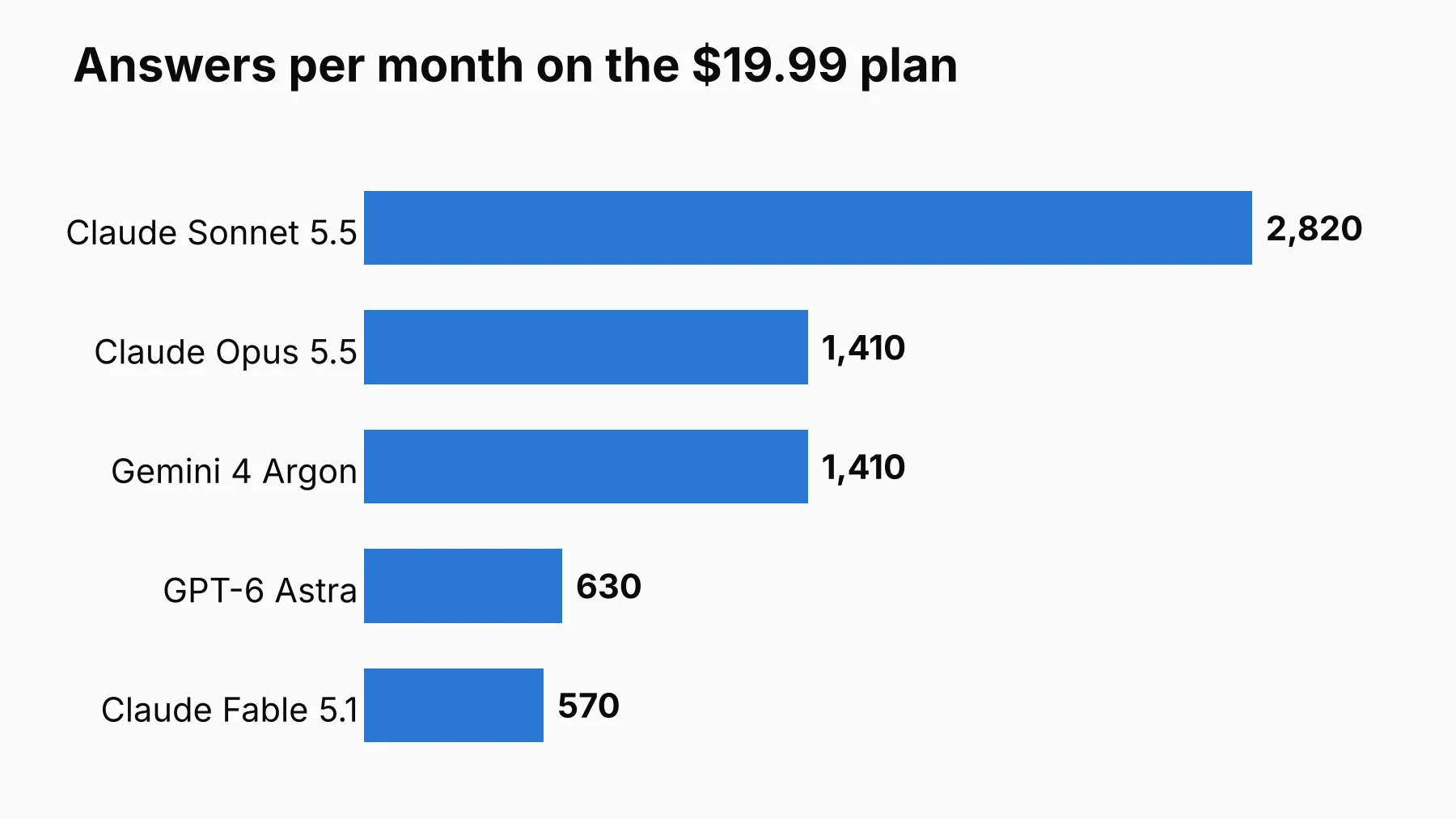 Three things jumped out at me.
The spread is huge. The cheapest model I checked, GPT-6 Luna, is about 90 times cheaper per answer than Claude Fable 5.1. On the same $19.99 plan, that is the difference between tens of thousands of answers and a few hundred. Picking the right model matters more than picking the right plan.
The dollar rate is printed right there. Every Rates panel shows a USD price next to the points. It works out to about $30 per million points, the same rate Poe charges for add-on points. So a Poe subscription is basically prepaid model usage at a fixed rate, with a nice app on top.
Video is in another league. Veo 3.1 charged 13,333 points per second of video when I checked. One 8 second clip is about 106,700 points. That means the whole $19.99 plan buys around six Veo clips and nothing else. If video is your main use, look at the bigger plans or a dedicated video tool.
Long Chats Get Expensive Fast
Here is the catch most reviews miss.
Every time you send a message, Poe sends your conversation history along with it, so the model remembers what you said. And you pay for that history as input, every single time.
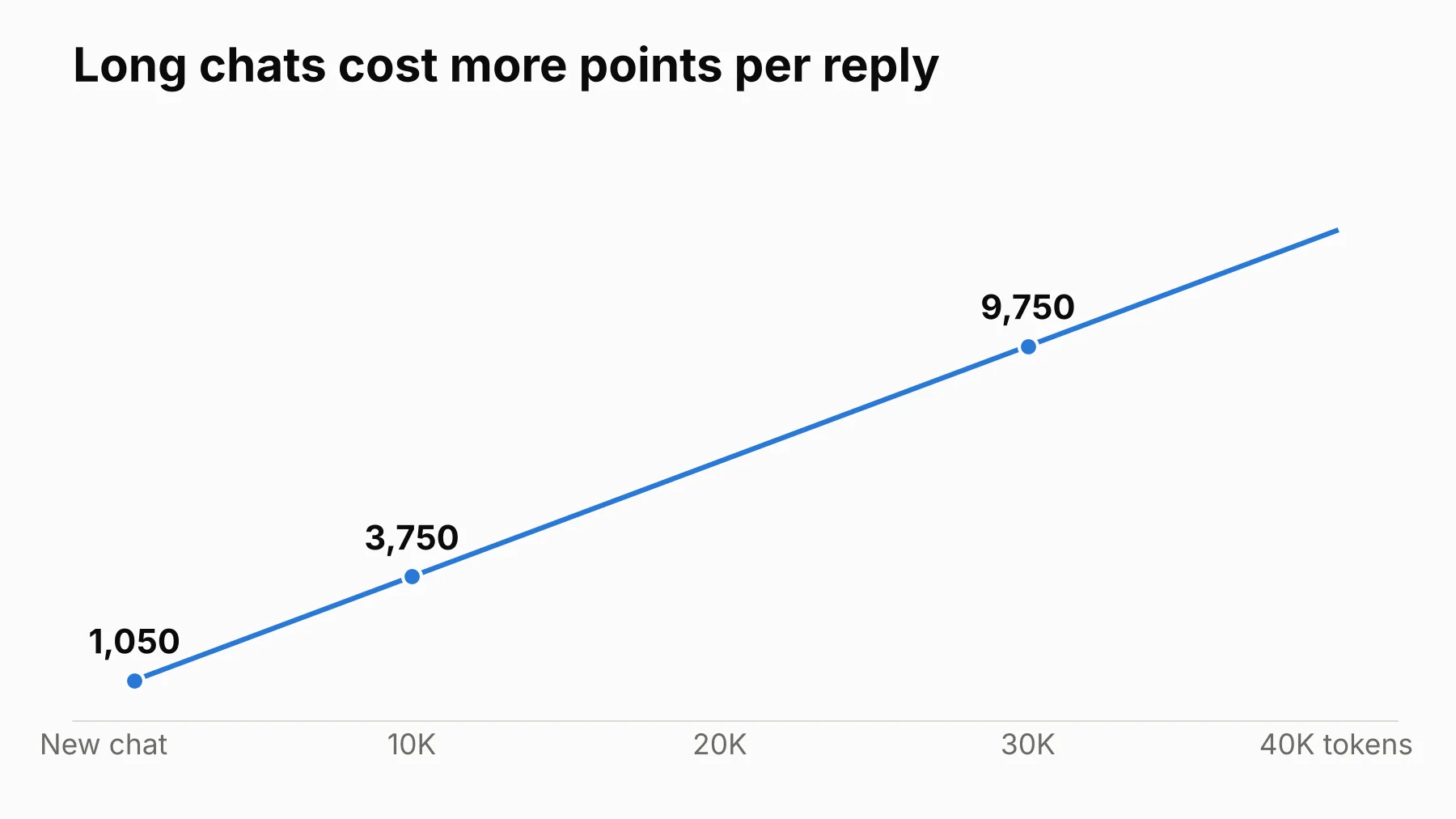 Using GPT-6 Astra's rates, the first reply in a new chat costs about 1,050 points. Once the chat carries around 30,000 tokens of history, the same size reply costs about 9,750 points. That is more than nine times as much for one answer.
It is like a taxi that charges you again for every street you have already driven down.
There is one thing that softens this. Every text bot's Rates panel I opened showed a cached chat discount of 90% to 97% on repeated history, as long as you send your next message fairly quickly, usually within a few minutes. So a fast back and forth costs much less than the chart shows. A chat you come back to an hour later pays close to full price.
This is why heavy users say their points "disappear." It is not that the models got pricier. It is that the conversation got longer, or they took a break in the middle of it.
How to Make Your Points Last
Keep "Auto-manage context" on. This setting trims how much old conversation gets sent with each message. Poe says most of the time you will not notice a difference in answers.
Start a new chat for a new topic. This is the simplest way to stop paying for old history.
Set a per-message budget. In Settings you can set a limit, and Poe will ask before any message goes over it. This works on user-created bots, not official ones.
Use cheaper models for easy jobs. You do not need Claude Fable 5.1 to summarize an email. GPT-6 Luna did the math at about 13 points for a short answer.
Reply quickly when you can. The cached chat discount I saw on the Rates panels, 90% to 97% off repeated history, only kicks in when messages are close together.
Check your Points History. Settings has a full log of what every message cost. After a week, you will know exactly which plan fits you.
Is Poe AI Safe and Private?
Poe is a real, established product from a well-known company. It is not a scam. But the privacy picture is more complicated than with a single AI app, and you should understand it.
Other users cannot see your chats. Poe's FAQ is clear on this. Your conversations are private unless you choose to share them.
But your messages do leave Poe. Because Poe is a middleman, your messages and file uploads are passed to the third-party model providers behind each bot. Poe's privacy policy also says bot developers can receive details of your chats with their bots. So when you talk to a user-created bot, a stranger's code may be handling your conversation. That is the most important user-created bot permission to understand.
Memory shares context across providers. If you turn Memory on, things Poe learns from your chats with one company's bot can be shared with other companies' bots. It is off by default.
Deleting Poe can delete Quora. If your Poe account is linked to a Quora account, deleting one deletes the other.
My simple rule for AI data privacy on Poe: do not paste anything you would not email to a stranger. That means no passwords, client contracts, medical records or private company data. For that kind of data handling, a business plan from a single provider with a proper data agreement is the safer path.
Is Poe accurate? Poe is only as accurate as the model you choose. AI-generated misinformation is still common across all models. Poe's own FAQ says bots can make incorrect statements and can be out of date. Responsible AI use here means fact-checking AI responses before you rely on them for anything important, especially medical, legal or money questions.
The one real advantage Poe has here: because you can ask two or three models the same question, it is easier to spot when one of them is making something up.
Pros and Cons of Poe AI
Pros | Cons |
|---|---|
GPT, Claude, Gemini and many more in one app | Free tier is tiny, about 300 points a day |
Switch models mid-conversation and compare answers | Points drain fast in long chats |
Text, image, video and audio from one account | Unused points do not roll over |
Build custom bots without code, and earn from them | $19.99 plan quietly dropped from 1M to 660K points |
One plan can be shared with family or a team | Your chats go to several third-party companies |
$4.99 entry plan for light users | Missing some native features, like ChatGPT's deep tools or Claude's projects |
Web, mobile and desktop apps that sync | Knowledge Base feature was removed in 2026 |
Poe AI vs ChatGPT, Claude and Gemini
This is the comparison most people are really making, so here it is side by side.
Poe ($19.99) | ChatGPT Plus ($20) | Claude Pro ($20) | Google AI Pro ($19.99) | |
|---|---|---|---|---|
Models | Many companies | OpenAI only | Anthropic only | Google only |
How limits work | Monthly points wallet | Usage limits that reset | Usage limits that reset | Usage limits that reset |
Runs out mid-month? | Yes, if points run out | No, it slows down for a while | No, it slows down for a while | No, it slows down for a while |
Native extras | Bots, apps, group chats | Full ChatGPT tools | Full Claude tools | Google apps, storage |
The key difference is not the price. All four cost about $20.
The difference is one wallet versus one company.
Poe AI vs ChatGPT: If almost everything you do is in ChatGPT, keep ChatGPT Plus. You get OpenAI's full set of tools, and your usage resets instead of running dry. Poe gives you GPT models, but not every ChatGPT feature.
Poe AI vs Claude: Same logic. If you write long documents or code all day in Claude, Claude Pro gives you the full Claude experience. On Poe, long Claude chats burn points quickly because of the history cost I showed above. If you are leaning toward Claude directly, our breakdown of how much Claude AI costs compares every Claude plan side by side.
Poe AI vs Gemini: Google AI Pro bundles Gemini with Google apps and cloud storage. If you live in Gmail and Docs, that bundle is hard for Poe to beat.
Where Poe wins: if you use two or three of these a bit each week, Poe costs one $20 bill instead of three. That is real subscription value.
Best Poe AI Alternatives
If Poe is not quite right, here is where I would look, depending on why you were drawn to Poe in the first place.
ChatGPT, Claude or Gemini directly. Best if one model does 80% of your work. You get full features and limits that reset.
Perplexity. Best if what you mostly want is research assistance with sources. It is an AI search tool first, and its paid plan lets you pick from several top models.
You.com. Another AI search assistant that mixes web search with chat, worth a look if you want answers grounded in live results.
Pay-as-you-go options. Bring-your-own-key apps like TypingMind, or model marketplaces like OpenRouter, let you pay only for what you use. More setup, but no monthly points that expire.
Who Should Use Poe AI?
Poe is a good fit if you:
Use two or three different AI models every week and want one bill
Like to compare AI responses before trusting one
Want to build custom AI bots, or earn from them
Want to share one AI plan with family or a small team
Are a light user who is happy with the $4.99 plan
Poe is a poor fit if you:
Use one AI model for most of your work
Have long, deep conversations or big coding sessions every day
Need to handle sensitive or regulated data
Want a generous free plan to rely on
Is Poe AI Worth It?
Let me answer this plainly.
If you are a mix-and-match user, yes. The $19.99 plan gives you somewhere between about 570 and 2,820 short answers from top models, depending on which ones you pick, plus thousands more from budget models. Buying those companies' plans separately would cost $40 to $60.
If you are a single-model power user, no. Your favorite AI company's own $20 plan will feel more generous, because it slows down instead of running out.
And if you are unsure, use the free plan for a week with the bots you would really use. Then open Points History in Settings. That one screen will tell you more about whether to pay than any review can, including this one.
My verdict: Poe is the best way to have every major AI in one place, as long as you understand you are spending points, not buying unlimited chat.
Frequently Asked Questions
Is Poe AI free?
Yes, Poe AI has a free plan, but it is small. Free users get a daily points allowance that resets every 24 hours and does not roll over. Independent trackers put it at about 300 points a day in 2026, which is not enough for one short answer from a top model like GPT-6 Astra. The newest bots need a paid plan.
How much does Poe AI cost?
Poe AI costs $4.99, $19.99, $49.99, $99.99 or $249.99 a month, depending on how many points you need. The most popular plan is $19.99 a month for 660,000 points, or $199.99 a year. Paying yearly saves about 17%.
Who owns Poe AI?
Poe AI is owned by Quora, Inc., the company behind the Quora question and answer site. Quora's CEO, Adam D'Angelo, leads the company.
Can Poe AI use ChatGPT and Claude models?
Yes. When I checked in October 2026, Poe had GPT-6 Astra and GPT-6 Luna from OpenAI, Claude Fable 5.1, Opus 5.5 and Sonnet 5.5 from Anthropic, and Gemini 4 Argon from Google, along with many others. It does not include every feature of the ChatGPT or Claude apps, but you get the underlying models.
Can you create your own bots on Poe?
Yes. You can create a prompt-based bot with plain instructions and no coding, or an API bot that runs your own code. Bots can be private or public, and public bot creators can earn money when people use them.
Can Poe AI generate images and videos?
Yes. Poe includes image models like Nano Banana and GPT Image, and more than 30 video models like Veo 3.1, Runway, Kling and Seedance. Video is very expensive in points. When I checked, one 8 second Veo 3.1 clip cost about 106,700 points, which is around a sixth of the $19.99 plan.
Is Poe AI safe for private conversations?
Your chats are hidden from other Poe users, but your messages and uploaded files are sent to the AI companies behind the bots you use, and to the developers of any user-created bots. Avoid sharing passwords, client data or anything highly sensitive.
Does Poe AI work on mobile?
Yes. Poe has apps for iOS and Android, plus desktop apps for Mac and Windows and a web version. Your chat history syncs across all of them.
Do Poe points roll over?
No. Subscription points and free points do not roll over. Add-on points bought separately at $30 per million are the exception and last for one year.