Is Originality AI Accurate? Our Test and Findings
So, is Originality AI accurate? Yes, for most real-world content. In our own test, Originality.ai scored two human samples at 0% and 2% AI, and scored raw, paraphrased and style-copied AI text at 93% to 96% AI. It also labeled a half-human, half-AI document as Mixed. But bigger studies show it still flags about 1 in 26 human passages, and misses more AI text when that text is built to copy a specific author. So the score is a strong signal, not proof.
Why I ran my own test
I had a simple problem with the pages already ranking for this question. Most of them quote Originality.ai's own "99% accurate" line, or run one scan and call it a review. One of them is copied word for word across two different domains.
None of that tells you what happens when you paste your own text in.
So I opened the free Originality.ai checker, built six samples with known origins, and scanned every one. Then I put my results next to the largest independent studies I could find, so you can see where my small test agrees with the big picture and where it does not.
How I tested Originality.ai
Here is exactly what I did, so you can repeat it.
Date: 21 October 2026
Tool: the free AI checker on originality.ai, no account, no paid plan
Model version: Originality Model 5.0 (the default setting)
Settings: AI score only, plagiarism scan turned off, Deep Scan off
Length: every sample was between 143 and 208 words, above the 100-word minimum
Cost: about 1 credit per 100 words, out of 100 free credits
I picked samples where I knew the truth for certain. That matters. You cannot measure detection accuracy if you are guessing who wrote the text.
Sample | Where it came from | What it really is |
|---|---|---|
1 | Walden by Henry David Thoreau, 1854 | Human |
2 | Wikipedia "Compost" article, May 2020 revision | Human (written before ChatGPT existed) |
3 | A gardening guide written by an AI model, no edits | AI |
4 | Sample 3, reworded sentence by sentence | AI, paraphrased |
5 | AI told to copy a real blogger's casual style on a new topic | AI, style imitation |
6 | 93 words of a human blog intro plus 110 words of sample 3 | Mixed (about 46% human, 54% AI) |
Is Originality AI Accurate? Our Test Results
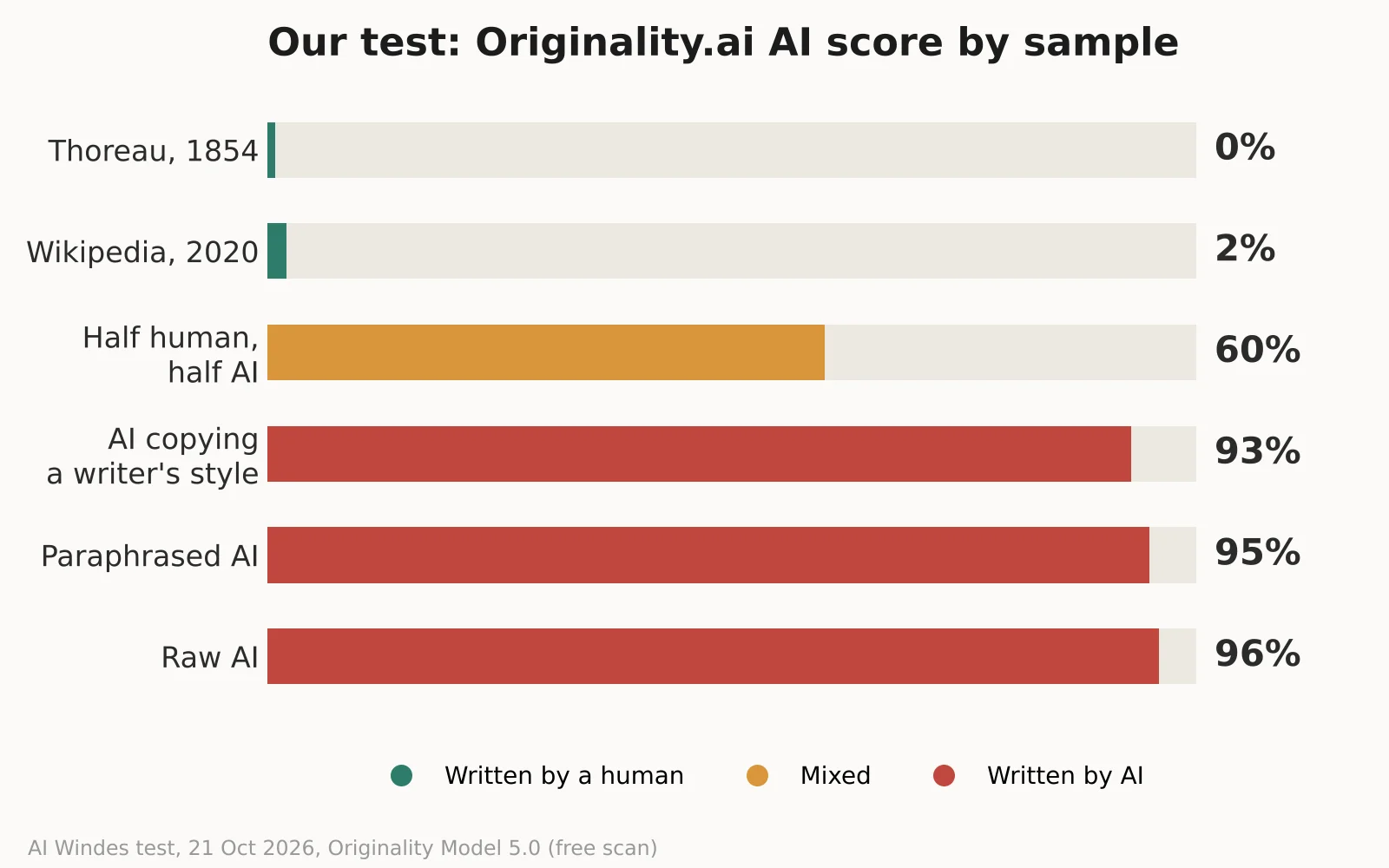 Our test on 21 October 2026. Human text scored 0-2% AI, every AI sample scored 93-96%, and the mixed sample was flagged as Mixed.
Six samples, six correct verdicts. Here is what each one showed.
Testing human-written content
The Thoreau passage came back 100% Likely Original. The 2020 Wikipedia text came back 98% Likely Original.
One detail I liked: in the Wikipedia scan, the tool highlighted only the very last sentence in orange, the one about "aerobic bacteria and fungi" converting inputs into heat and carbon dioxide. That sentence is dry and textbook-like, which is the kind of text that looks predictable to a detector. The overall verdict still stayed Original. This is what sentence-level highlighting is for. It shows you which lines pushed the score, instead of hiding everything inside one number.
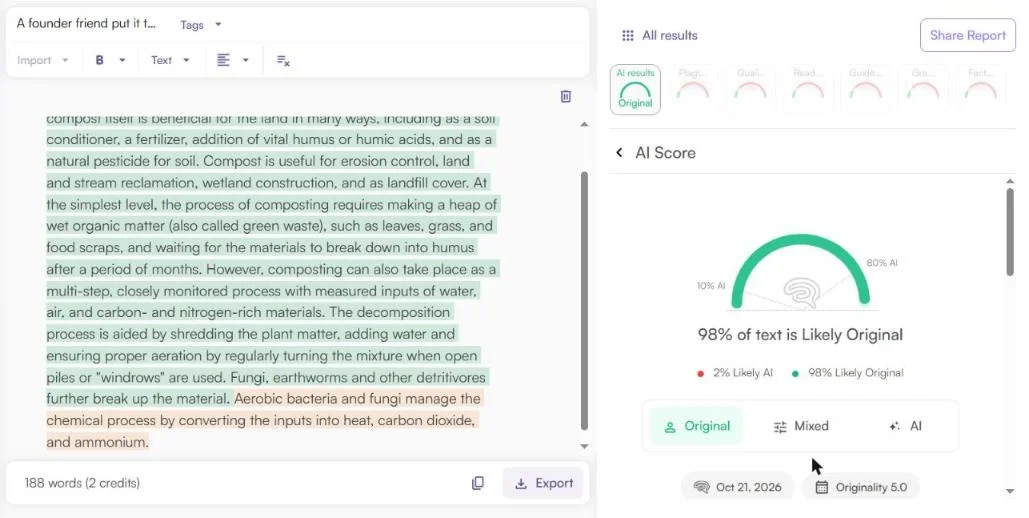 Our scan of the 2020 Wikipedia text: 98% Likely Original, with only the last sentence highlighted.
Testing raw and paraphrased AI text
The unedited AI gardening guide scored 96% Likely AI. No surprise there.
The paraphrased version is more interesting. I changed almost every sentence: "Starting a vegetable garden is one of the most rewarding ways" became "Growing your own vegetables is a great way." Different words, same ideas, same order. It still scored 95% Likely AI.
That lines up with what Originality.ai says about itself: it trains on paraphrased and edited AI text on purpose. In my test, swapping words did almost nothing.
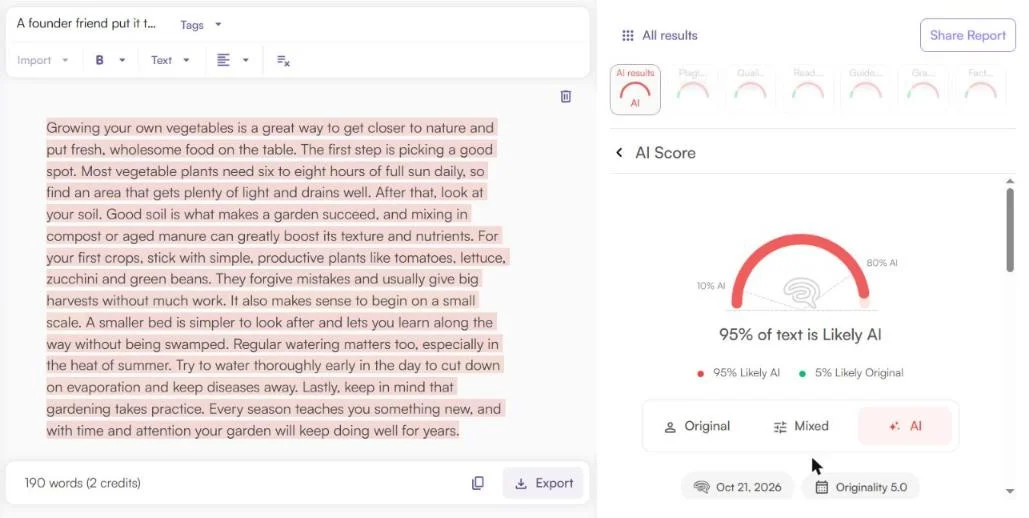 Our paraphrased AI sample still scored 95% Likely AI.
Testing AI that copies a real writer's style
This was the test I cared about most, because it is where independent research says detectors break.
I gave an AI model a real blog intro written in a short, casual, first-person voice, and asked it to write something new in that exact style. The result had short lines, a story about a cousin, a kitchen analogy, and plain words. To my eye, it read like a person.
Originality.ai still scored it 93% Likely AI.
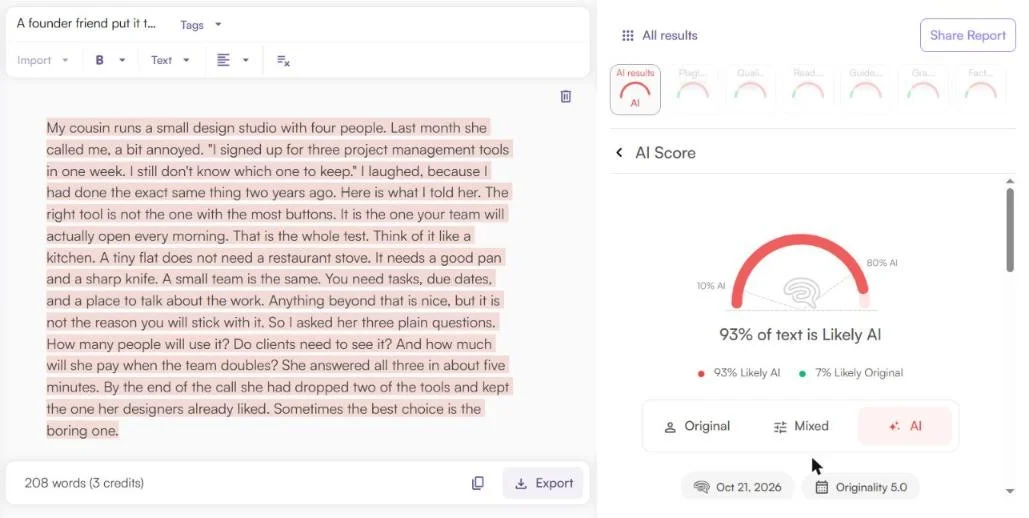 AI text written to copy a real blogger's voice scored 93% Likely AI.
Testing mixed human and AI writing
The mixed document was about 46% human and 54% AI by word count. Originality.ai labeled it Mixed, with 60% Likely AI and 40% Likely Original.
That is not a perfect split, but it is close, and the label was right. For editors, this is the most useful result in the whole test. Real content is rarely 100% one thing. A writer drafts, an AI tool tidies a paragraph, an editor rewrites the intro. A detector that can only say "human" or "AI" is not much help with that kind of mixed-origin content.
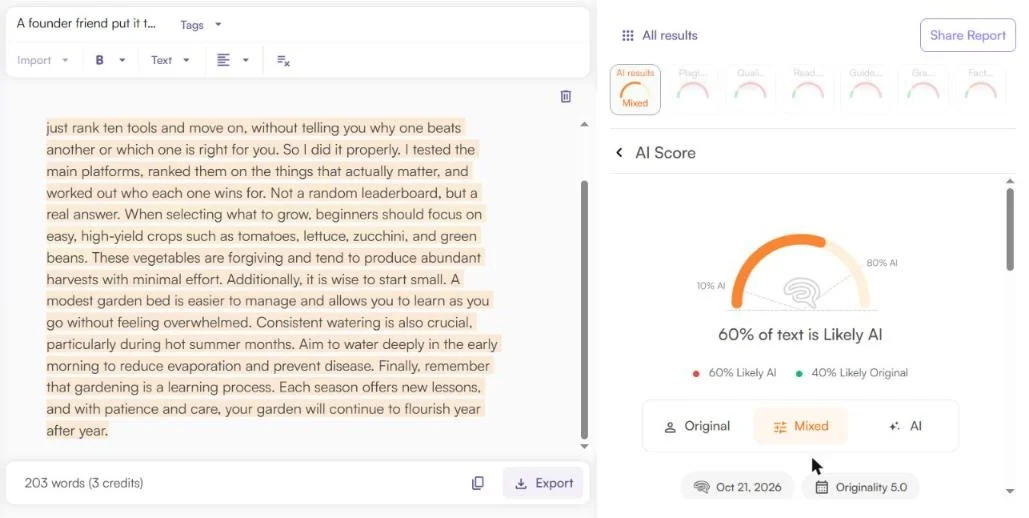 Half human, half AI: Originality.ai labeled it Mixed at 60% Likely AI.
What my small test can and cannot prove
Let me be straight about the limits, because this is where most reviews stop being honest.
Six samples is a tiny sample size. A perfect 6 out of 6 does not mean Originality.ai is 100% accurate. It means it did not fail on these six texts, on this day, with this model version.
My human samples also had an easy edge. Thoreau and a 2020 encyclopedia page are very clearly human. The hard cases for any AI detector are modern, plain, tidy human writing, and text from non-native English writers, where the style can look smooth and predictable. That is where false positives tend to show up.
So I treat my test as a reality check, not as a final number. For the final number, you need studies with hundreds of samples.
What Originality.ai is and how it detects AI
Originality.ai is a paid content-checking platform built mainly for publishers, SEO teams, agencies and schools. Besides the AI detector, it bundles a plagiarism checker, a readability checker, a fact checker and a grammar checker. It also offers an API, team workflows and a Chrome extension that can replay how a document was typed.
The AI detector is a text classification model. It reads your text and estimates how likely it is to be machine-generated text from a large language model. Two ideas explain most of how this works:
Perplexity is how predictable each word choice is. AI models tend to pick the expected next word, so their text is often low in perplexity.
Burstiness is how much sentence length and shape vary. People mix short and long sentences without thinking. AI text from a plain prompt is usually smoother and more even.
The model turns these writing patterns into an AI probability score. Model 5.0 then sorts the result into three buckets: Original, Mixed or AI. There is also a feature called AI Allowance, which lets a team choose how much AI involvement is acceptable before a document gets flagged, instead of treating any AI help as a failure.
This also explains why style imitation is hard. When a model copies a real author's sentence rhythm and word choices, it deliberately adds back the burstiness and surprise that the classifier links to human writing.
What the bigger studies say about Originality.ai accuracy
Here are the three sources I trust most, from weakest to strongest evidence.
1. Originality.ai's own numbers. The company reports accuracy above 99% for its AI Allowance setup at 15% allowed AI, and a 2.8% false positive rate on its toughest internal test. These are vendor-reported results on datasets the company chose. Useful, but not neutral.
2. The RAID benchmark. RAID is a large, independent benchmark dataset that tested 12 detectors across millions of texts, including text altered to dodge detection. Using an earlier Originality.ai model, it scored 85% accuracy on the base dataset at a fixed 5% false positive threshold, ahead of the next detector at 80%. On paraphrased AI text, it scored 96.7% while the average detector managed 59%. My paraphrase result fits that pattern.
3. Epoch AI's 2026 study. This is the newest and, to me, the most useful one. Researchers at Epoch AI tested Originality.ai (Turbo 3.0.2), Pangram and GPTZero on 495 human passages and two kinds of AI text, including AI that copied a specific author after reading five of their real writing samples. You can read the full Epoch AI study yourself.
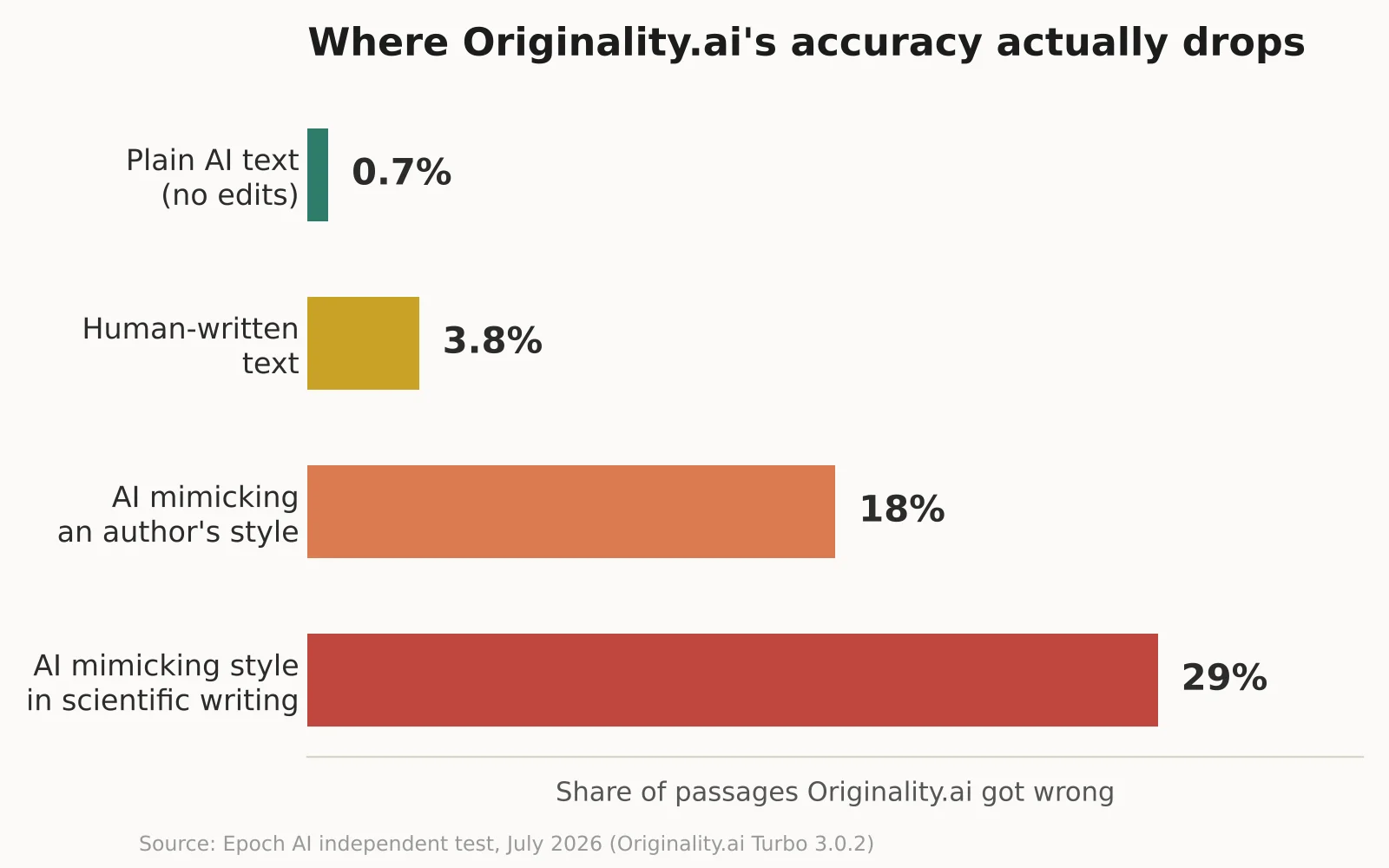 In a much larger study, Originality.ai missed far more AI text when it copied a real author's style, especially in science writing.
What Epoch found for Originality.ai:
Plain AI text was almost always caught. All three detectors missed at most 0.7%.
It wrongly flagged 19 of 495 human passages as AI. That is a 3.8% false positive rate. Pangram and GPTZero flagged none.
It missed 18% of AI passages that copied an author's style (53 of 297).
On style-copied scientific writing, it missed 29%, the worst result of the three tools.
One warning: do not compare these percentages as if they came from one experiment. Each study used a different model version, dataset, text length and scoring method.
Why my results look better than Epoch's
At first glance my test and Epoch's seem to disagree. My style-copy sample was caught. Theirs slipped through 18% of the time. I think three things explain it.
First, sample size. I ran one style-copy sample. Epoch ran 297. At an 18% miss rate, most single samples still get caught. I would need to be fairly unlucky to see a miss on my first try.
Second, the setup. Epoch gave the AI five real writing samples and used 500-word passages. I gave mine one sample and got about 200 words. More reference text means a closer copy.
Third, the genre. My sample was a casual blog story. Epoch's worst results were in scientific writing, which is formal and predictable even when humans write it. That makes human and AI versions harder to tell apart.
So both results can be true at once. Originality.ai catches most style-copied text, especially casual web content. It just does not catch all of it, and its weak spot is academic writing.
Can Originality.ai flag human writing as AI?
Yes. This is called a false positive, and every AI detector has them.
Across the sources, Originality.ai's false positive rate lands around 3% to 4%. In my test it had zero false positives, but with only two human samples, that tells you very little.
It helps to know what the common accuracy terms actually mean, because vendors mix them up:
Accuracy is the share of all texts labeled correctly, human and AI together.
Precision is, of all texts flagged as AI, how many really were AI.
Recall is, of all real AI texts, how many got caught.
F1 score is a single number that balances precision and recall.
False positive rate is the share of human texts wrongly flagged as AI.
False negative rate is the share of AI texts that slipped through.
A detector can have high overall accuracy and still produce false positives on individual documents. A 3.8% false positive rate sounds small until you scan 500 freelance articles a month. That would be around 19 honest writers flagged.
Originality.ai itself says, on its own checker page, that a score should be used as a signal for review, not proof of authorship or misconduct. I agree with that.
Originality.ai vs GPTZero and other AI detectors
There is no single winner, and it depends on which mistake you fear more.
What you care about | Who looks stronger | Evidence |
|---|---|---|
Catching paraphrased AI | Originality.ai | RAID: 96.7% vs 59% average |
Not flagging human writers | Pangram and GPTZero | Epoch: 0 false positives vs 3.8% |
Catching style-copied AI | Pangram and GPTZero, slightly | Epoch: 10% and 11% missed vs 18% |
Labeling mixed documents | Originality.ai performed well in our test | Our mixed sample was labeled Mixed |
If you run an SEO or publishing team and your main worry is writers passing off reworded AI text, Originality.ai fits that job well. If your main worry is wrongly accusing a human, especially a student, the Epoch data leans toward Pangram or GPTZero.
Does Originality.ai accuracy matter for SEO?
Less than most people think.
Google does not run your pages through Originality.ai, and passing an AI detector is not a ranking factor. Google's guidance says it rewards helpful, reliable, people-first content however it is produced. What it acts on is scaled content abuse: publishing lots of low-value pages mainly to game rankings, whether a person, a content farm or an AI wrote them.
So a 0% AI score does not make a page rank, and a 90% AI score does not get it penalized. What matters is whether the page is accurate, original and useful, and whether it shows first-hand experience. Funny enough, that is exactly why I ran my own test for this article instead of rewriting other people's numbers.
Where Originality.ai does help SEO teams is quality control. If you pay freelancers for human-written content, a scan before you publish is a cheap way to spot copy that was pasted straight from a chatbot.
How to read an Originality.ai score without getting burned
After running these scans, this is the routine I would follow:
Scan at least 100 words, ideally 300 or more. Short text gives the classifier too little to work with.
Look at the label, not just the number. Model 5.0 says Original, Mixed or AI. Mixed is not an accusation. It often just means someone used AI help on part of the text.
Check the highlighted sentences. If only one dry, technical sentence is highlighted, that is very different from the whole page lighting up.
Never act on one scan alone. Ask for drafts, version history, or a quick chat about the topic. A writer who wrote the piece can talk about it.
Be extra careful with academic and technical text. That is where both false positives and missed AI are most common.
Note the model version. Scores change between versions, so a scan from last year may not match one today.
Is Originality.ai worth using?
For publishers, agencies and SEO teams, yes. It caught every AI sample I threw at it, including paraphrased text and a fair attempt at copying a human voice, and it handled mixed content better than I expected. The free scan is enough to try it before paying.
For high-stakes calls on one person's work, like a student essay or a disputed freelance piece, use it as one signal among several. The independent data is clear that roughly 1 in 26 human passages can get flagged, and that well-made style copies, especially in scientific writing, can slip through.
If you are also checking code, that is a different problem with its own accuracy issues. I covered it in our AI code checker guide
Frequently Asked Questions
Is Originality AI accurate for ChatGPT content?
Yes. Plain ChatGPT-style output is its strongest case. In the RAID benchmark it scored 98.2% on ChatGPT text, and in Epoch AI's study it missed almost no AI text written from simple prompts. Our raw AI sample scored 96% AI.
Can Originality.ai detect paraphrased AI text?
Yes, in most cases. Our paraphrased sample still scored 95% AI, and RAID measured 96.7% accuracy on paraphrased text, well above the 59% average across other detectors.
Can Originality.ai detect humanized AI content?
Often, but not always. Our style-copied sample scored 93% AI. In Epoch AI's larger test, 18% of style-copied passages slipped through, rising to 29% for scientific writing.
Why does Originality.ai say my writing is AI-generated?
Smooth, predictable writing can look like AI to a classifier. Heavy grammar tools that rewrite sentences can also push the score up. Check which sentences are highlighted, and keep your drafts so you can show your process.
Does Originality.ai work on mixed human and AI writing?
Yes. Model 5.0 has a Mixed label. Our half-human, half-AI document was labeled Mixed at 60% AI, close to its real split of about 54% AI.
Is Originality.ai free to use?
You can run free scans without an account, up to 100 credits, which is roughly 10,000 words. Note that text pasted into the free checker may be used for training. People with an account can opt out.
Does Google use Originality.ai to rank pages?
No. Google does not use third-party AI detectors as a ranking signal. It judges content on quality and helpfulness, and targets scaled, low-value content whoever or whatever wrote it.