Who Owns ChatGPT? The 2026 Ownership Breakdown
OpenAI owns ChatGPT. And OpenAI itself is controlled by a nonprofit called the OpenAI Foundation, which appoints its entire board.
When people ask what company owns ChatGPT, the short answer is OpenAI. The longer answer is three groups: Microsoft holds about 27%, the OpenAI Foundation about 26%, and employees and investors the rest. Those are the last official numbers, from October 2025.
So who owns ChatGPT? No single person. Not Microsoft, not Elon Musk, and not Sam Altman.
If you asked this question a year ago, you would have got a different answer. Since then, OpenAI has restructured, raised $122 billion, rewritten its Microsoft deal, won a court case against Musk and filed paperwork to go public.
Most pages ranking for this question stop before those changes. I went through OpenAI's own structure page and the 2026 reporting on each event, so this is the up-to-date version.
Who Owns ChatGPT, Person by Person
Most confusion comes from big names that get linked to ChatGPT. So I put each one in a single table, with what they really hold.
Person or company | Owns part of ChatGPT? | Their real role |
|---|---|---|
OpenAI Foundation | Yes, about 26% | Nonprofit that controls the board |
Microsoft | Yes, about 27% | Largest shareholder and cloud partner |
Employees | Yes, part of 47% | Includes president Greg Brockman |
Amazon, SoftBank, Nvidia | Yes, since 2026 | Led the March 2026 round |
Sam Altman | No direct stake | CEO and co-founder |
Elon Musk | No | Co-founder who left, now a rival |
No | Makes the rival Gemini |
The percentages are the October 2025 figures, the last official ones. The March 2026 round made all of them a little smaller.
Three owners. One in charge. That is the whole picture.
Who Owns OpenAI, and How the Split Works
Who owns OpenAI is really two questions: who controls it, and who holds its shares. The answers are different.
Control sits with the OpenAI Foundation, a nonprofit. According to OpenAI's structure page, the Foundation appoints every board member of the for-profit company and can replace them at any time.
Shares sit in OpenAI Group PBC. That is the for-profit company that actually runs ChatGPT. PBC stands for public benefit corporation, which means it must follow its mission, not just make money for shareholders.
Here is the last official ownership split, from when the new structure closed in October 2025:
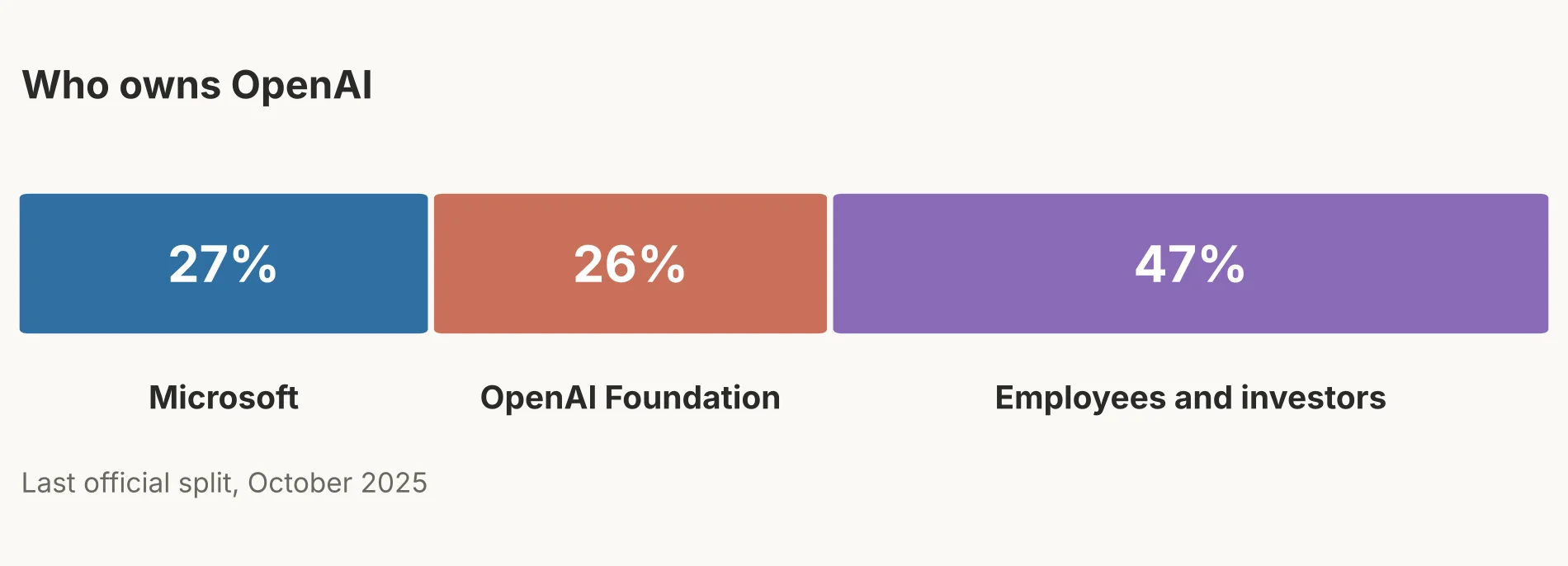 The last official split, published when OpenAI restructured in October 2025.
Owner | Stake | What it means |
|---|---|---|
Microsoft | About 27% | The largest single shareholder |
OpenAI Foundation | 26% | A nonprofit, and the one in control |
Employees and investors | 47% | Staff, early backers and funding rounds |
OpenAI valued the Foundation's 26% at about $130 billion at the time. The Foundation also holds a warrant to get more shares if the price rises more than tenfold over 15 years.
Why These Numbers Are Already Out of Date
This is the part I think most readers miss. In March 2026, OpenAI raised $122 billion at an $852 billion valuation, according to reporting on the round. Amazon, SoftBank and Nvidia led it, and Microsoft also took part.
A new round like that adds new shareholders, so every older stake gets a little smaller. That is called dilution.
OpenAI has not published a new ownership table since. So the October 2025 split is still the latest official one, but the real percentages today are somewhat lower for Microsoft and the Foundation.
Is OpenAI a Nonprofit?
Is OpenAI a nonprofit? Partly. It is a nonprofit at the top and a for-profit company underneath.
Let me keep this plain, because the legal names make it sound harder than it is.
Think of a car. The OpenAI Foundation sits in the driver's seat and holds the steering wheel. Microsoft and the other investors paid for big parts of the car, and they ride along in the back.
They own a lot of the car. But they do not decide where it goes. The driver does.
OpenAI Group PBC is the car itself. It is the business that builds ChatGPT, sells subscriptions and takes investment.
It used to be messier. From 2019, OpenAI ran a "capped-profit" company, where investor returns had a ceiling. The October 2025 restructuring, which OpenAI calls a recapitalization, replaced that with the simpler setup above.
We should be clear about one thing, though. "Nonprofit at the top" does not mean ChatGPT is a charity. The company that runs it charges for subscriptions, sells to businesses and aims to make a profit.
How OpenAI's Ownership Changed From 2015 to 2026
To see why ownership is confusing, I think it helps to see how we got here.
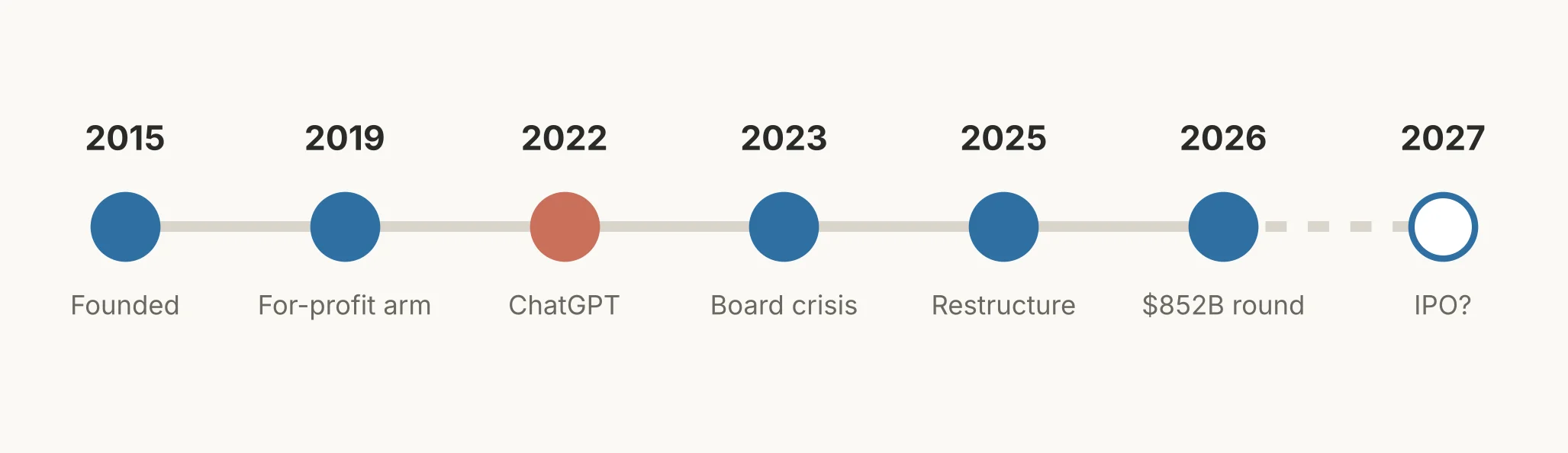 Eleven years from nonprofit lab to a likely 2027 stock market debut.
2015: OpenAI is founded as a nonprofit research lab by a group including Sam Altman, Elon Musk, Greg Brockman and Ilya Sutskever.
2019: It creates a for-profit arm to raise money, and Microsoft invests $1 billion.
November 2022: ChatGPT launches and becomes one of the fastest-growing apps ever.
2023: Microsoft invests billions more. In November, the board fires Sam Altman, then brings him back within days.
October 2025: OpenAI restructures into the Foundation and OpenAI Group PBC, with the 26%, 27% and 47% split.
2026: A $122 billion round in March, a new Microsoft deal in April, Musk's lawsuit lost in May, and confidential IPO paperwork in June.
2027: The likely year OpenAI lists on the stock market, based on recent reports.
Does Microsoft Own ChatGPT?
Does Microsoft own ChatGPT? No. Microsoft is OpenAI's biggest outside shareholder, but it does not control the company or own ChatGPT outright.
I see why people think it does. You open Word or Windows, see Copilot, ask it something, and it answers a lot like ChatGPT. Same feel, so it must be the same owner. Right?
Not quite.
Microsoft's stake came from billions invested since 2019. That money mostly paid for the huge computing power OpenAI needs, much of it on Microsoft's Azure cloud.
In return, Microsoft got to build OpenAI's models into its own products. That is why Microsoft Copilot feels so close to ChatGPT. So in car terms, Microsoft paid for a big part of the car. It is just not the one driving.
The relationship changed again in April 2026. According to TechCrunch's report on the new deal:
Exclusivity ended. OpenAI can now sell its products on any cloud, not just Azure.
Microsoft's license runs to 2032. It can keep using OpenAI's models in its own products, but no longer exclusively.
Revenue sharing changed. Microsoft stopped paying a share to OpenAI, while OpenAI keeps paying Microsoft a capped share through 2030.
Microsoft still held about 27% of the for-profit company at that point, based on the last figure it shared. So it is a very large investor, but a partner, not the owner.
Does Elon Musk Own ChatGPT?
Does Elon Musk own ChatGPT? No. Musk co-founded OpenAI in 2015 and gave about $38 million in its early years, but he left and holds no stake in the company today.
He later sued OpenAI, Sam Altman and Greg Brockman. He argued they turned a charity into a for-profit business to enrich themselves.
On May 18, 2026, a unanimous jury in Oakland, California, ruled against him. According to reporting on the verdict, the jury found he brought his case too late, after less than two hours of deliberation. Musk has said he will appeal.
So for now, the answer is simple. Musk helped start OpenAI. He does not own any of it.
This was not his first attempt to win back influence. In early 2025, a group led by Musk offered about $97 billion to take control of OpenAI's nonprofit, and OpenAI's board turned it down.
Musk now runs his own AI company, xAI, which makes the Grok chatbot. So from what I can see, he competes with ChatGPT rather than owning any part of it.
Who Runs OpenAI Day to Day?
Who is the CEO of OpenAI? Sam Altman. He co-founded the company and has led it for most of its life, apart from a few days in November 2023.
Here is the surprising part. Altman does not own OpenAI. May 2026 court filings, as reported in coverage of the Musk trial, showed he holds no direct equity in the company.
Others do hold large stakes. Greg Brockman, OpenAI's president, testified in the Musk trial that his stake is worth nearly $30 billion.
The board is chaired by Bret Taylor. Most directors sit on both the Foundation board and the company board, which is how the nonprofit keeps control.
What the 2023 Board Crisis Showed
We already saw this control in action once. In November 2023, OpenAI's nonprofit board fired Sam Altman, with almost no warning to Microsoft.
Within days, most employees threatened to quit and Microsoft offered to hire Altman. He was reinstated, and most of the board was replaced.
To me, that episode is the clearest proof of how OpenAI works. Investors like Microsoft have money in the company, but the nonprofit board holds the real power over who runs it.
Can You Buy OpenAI Stock?
Can you buy OpenAI stock? Not on a stock exchange today. OpenAI is still a private company, so there is no OpenAI ticker you can buy through a normal brokerage app.
That is starting to change. On June 8, 2026, OpenAI confidentially filed draft paperwork with the SEC for a possible IPO. It filed a week after Anthropic, the company behind Claude, did the same.
But a filing is not a listing. OpenAI said at the time that it had not decided on timing. In late September, reports said Altman had ruled out a 2026 listing, pointing to 2027 instead, while OpenAI held talks to raise around $30 billion more at about $1.4 trillion.
Some OpenAI shares do change hands privately on secondary markets, open only to large or accredited investors. TechCrunch reported those trades valued OpenAI at about $880 billion in April 2026.
For most people, the only indirect way in is through public companies that own a stake, like Microsoft, Nvidia, SoftBank or Amazon. I would be careful here, though. OpenAI is a small part of each of those businesses, so buying their shares is not the same as owning OpenAI.
Who Owns the Other Big AI Chatbots?
Once I had the ChatGPT answer, I wanted to see how it compares with its main rivals. The setups are very different.
Chatbot | Owner | Who can buy shares |
|---|---|---|
ChatGPT | OpenAI, controlled by a nonprofit | No one yet, IPO expected 2027 |
Gemini | Google, part of Alphabet | Anyone, through Alphabet stock |
Copilot | Microsoft | Anyone, through Microsoft stock |
Claude | Anthropic, a public benefit corporation | No one yet, IPO paperwork filed |
Grok | xAI, Elon Musk's AI company | Private investors only |
So ChatGPT is the only big chatbot whose owner is still steered by a nonprofit. That is the single biggest difference, and it is why the ownership question has such a long answer.
Frequently Asked Questions
Who owns ChatGPT?
OpenAI owns ChatGPT. OpenAI is controlled by the nonprofit OpenAI Foundation, while Microsoft, the Foundation, employees and investors hold its shares.
Who created ChatGPT?
OpenAI created ChatGPT and launched it in November 2022. It is built on OpenAI's GPT family of large language models.
Does Microsoft own OpenAI?
No. Microsoft held about 27% of OpenAI's for-profit company at the last official count, making it the largest shareholder. But the OpenAI Foundation controls the board.
Does Sam Altman own OpenAI?
No. Sam Altman is the CEO, but May 2026 court filings showed he holds no direct equity in OpenAI.
How much is OpenAI worth?
OpenAI was valued at $852 billion after its March 2026 funding round. In September 2026, it was reported to be in talks to raise more at about $1.4 trillion.
When will OpenAI go public?
Most likely in 2027. OpenAI filed confidential IPO paperwork in June 2026, but recent reports say a 2026 listing is off the table.
Is ChatGPT owned by Google?
No. Google makes its own rival chatbot, Gemini. Google has no ownership stake in OpenAI.
Can I buy shares in ChatGPT?
Not directly. ChatGPT is a product, not a separate company, and its owner OpenAI is not yet listed on any stock exchange.
Who are OpenAI's biggest investors?
Microsoft is the largest. Amazon, SoftBank and Nvidia led the $122 billion round in March 2026, according to reporting on the round. Andreessen Horowitz was also reported to take part.
What Ownership Means for ChatGPT Users
You might wonder why any of this matters if you just use ChatGPT to write emails.
Here is how I see it, and why we think it is worth knowing. Ownership decides who sets the rules. Because a nonprofit controls OpenAI, its stated mission still sits above profit on paper. Because Microsoft no longer has exclusivity, ChatGPT can now run on other clouds too.
And once OpenAI lists on the stock market, public shareholders will join the picture. That could shape prices, features and how fast new models arrive.
So the next time someone asks who owns ChatGPT, the real answer is a nonprofit in control, Microsoft as its biggest investor, and a long list of shareholders that is about to get much longer.