16 AI Chip Makers That Matter in 2026: Who Designs, Who Builds, Who Controls Supply

NVIDIA still designs most of the AI chips the world runs on, holding somewhere between 70 and 81 percent of the data centre accelerator market depending on whose methodology you accept. AMD is the only merchant rival with real share, near 10 percent. Broadcom quietly designs a large share of everything else. And almost none of these companies manufacture anything, because TSMC does that for nearly all of them.
That last sentence is the one most lists get wrong, so this one is sorted by what each company actually does rather than by revenue.
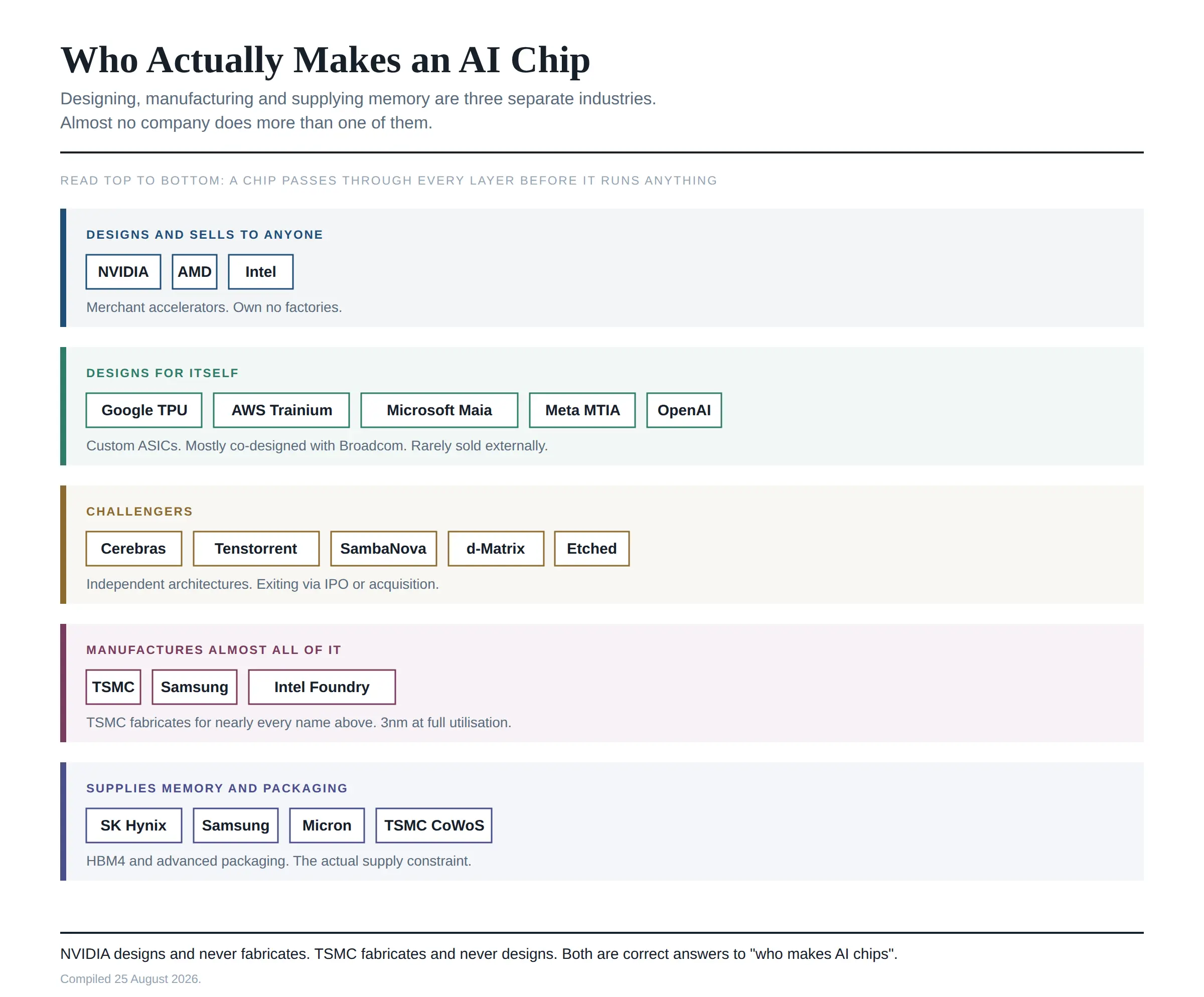
Three Businesses People Keep Confusing
When someone asks who makes AI chips, they are usually asking three questions at once.
Who designs the chip. NVIDIA, AMD, Google, Broadcom. They decide the architecture and own the intellectual property. Most own no factories at all.
Who manufactures it. Almost always TSMC. Samsung and Intel do some. This is a capital business measured in tens of billions per plant.
Who supplies memory and packaging. SK Hynix, Samsung and Micron for high bandwidth memory. TSMC again for advanced packaging. This is where the actual shortage lives.
A company can dominate one layer and be absent from the other two. NVIDIA designs and sells but does not fabricate. TSMC fabricates for everyone and designs nothing of its own here.
Confusing those two is why so many rankings read as nonsense.
 Layer One: Designed and Sold to Anyone
Three companies design accelerators and sell them to whoever has the money.
1. NVIDIA
The scale is hard to convey with percentages, so here is a number instead.
NVIDIA reported 193.7 billion dollars in data centre revenue for fiscal 2026, up 68 percent, with GAAP net income of 120.1 billion dollars at a 55.6 percent margin, according to a review of the FY2026 filings.
That same analysis notes the figure exceeds the combined net income of TSMC, Broadcom, AMD and Intel, which came to roughly 82.4 billion. One company out-earned the other four together.
The moat is not really the silicon. It is CUDA, the software layer fifteen years of researchers have built habits around, plus priority access to TSMC's packaging capacity.
Current generation is Blackwell, with Vera Rubin following at 288GB of HBM4.
2. AMD
The credible second source, and 2026 was the year that became true rather than aspirational.
IDC puts AMD near 10 percent of the AI data centre chip market, roughly double its 2024 share. Data centre revenue hit 5.8 billion dollars in the first calendar quarter of 2026, up 57 percent.
The strategic shift matters more than the number. Microsoft, Meta, Oracle and OpenAI now run both NVIDIA and AMD hardware in production. Dual sourcing is normal now, driven by supply security and pricing leverage as much as performance.
One disagreement worth flagging. IDC puts AMD near 10 percent, while another analysis puts its Instinct line at 5 to 7 percent. Both are defensible depending on what counts as the market.
3. Intel
Still the hardest company here to place.
Its net loss narrowed to 0.3 billion dollars in fiscal 2025 from 18.8 billion the year before. Headcount fell from roughly 108,900 to 85,100 and gross margin recovered to 34.8 percent.
That is a turnaround in progress, not a finished one.
Its AI accelerator position remains weak. Its foundry position, backed by the largest single CHIPS Act grant at 7.86 billion dollars, is the more interesting bet.
Layer Two: Designed In-House by the Buyers
The fastest moving part of the market, and the one most lists underweight.
Custom application specific chips are projected to grow around 44.6 percent year over year in 2026, nearly triple the 16.1 percent forecast for merchant GPUs, with ASIC based AI servers reaching 27.8 percent of shipments.
The reason is inference. Roughly two thirds of AI compute spending now goes on running models rather than training them, and inference is repetitive enough to justify fixed silicon.
4. Google
The most mature custom AI silicon programme by roughly a decade.
Ironwood, the seventh generation TPU, delivers 4,614 FP8 TFLOPS with 192GB of HBM3E at 7.37 TB/s, built on TSMC's N3P process in a dual chiplet design. Pods scale to 9,216 chips.
Two things make Google unusual. It now sells TPU access externally rather than only using it internally. And its design partner is Broadcom, under an agreement reported to run through 2031.
5. Amazon
Trainium3 went generally available in December, Amazon's first 3 nanometre chip, at 2.52 PFLOPS FP8 with 144GB of HBM3e.
The real advantage is deployment scale. More than 500,000 Trainium2 chips are already in production, the largest commercial hyperscaler ASIC fleet by unit count.
The chips come from Annapurna Labs, acquired back in 2015. Both Anthropic and OpenAI run workloads on Trainium.
6. Microsoft
Maia 200 arrived in early 2026 on TSMC 3nm, with over 140 billion transistors, more than 10 PFLOPS of FP4 compute, and 216GB of HBM3e. That is the largest memory capacity among 2026 custom accelerators.
Microsoft claims it exceeds three times the FP4 throughput of Trainium3. Treat vendor comparisons across different number formats with suspicion.
One operational signal is more telling than any spec. Reported wait times for committed capacity run two to three months for Google TPUs against 18 to 24 months for Maia. Announcing a chip and shipping it at scale are different achievements.
7. Meta
Meta runs its MTIA accelerator line and has published a roadmap of four chip generations in two years.
That cadence is aggressive even by this industry's standards, and it is worth watching whether it holds.
8. OpenAI
Signed a deal with Broadcom in October 2025 to co-design roughly 10 gigawatts of custom accelerators.
Reporting suggests the first chip slipped from a second quarter 2026 target to the third quarter at the earliest. Being a chip maker is harder than commissioning one.
9. Broadcom
Here is what most coverage misses. Most hyperscaler chips are not designed alone.
Broadcom co-designs Google's TPU, built Meta's MTIA, and is co-developing OpenAI's accelerator.
Its AI semiconductor revenue went from 8.4 billion dollars in the first quarter of fiscal 2026 to 10.8 billion in the second, up 143 percent, with third quarter guidance of 16 billion and full year guidance of 56 billion.
Its named custom silicon customer list grew to six hyperscalers, with a reported 73 billion dollar backlog.
If you are tracking who challenges NVIDIA, tracking Broadcom tells you more than tracking AMD.
Layer Three: The Independent Challengers
2026 was a brutal and clarifying year for AI chip startups.
10. Cerebras
Went public in May 2026 and touched close to 80 billion dollars in intraday market capitalisation on its first day, settling well below that afterwards.
Its wafer scale architecture remains the most genuinely different design in production, putting an entire system onto one enormous piece of silicon rather than connecting many small ones.
11. Tenstorrent
The RISC-V company led by Jim Keller, reportedly in acquisition talks with Qualcomm at 8 to 10 billion dollars in June 2026. That is unconfirmed and we could not verify it.
Its differentiator is licensing. It sells intellectual property and chiplets rather than only finished systems, which is a different business model from everyone else on this list.
12. d-Matrix
Reached full production of its Corsair product in June 2026 at a reported 2 billion dollar valuation.
Production matters more than valuation in this sector. Plenty of well funded chip startups never ship.
There are others worth knowing without full entries. Groq was effectively absorbed when NVIDIA licensed its inference technology in December 2025 in a deal reported around 20 billion dollars and took on its key people. SambaNova, Graphcore, Etched and MatX are working on transformer specific silicon. Rebellions is the Korean entrant. Hailo focuses on edge devices.
The pattern is clear enough. Independent AI chip companies in 2026 mostly exit through acquisition or public markets rather than by taking share from NVIDIA directly.
Layer Four: Who Actually Manufactures
Nearly everything above is made by two companies, and mostly by one.
13. TSMC
Fabricates for NVIDIA, AMD, Google, Amazon, Microsoft, Broadcom and most of the startups.
Its high performance computing segment hit a record 61 percent of revenue, with capital expenditure guided between 52 and 56 billion dollars. Its 3 nanometre capacity runs at full utilisation, with demand reported at roughly three times supply.
This is the concentration risk nobody can engineer around quickly. A single company in Taiwan is the manufacturing layer for almost the entire AI industry.
14. Samsung
Fabricates some AI silicon, including the NVIDIA Groq LPU on its 4nm process, and competes seriously in memory.
It is the only company on this list operating at scale in both foundry and high bandwidth memory, which is a structurally interesting position even though it trails TSMC on leading edge logic.
Intel Foundry is trying to become a third option and is not there yet, which is why Intel appears at number three rather than here.
Layer Five: The Bottleneck Nobody Talks About
Ask what limits AI chip supply and most people say wafers. That has not been true for a while.
The constraint is advanced packaging, specifically TSMC's CoWoS process, which attaches high bandwidth memory to the logic die on a silicon interposer. TSMC has tripled CoWoS output two years running and is still rationing it between NVIDIA, AMD and the hyperscalers.
Behind that sits memory, from three suppliers.
15. SK Hynix
The leading HBM supplier and the company whose allocation decisions quietly shape who ships accelerators and when.
Even inference specialists that once planned to avoid expensive memory, including Cerebras, Tenstorrent and d-Matrix, are now designing HBM4 into their roadmaps.
16. Micron
The third HBM supplier alongside SK Hynix and Samsung, and the one most often left off lists like this despite sitting on the same critical path.
The economics explain why memory matters so much. When an accelerator costs 30,000 dollars and sits starved of bandwidth, spending several thousand more on HBM to lift utilisation from 30 percent to 80 percent is the easiest decision in the building.
If you want to know who really controls AI chip supply, the honest answer includes three memory companies and one packaging line.
What Is an AI Chip, Exactly
Worth defining the terms, since they get used interchangeably and should not be.
GPU. Originally a graphics processor, now the general purpose workhorse for AI. Flexible, programmable, expensive. NVIDIA and AMD.
TPU. Tensor Processing Unit, Google's name for its own accelerator, built for the matrix mathematics neural networks run on.
NPU. Neural Processing Unit, generally the term for on-device AI silicon in phones and laptops. Apple, Qualcomm and Intel all ship these.
ASIC. Application Specific Integrated Circuit, fixed in hardware for one job. Fastest and cheapest per unit of work, impossible to change afterwards. Trainium, MTIA and Maia are ASICs.
The trade off is simple, and chip historian Chris Miller has put it well: once a design is carved into silicon you cannot change it. The more specialised the chip, the better it performs on the workload it was designed for and the worse it copes when that workload changes.
Given how fast model architectures move, that flexibility premium is exactly why NVIDIA has held on.
Why the Market Share Numbers Disagree
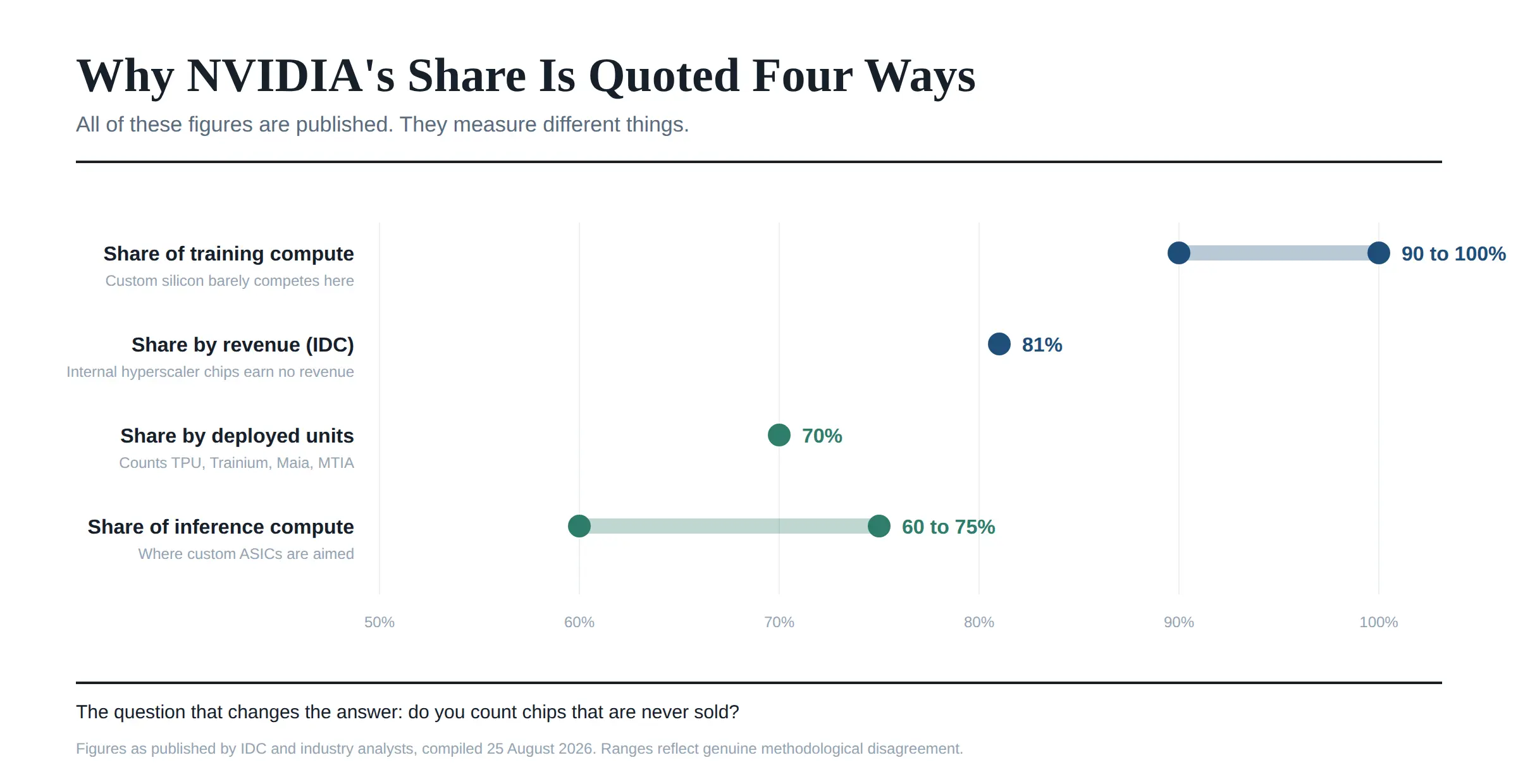 You will see NVIDIA's share quoted as 70 percent, 75 percent, 80 percent, 81 percent and above 90 percent, sometimes in articles published the same week. They are not all wrong.
The gap comes down to one question: do you count chips that are never sold? One methodology note applies to every table of this kind, and this is it.
Google's TPUs, Amazon's Trainium and Microsoft's Maia generate no external revenue. Count them by revenue and they barely register, which pushes NVIDIA above 80 percent. Count them by units or deployed compute and NVIDIA falls toward 70.
Training and inference split too. One estimate puts NVIDIA above 90 percent of training but between 60 and 75 percent of inference, which is exactly where custom silicon is aimed.
Market size estimates vary just as widely. We found the 2026 AI accelerator market put at 79.1 billion dollars by one source and above 200 billion by another. Neither published enough methodology for us to reconcile them.
Hyperscaler capital expenditure for 2026 is quoted at roughly 745 billion dollars in one place and 660 to 690 billion in another, depending on who is counted.
Treat any single figure in this sector as an estimate with a wide error bar. Distrust anyone quoting it to one decimal place.
What We Could Not Verify
Three things, stated plainly.
The Qualcomm and Tenstorrent acquisition talks are reported but unconfirmed, as is a follow-on funding round at a 3.2 billion dollar valuation. Both are labelled as reported above.
Cross vendor performance claims are almost all vendor supplied and use different numeric formats. Microsoft comparing Maia 200 FP4 throughput against Trainium3 is a company comparing its own chip on a metric it chose.
One name in circulation does not belong on these lists at all. C-Motive Technologies appears in some AI chip keyword sets, but it makes electrostatic motors, not semiconductors. If you have seen it listed as an AI chip maker, that is an error propagating between articles.
Frequently Asked Questions
Who makes AI chips?
NVIDIA, AMD and Intel design and sell them openly. Google, Amazon, Microsoft and Meta design their own, mostly with Broadcom. TSMC manufactures for nearly all of them.
Who are the biggest AI chip makers?
NVIDIA by a wide margin, then Broadcom by custom silicon revenue, then AMD. Google is arguably second by deployed compute but sells almost none of it externally.
Who manufactures AI chips?
TSMC makes the overwhelming majority. Samsung and Intel Foundry handle smaller volumes. Designers and manufacturers are mostly different companies.
Who makes AI chips besides NVIDIA?
AMD and Intel sell merchant accelerators. Google, Amazon, Microsoft and Meta build their own. Broadcom co-designs many of those. Independents include Cerebras, Tenstorrent, SambaNova, d-Matrix and Etched.
What companies compete with NVIDIA in AI chips?
AMD is the direct merchant competitor. The larger structural threat is custom hyperscaler silicon, growing roughly three times faster than merchant GPUs.
What is the difference between an AI chip and a GPU?
A GPU is one kind of AI chip. Others include TPUs, NPUs and ASICs. GPUs are the most flexible and the most widely used.
What is an AI accelerator?
Any chip built to speed up AI mathematics, principally matrix multiplication, faster than a general purpose CPU can.
Why is demand for AI chips increasing?
Inference, not training. Running models in production is now roughly two thirds of AI compute spending, and it grows with every user rather than with every new model.
Which company makes the best AI chips?
NVIDIA for flexibility and software maturity. Google's TPU for large scale inference on its own infrastructure. There is no single best, which is why the market split into merchant and custom lanes.
What to Watch
Three things will decide the next two years.
Whether custom silicon actually displaces merchant GPUs or merely absorbs growth. Announcing a chip is easy. Getting it into production with a working software stack is what separates Google from everyone else.
Whether packaging and memory capacity catches up with demand. Until it does, allocation rather than architecture decides who ships.
And whether NVIDIA's software moat holds. Every challenger has a hardware story. Almost none have an answer to fifteen years of accumulated CUDA habit.
If your question is less about who makes the chips and more about which model to build on, that is the problem AI Windes solves directly, comparing 316 models on price, context and benchmark evidence. Our guide to the best Claude model covers one family in depth.
Every figure above is sourced at the point it is claimed. Compiled 25 August 2026.