Class Companion Review 2026: Free for Teachers, Quote Only for Schools
If you teach, sign up. It costs nothing, it has cost nothing since October 2023, and the free tier is the real product rather than a trial that quietly converts.
If you buy software for a school, you have a harder afternoon ahead. Class Companion does not publish a price for its paid plan anywhere.
That gap between the two experiences is the whole story of this tool. Most reviews skip it.
What It Does
A teacher uploads an assignment or generates one, attaches a rubric, and invites a class.
Students write. The platform scores each response against that rubric, says what was good, points at what was thin, and lets the student go again.
An AI tutor called Ditto sits alongside and answers questions while they work.
That is the whole product. Not a lesson planner. Not a classroom management system. It will not write your reports.
What separates it from the pile of AI grading tools that appeared after 2023 is the retake.
Normal marking is a verdict that arrives Thursday about something written Monday. By then the student has forgotten their own reasoning and reads the comment as a complaint.
Class Companion collapses that gap to seconds. One assignment becomes a practice loop.
Teachers keep describing this as changing how they plan lessons, not how they grade. I think that is the honest framing. It is a pedagogy change wearing a grading tool's clothes.
Setting It Up
Four steps, and only one of them matters.
Add the assignment. Generate it from a prompt, upload what you already use, or pull from a public library the company puts at over 10,000 assignments and 500 rubrics. Short answer, essay, and multiple choice can share one assignment.
Set the rubric. This is the step that decides whether the tool is useful or infuriating.
The rubric is the instruction set. A vague rubric produces vague feedback, and no amount of clever AI rescues it.
Every teacher I have seen report good results spent real time here. Every complaint about generic feedback traces back to a rubric that could have described almost any essay.
Invite students. They get feedback within seconds and revise if you allowed multiple attempts.
Read the dashboard. Submissions, class performance, where people struggled, how they engaged with the feedback.
One feature buried in that last step is better than it sounds. Students can dispute a score, and you accept or overrule.
The teachers getting the most from this make the student argue their case in writing. A grading complaint quietly becomes another writing exercise. Small design decision, a lot of work done.
What You Get Without Paying
Most reviews note that a free plan exists and move on. Not useful when you are deciding.
Here is the itemised split from the company's own plan comparison, checked on 25 August 2026. Twelve of the twenty four features I tracked are free.
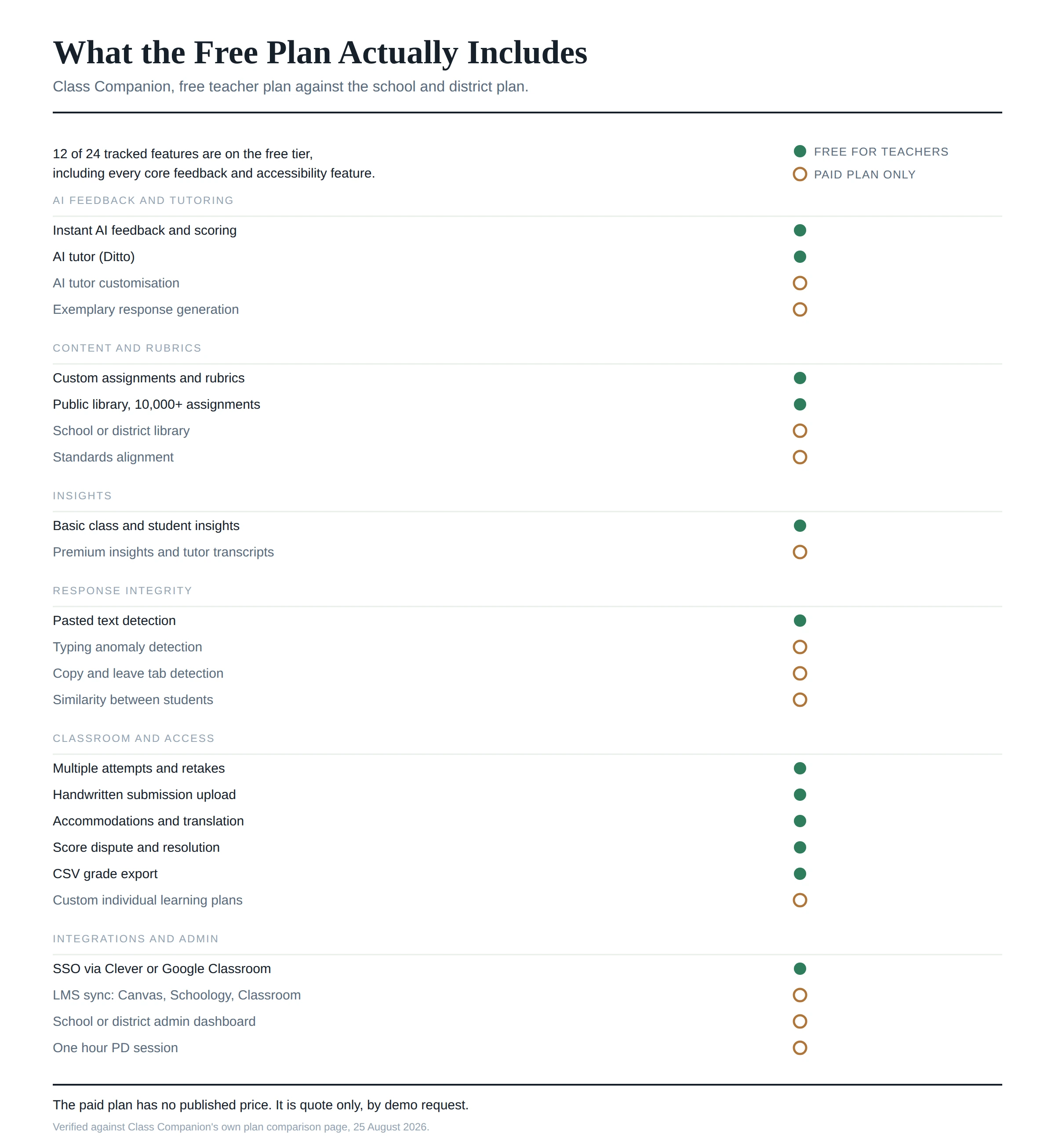 The free side is not thin. Instant AI feedback and scoring, the Ditto tutor, custom assignments and rubrics, the full public library, unlimited retakes.
Also handwritten uploads, where you photograph a paper response and it reads it. Accommodations including translation and adjustable reading levels. Basic insights, score disputes, CSV export, paste detection, single sign on through Clever or Google Classroom, and FERPA compliance.
Behind the paywall sit the things an administrator cares about more than a teacher does.
LMS integration with Canvas, Schoology, and Google Classroom, meaning roster sync and grade passback. Premium insights, including what students actually said to the tutor. Standards alignment. A private school library. The three cheating signals beyond paste detection. An admin dashboard, a PD session, and a district data privacy agreement.
There is also a third column in that table labelled Premium Trial. It appears nowhere in the plan cards above it, and nothing explains what it is or how you get one.
I have no idea what it covers. If you are evaluating seriously, ask.
The Price Problem
For a teacher, zero.
The company took a 4 million dollar seed round from Index Ventures at launch and lists OpenAI as a backer. The free tier is funded by investors rather than by you. That has held for nearly three years.
For a school, I cannot tell you.
The paid plan lists its features in careful detail, then puts a Book a demo button where the number should be. I checked the plans page, the schools and districts page, and the homepage. Nothing.
Several third party review sites call it freemium with paid subscriptions for larger cohorts. Not one of them publishes a figure either, and I could not find one anywhere public.
This is normal for district education software. It is still a disadvantage.
If you are comparing three tools and two publish rate cards, Class Companion costs you a procurement call before you can even shortlist it. Budget for that.
What the Evidence Actually Shows
Here is where I want to be careful, because the numbers everyone repeats are the company's own.
Class Companion says it supports over 25,000 schools across America. It reports a 16 percent increase in test scores and a doubling of formative assessment.
In student surveys it cites, 95 percent said confidence increased, 96 percent said learning increased, 88 percent said grades went up.
There is a wrinkle in those figures I did not expect to find.
The homepage puts average time saved at 12 hours a week. The plans page puts it at 30 percent of time saved per week.
Those two numbers are hard to reconcile. Neither page explains how it was measured. They sit two clicks apart on the same site. Treat both as directional.
What I could verify independently: the seed round, the Index Ventures and OpenAI backing, the October 2023 launch, and the Forbes coverage of it.
What I could not find, and I did look, is any independent study measuring learning outcomes from this platform. Every site quoting the 16 percent figure traces back to the company.
That does not mean it fails to work. Individual teacher accounts are specific and consistent enough to take seriously, and one AP teacher describing a jump from a third of a class passing to three quarters is not the kind of thing you invent.
But teacher testimony and a controlled study are different objects. A procurement case built on the first while implying the second will not survive a sceptical finance director.
Can It Tell If a Student Used AI
Teachers ask this more than anything else, and most reviews answer it sloppily.
It does not claim to detect AI generated text.
What it detects is behaviour around the answer box. Text pasted in. Typing anomalies. How often a student copies the question and leaves the tab. How closely one response resembles others in the class.
Those are not the same thing.
Paste detection catches a student who generated an answer elsewhere and pasted it. It does nothing about a student who reads the AI answer on their phone and retypes it by hand.
Which is what students do, roughly ten minutes after they learn paste detection exists.
Only paste detection is free. The other three signals are school and district only.
The company's own line is that teachers should evaluate student work individually and use the platform for support rather than as a verdict.
I would rather see that than competitors selling AI detection as solved when the false positive rates are what they are. An accusation based on a typing anomaly is a bad afternoon for everyone in it.
Privacy
Unusually clean, if you have to get this past an IT director.
FERPA, COPPA, and state privacy law compliance. Student Privacy Pledge signatory. TrustEd Apps certified. It states plainly that it does not market, sell, or rent personal information, or use the data for advertising.
It publishes a downloadable privacy packet with the agreement inside, so a teacher can forward it to a district without going through sales. A small thing that tells you they have done this before.
It also publishes a subprocessor list. Most edtech companies this size do not, and it is usually the first thing a serious district audit asks for.
Who This Is For
If you teach English, history, social studies, or a world language, and the bottleneck in your week is that proper feedback takes longer than you have, this solves that exact problem for free.
Same if you run AP or standardised test prep. Repeated practice against a rubric is close to the ideal use case.
Teachers with multilingual learners or students on accommodations should look harder than most. Translation, text to speech, and adjustable reading levels are all free here. That is not true of the competition.
If your assessments are mostly multiple choice or numerical, do not bother. The value lives entirely in written response, and a simpler quiz tool will do the job with less setup.
And if you are buying at district level mainly for the cheating detection, think twice, then think again.
Those signals are behavioural, not proof. Decide what you will do with a flag before you deploy it, rather than during the first argument with a parent.
Alternatives Worth a Look
Depends what you actually wanted.
Gradescope is the established option for university scale grading, and handles handwritten mathematics and code far better.
MagicSchool AI covers much more ground as a general AI teaching assistant, planning lessons and generating materials, with correspondingly less depth on writing feedback.
Turnitin is a different category, and the right answer if integrity rather than feedback is the actual goal.
None of the three give you unlimited rubric aligned feedback with retakes at no cost to the teacher. That remains the thing Class Companion is genuinely good at.
Frequently Asked Questions
What is Class Companion?
An AI platform giving students instant, rubric aligned feedback on written work while giving teachers back grading time. English, science, social studies, and world languages, from kindergarten through higher education.
Is Class Companion free?
Yes, for individual teachers and their students, since October 2023. Schools pay for LMS integration, premium insights, and the additional integrity signals.
How much does Class Companion cost for schools?
No published price. The plan lists features but requires a demo booking for a quote. I found no figure anywhere public as of 25 August 2026.
How does Class Companion grade assignments?
Against a rubric you supply. It scores the response, explains the score, and flags strengths and gaps. You control what it rewards and how many attempts students get.
Can Class Companion grade essays?
Yes, and essays are where it is strongest.
Can it detect if a student used AI?
Not directly. Paste detection is on every plan. Typing anomalies, tab switching, and cross student similarity are paid only. All behavioural signals, not proof.
Is Class Companion safe and legitimate?
Yes. FERPA and COPPA compliant, Student Privacy Pledge signatory, TrustEd Apps certified. It states it does not sell user data. It raised 4 million dollars from Index Ventures and lists OpenAI as a backer.
Is Class Companion good for students?
The design rewards revision over a single graded attempt, which is sound teaching. Student reported outcomes are strong but come from company surveys, not independent research.
What are the best Class Companion alternatives?
Gradescope for technical and higher education grading, MagicSchool AI for broader teaching assistance, Turnitin if integrity is the real goal.
Verdict
Class Companion is one of the few AI tools in education where the free tier is the product rather than bait.
Sign up this morning, run a real assignment this week, never pay. Against an industry that usually wants a purchase order before it shows you a screenshot, that counts for something.
My reservations are about evidence and procurement, not the software.
Every outcome statistic traces back to the company. The vendor's own time saved figures disagree across two pages of its own site. No district can compare it on cost without a call.
So the advice splits.
If you teach, ignore all of that and try it. Being wrong costs you ten minutes.
If you buy for a district, run it in one department first. Treat the published statistics as a hypothesis you are testing, not a result you are purchasing.
If your real question is which underlying model to build your own feedback workflow on, that is a different problem. AI Windes answers it directly across 316 models on price, context, and benchmark evidence.
Features, plan contents, and compliance claims here were checked against Class Companion's plans page and data privacy page on 25 August 2026.