DeepSeek vs ChatGPT vs Gemini: The 2026 Comparison That Shows You the Real Bill
ChatGPT is the strongest at the top end and the safest default. Gemini is the best value across almost every tier, and the only one whose cheapest model still carries a full million token context window. DeepSeek is the cheapest at the flagship level and the only one you can download and run yourself, but its hosted service stores your data in China and its prices now change depending on the hour.
The important part is what those sentences hide. Below, we ran two real workloads through all three and printed the actual monthly bills. On one of them, the result was the opposite of what almost every comparison article will tell you.
Why Most of These Comparisons Are Wrong Right Now
Nearly every article on this topic says the same thing: DeepSeek is about ten percent of the price of the others. That was true. It is not any more.
Here is what happened in the eight weeks before we published this.
DeepSeek raised its API prices roughly fourfold in mid August 2026 and introduced peak and off peak billing, so the same request now costs a different amount depending on when it runs. OpenAI cut one model by 80 percent, another by 20 percent, then cut its flagship as well. Google shipped two new Flash models and put both on introductory rates that expire at the end of 2026.
Three vendors, five price changes, two months.
How we checked this: every rate, context window, and output limit below was verified on 24 August 2026 against OpenAI's API pricing page, Google's Gemini API documentation, and DeepSeek's API pricing docs. We did not take a single figure from another article. If you are reading this months later, the shape of the argument will hold but the numbers will not.
The Lineup as It Stands
Names change fast here, so this is who is actually on the field.
ChatGPT runs OpenAI's GPT-5.6 family, released July 2026. Sol is the flagship, Terra is the everyday model, Luna is the cheap one. All three share roughly a million tokens of context and 128,000 tokens of output.
Gemini is Google's family. Gemini 3.1 Pro is the flagship. Gemini 3.7 Flash, released 13 August 2026, is the new workhorse. Flash-Lite tiers sit underneath. Every Gemini model carries a million token context window, including the cheapest one.
DeepSeek runs V4. V4-Pro reached general availability on 13 August 2026, V4-Flash on 31 July. Both carry a million tokens of context and, unusually, up to 384,000 tokens of output. The weights are published under an MIT licence.
If you are reading a comparison that still names GPT-5.2, Gemini 3.0, or DeepSeek V3, it is describing a market that no longer exists.
What Each One Charges
Rates per million tokens, input then output, verified 24 August 2026.
Tier | DeepSeek | ChatGPT | Gemini |
|---|---|---|---|
Flagship | V4-Pro: 0.66 / 1.98 off peak, 1.32 / 3.96 peak | Sol: 4.00 / 20.00 | 3.1 Pro: 2.00 / 12.00 |
Mid | Not offered | Terra: 2.00 / 12.00 | 3.7 Flash: 0.75 / 3.75 |
Budget | V4-Flash: 0.22 / 0.66 off peak | Luna: 0.20 / 1.20 | 2.5 Flash-Lite: 0.10 / 0.40 |
Two footnotes matter more than the table itself.
OpenAI describes Sol's current rate as promotional, held at least into late November 2026, and its launch rate was higher. Google's Flash rates are introductory and rise on 1 January 2027. DeepSeek's peak windows are defined in UTC, which means a job scheduled by an engineer in one timezone can cost double what the same job costs a colleague in another.
The Part Nobody Shows You (Two Real Bills)
Rate cards are not bills. Here is the same work priced across all three.
Workload one: high volume, simple
A classifier or summariser handling 100,000 requests a month, roughly 2,000 input tokens and 300 output tokens each. That works out to 200 million input and 30 million output tokens.
Model | Monthly cost, USD |
|---|---|
Gemini 2.5 Flash-Lite | 32.00 |
DeepSeek V4-Flash, off peak | 63.80 |
GPT-5.6 Luna | 76.00 |
DeepSeek V4-Flash, peak | 127.60 |
Gemini 3.7 Flash | 262.50 |
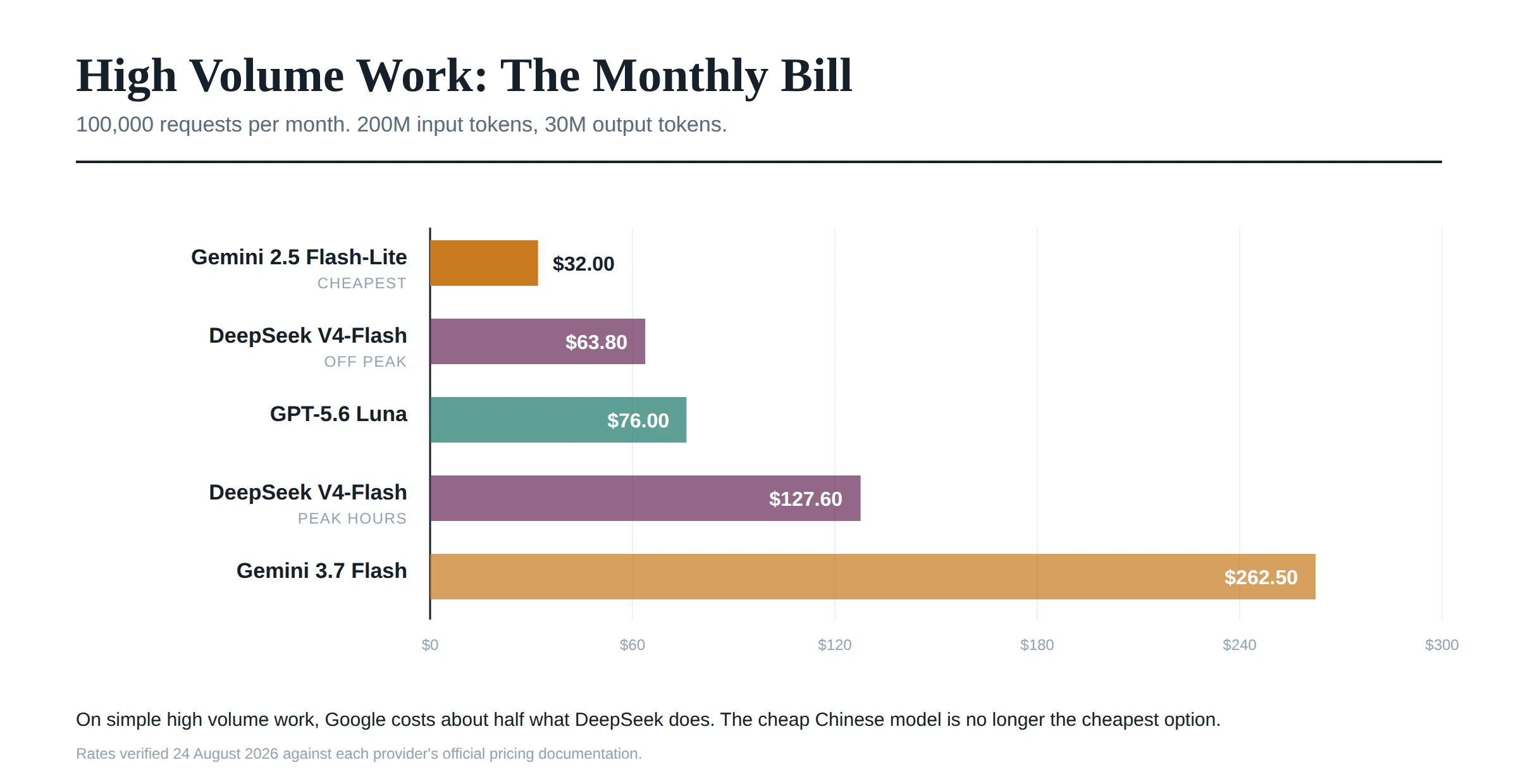 Read that top line again. On high volume, low complexity work, Google costs roughly half what DeepSeek does. The cheapest option in this comparison is not the Chinese one.
That contradicts the received wisdom on this topic completely, and it is a direct result of DeepSeek's August price rise. If your job happens to run during DeepSeek's peak hours, the gap widens to four times.
Workload two: long documents
500 requests a month, 300,000 input tokens and 5,000 output tokens each. That is 150 million input and 2.5 million output tokens.
Model | Monthly cost, USD |
|---|---|
DeepSeek V4-Pro, off peak | 103.95 |
DeepSeek V4-Pro, peak | 207.90 |
Gemini 3.1 Pro | 645.00 |
GPT-5.6 Sol | 1,275.00 |
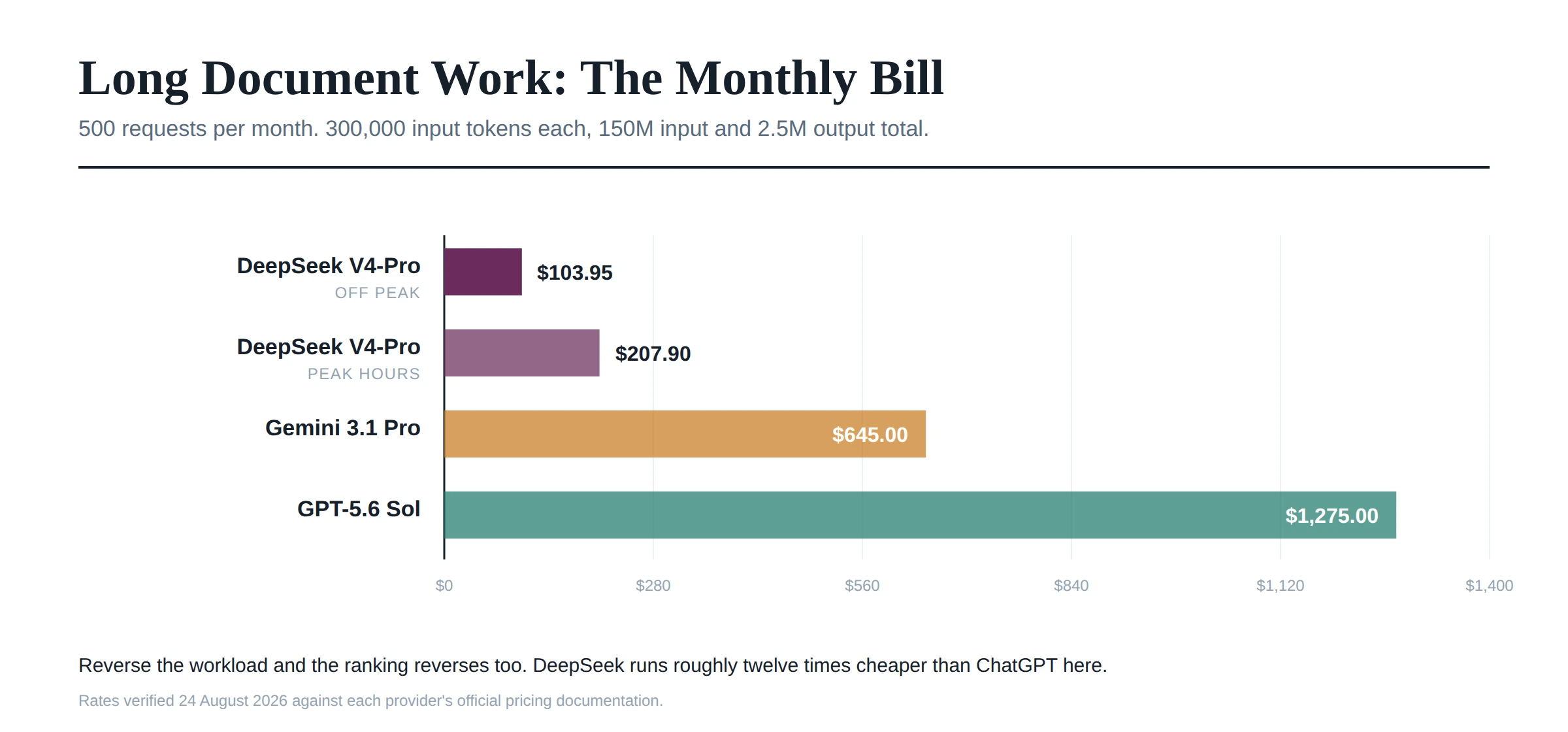 Here DeepSeek wins by a mile, and the reason is a pricing rule that almost nobody writes about.
The Hidden Price Cliff
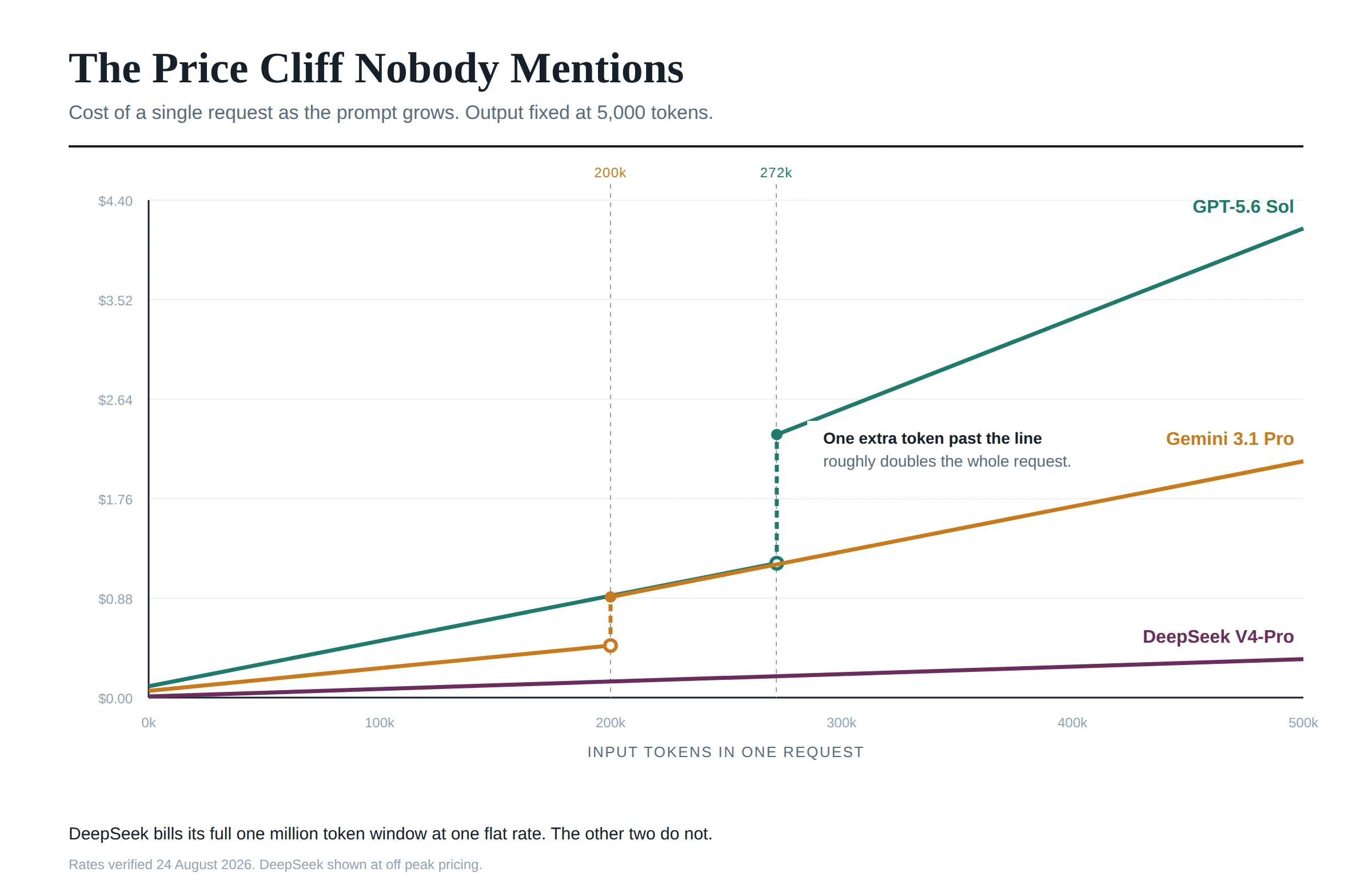 Both OpenAI and Google charge a higher rate per token once a single request crosses a size threshold. OpenAI's higher meter starts above roughly 272,000 input tokens. Google's starts above 200,000.
The workload above sends 300,000 tokens per request. It crosses both.
Had those same requests come in just under the line, ChatGPT would have cost around 650 dollars instead of 1,275, and Gemini around 330 instead of 645. Crossing an invisible threshold roughly doubled both bills.
DeepSeek does not do this. Its full million token window bills at the standard rate.
This is the most useful thing in this article. If your prompts sit anywhere near 200,000 or 272,000 tokens, trimming duplicate retrieval chunks or stale conversation history to stay under the line is worth more money than switching vendors.
Five Things That Actually Differ
Price aside, these are the real distinctions.
Context window. All three reach roughly a million tokens. The difference is that Gemini offers it on every tier, down to the cheapest model. On the other two, the big window sits mostly at the expensive end.
Output ceiling. DeepSeek allows 384,000 tokens of output. ChatGPT allows 128,000. Gemini allows around 65,000. If your job is generating something enormous in one pass, such as a full translation or a bulk transformation, DeepSeek is the only one of the three that can do it without chunking.
Multimodal input. Gemini takes text, images, video, audio, and PDFs. ChatGPT covers images, audio, and video across its wider product range. DeepSeek is text only, with vision still marked experimental.
Open weights. DeepSeek publishes its model weights under an MIT licence. ChatGPT and Gemini do not. You can run DeepSeek on your own hardware. You cannot do that with the other two at any price.
Where the data lives. DeepSeek's privacy policy, last updated February 2026, states that it collects, processes, and stores personal data in the People's Republic of China. OpenAI and Google are US based, with the legal protections that implies.
Which Wins Each Job
Coding. ChatGPT at the top. GPT-5.6 Sol scores 61 at maximum effort on the independent Artificial Analysis Intelligence Index against 53 for DeepSeek V4-Pro. That is the cleanest cross vendor comparison available, because both were run on the same third party harness. Vendor run benchmarks put them closer, but we would weight the independent one. For everyday coding, Gemini 3.7 Flash gives you most of the quality at a fraction of the price.
Writing. ChatGPT produces the most polished first draft and needs the least editing. Gemini is stronger when the writing depends on source material you supply. DeepSeek is competent and verbose, and independent measurement flags it as generating more tokens than average for the same task, which costs you twice: once in editing, once on the bill.
Research and long documents. Gemini on capability, DeepSeek on cost, as the second table shows. This is the one category where the right answer genuinely depends on your budget rather than your preference.
Anything multimodal. Gemini, without argument. DeepSeek is not in this race.
Regulated or client data. ChatGPT or Gemini for hosted use. Self hosted DeepSeek if you have the engineering capacity, since data that never leaves your building beats any policy promise.
On DeepSeek and Data
I want to be direct here, because this is where most coverage goes either soft or shrill.
DeepSeek's position is published in its own privacy policy: personal data is collected, processed, and stored in China. Under Chinese law, organisations can be required to support state intelligence work. That is a structural difference from OpenAI and Google, where a data request generally needs a court order. It is why regulators in Italy and the Netherlands opened proceedings and why several governments blocked the app on official devices.
This is not a claim that anyone is reading your messages. It is that the legal protections you would expect are absent.
The nuance that matters: all of this applies to the hosted app, website, and API. Because the weights are MIT licensed, you can run V4 on your own hardware or a Western cloud, and your prompts never reach DeepSeek at all. That is a real engineering project rather than a checkbox, but it removes the concern entirely, which is why serious teams treat hosted DeepSeek and self hosted DeepSeek as two different products.
Where Claude Fits
Worth naming, since it is the obvious omission from any three way comparison.
Anthropic's Claude sits alongside these three and competes hardest on careful reasoning and agentic coding. Claude Opus 5 runs 5 dollars in and 25 dollars out per million tokens, which places it above Gemini's flagship and near ChatGPT's. If reliability on high stakes work matters more to you than price, it belongs on the shortlist, and we have covered its lineup separately.
Four Traps That Cost People Money
Comparing flagships only. Most work does not need one. The budget tiers from all three now beat last year's frontier models.
Ignoring output rates. Output costs several times input on every platform here, six times on ChatGPT. Long answers, not long prompts, are usually what inflate a bill.
Missing the context cliff. Covered above. It is the most expensive rule in this article and the least documented.
Assuming today's prices hold. Five changes in two months. Whatever you budget on, put a review in the calendar.
Route, Do Not Choose
The framing of this whole question is slightly wrong.
Nobody serious picks one vendor and sends everything to it. They route: cheap models for classification and extraction, mid tier for production traffic, flagship only where the task genuinely fights back. Teams that do this routinely cut spend by more than half with no drop in output quality.
If you take one action from this article, it should not be switching vendors. It should be checking what your simplest, highest volume job is currently running on. That is where the money is.
What We Could Not Verify
Four honest gaps.
ChatGPT's flagship rate is temporary. OpenAI's page describes 4 and 20 dollars as promotional through at least 21 November 2026. Plenty of published writing still quotes the older, higher launch rate. We used the live figure, but it is explicitly not permanent.
DeepSeek has no single price. Peak and off peak differ by a factor of two, and the windows are set in UTC. Every DeepSeek figure here is off peak and labelled as such. Your real cost depends on your schedule.
One source contradicts DeepSeek's own policy. During research we found a site claiming DeepSeek stores data in the United States, Singapore, and Germany. That contradicts the company's published privacy policy. We went with the primary source and disregarded the claim, but we are naming the conflict rather than quietly resolving it.
Some benchmarks are vendor run. DeepSeek and OpenAI each published their own Terminal-Bench figures under their own conditions. We leaned on the independent index instead and said so, but treat any small gap between vendor reported numbers as noise.
Frequently Asked Questions
What is better, DeepSeek, ChatGPT, or Gemini?
ChatGPT is the best overall and the strongest at the top of coding and reasoning. Gemini is the best value and the best for multimodal and long context work. DeepSeek is cheapest at the flagship tier and the only one with open weights.
Which is cheapest, DeepSeek, ChatGPT, or Gemini?
It depends on the workload, which is the whole point of this article. On high volume simple tasks, Gemini's Flash-Lite tier came out cheapest in our worked example, roughly half of DeepSeek. On large document work, DeepSeek came out around six times cheaper than ChatGPT.
Is DeepSeek still ten times cheaper than everyone else?
No. That was true before August 2026. DeepSeek raised prices roughly fourfold and added peak billing while OpenAI and Google cut theirs. It is still cheap. It is no longer in a category of its own.
Which AI is best for coding?
ChatGPT for the hardest work, on the independent intelligence index. Gemini 3.7 Flash for excellent results at low cost. DeepSeek when cost per completed task is the number you are optimising.
Which AI has the longest context window?
All three reach roughly a million tokens. Gemini offers it on every tier including the cheapest, which is the practical difference. DeepSeek allows the largest output at 384,000 tokens.
Which AI is best for students?
Gemini. The free tier is capable and the cheapest paid step is the lowest of the three.
Which AI is best for business?
ChatGPT or Gemini. Both are US based with normal enterprise agreements. We would not put regulated data into hosted DeepSeek.
Is DeepSeek safe to use?
For casual, non sensitive questions the risk is low. For work data, client data, or anything regulated, the hosted version is not appropriate, because data is stored in China under laws that can compel disclosure. Self hosting the open weights avoids this completely.
Do all three have a free plan?
Yes. ChatGPT's free tier runs its mid tier model. Gemini's free tier runs a current Flash model. DeepSeek's web chat is free, though there is no permanent free API tier.
Which one should I actually pay for?
If you want one subscription and no thinking, ChatGPT. If you work with documents, images, or video, or you want frontier quality for less, Gemini. If you are paying API bills at volume, do the arithmetic above with your own numbers before deciding anything.
The Verdict
ChatGPT is the best assistant of the three. Gemini is the better buy. DeepSeek is the cheapest engine, with a compliance question attached that you answer either by self hosting or by not sending it anything sensitive.
But the honest conclusion is that the capability gap between these three has narrowed to the point where it is no longer the interesting variable. Price structure is. Two of the three will quietly double your bill when a request crosses a size threshold you cannot see. One changes its rate depending on the hour. And the cheapest option on paper turned out to be the more expensive choice on one of our two test workloads.
Work out what your actual jobs look like, price them, and route accordingly. That will save you more than picking a winner ever could.
For current rates, the companies publish their own numbers: OpenAI's API pricing page and DeepSeek's pricing documentation. Google publishes Gemini rates in its Gemini API documentation. Every figure here came from those three sources on 24 August 2026.