Grok vs Gemini vs ChatGPT: 6 Head-to-Head Rounds and the Costs Nobody Mentions (2026)
ChatGPT wins on breadth and is still the safest single subscription. Gemini wins on value, long documents and anything involving images, video or audio, and its free tier is the strongest of the three. Grok wins on live information from X and on cost per token at the API level, and it is the weakest choice if you want a general assistant.
At 20 dollars a month, the real decision for most people is ChatGPT Plus against Google AI Pro. Grok's equivalent tier costs 30 dollars and is aimed at a narrower user.
Below are six rounds, the actual plan prices, and one cost that applies to all three that no other comparison on this topic mentions.
Why This Comparison Changed in 2026
For two years this question had an obvious answer. It does not any more.
Reported United States mobile app share tells the story. ChatGPT went from roughly 69 percent in January 2025 to about 45 percent a year later. Gemini climbed from under 15 percent to 25 percent. Grok went from under 2 percent to 15 percent.
Losing a third of your share in twelve months is not a rounding error. Whatever you concluded about these three in 2024 is now out of date.
How we checked this: every price below was verified on 26 August 2026 against OpenAI, Google and xAI published rates. This is the fastest moving pricing category we cover, and several competing articles ranking for this term still quote model names that were retired months ago.
The Current Lineup
Names moved a lot this year, so here is who is actually on the field.
ChatGPT runs OpenAI's GPT-5.6 family. Sol is the flagship, Terra the mid tier, Luna the fast cheap one. Luna became the free default in August 2026.
Gemini runs Gemini 3.1 Pro as the flagship and Gemini 3.7 Flash, released 13 August 2026, as the workhorse. Every Gemini model carries a one million token context window.
Grok runs Grok 4.6 as flagship, with Grok 4.3 and the Grok 4.20 variants a tier below and Grok Build for coding. xAI retired Grok 3 and Grok 4 in May 2026.
If you are reading a comparison that names GPT-5.5, Gemini 3.0 or Grok 4, it is describing a market that no longer exists.
Round 1: The Free Plans
All three have a real free tier, not a trial, and they are not equivalent.
ChatGPT free runs GPT-5.6 Luna with unlimited text chats since August 2026. Files, images and voice stay capped. That unlimited text allowance is genuinely generous and new.
Gemini free runs Gemini 3.6 Flash with a one million token context window. That window is the differentiator, because it means the free tier can read very long documents that the other two cannot.
Grok free is available through grok.com and X with tighter limits, and it includes live X search, which neither competitor offers at any price.
Winner: Gemini, narrowly, on the strength of the context window. ChatGPT is a close second and wins if you mostly want conversation rather than document work.
Round 2: The 20 Dollar Tier
This is where most people actually decide, and the two main options are within a cent of each other.
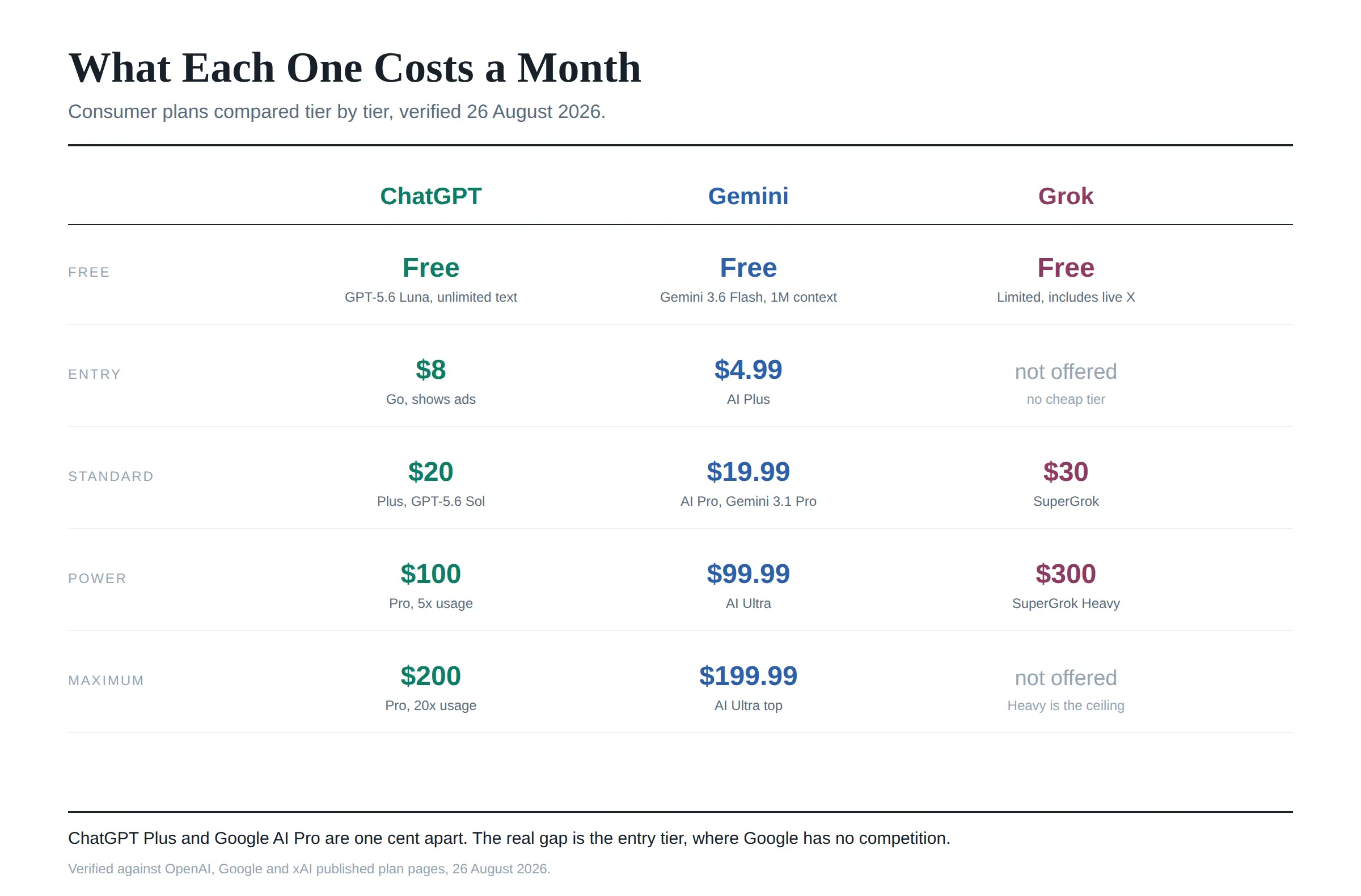 ChatGPT Plus is 20 dollars a month and unlocks GPT-5.6 Sol. Google AI Pro is 19.99 and unlocks Gemini 3.1 Pro.
Below that, Google undercuts sharply. Google AI Plus is 4.99 a month against ChatGPT Go at 8 dollars, and Go still shows advertisements despite being paid.
Above it the ladders differ. ChatGPT Pro splits into 100 dollars for five times Plus usage and 200 for twenty times. Google AI Ultra starts at 99.99 and runs to about 199.99.
Grok sits outside this pattern. SuperGrok is 30 dollars a month and SuperGrok Heavy is 300, with no cheap middle tier.
Winner: Gemini, on price laddering. It is the only one of the three with a capable sub-five-dollar option.
Round 3: Coding
Grok made a real move here and it deserves credit.
Grok 4.6 and Grok Build were developed using real coding session data from Cursor, the editor xAI is folding in. On agentic coding benchmarks the family scores well relative to its general reasoning score, which suggests xAI optimised for doing the work rather than winning the leaderboard.
ChatGPT still leads at the top on general reasoning, and its Codex agent is the more mature product with the wider integration surface.
Gemini is the value pick. Gemini 3.7 Flash delivers strong agentic coding results at a fraction of the flagship price.
Winner: ChatGPT for the hardest work, Grok for agentic coding on a budget, Gemini if cost per task is what you optimise.
Round 4: Research and Long Documents
Not close.
Gemini carries a one million token context window on every tier including the free one. Grok's flagship carries 500,000, though its cheaper Grok 4.3 and 4.20 models carry a full million. ChatGPT sits around a million on its API models.
The practical difference is where the big window lives. On Gemini it is available at every price point. On the other two it mostly sits at the expensive end, or on Grok's case, oddly, on the cheaper models rather than the flagship.
Gemini also handles more input types than either competitor: text, images, video, audio and PDFs.
Winner: Gemini, comfortably.
Round 5: Live Information
This is Grok's home turf and the one round it wins outright.
Grok reads live data from X. For monitoring breaking news, tracking sentiment on a story, or anything where the last two hours matter more than the last two years, nothing else in this comparison competes.
ChatGPT and Gemini both search the web well. Neither has native access to a live social feed.
There is a cost attached that we cover below, and it is the thing every other article on this topic misses.
Winner: Grok, with no serious argument.
Round 6: Images and Multimodal
Gemini takes text, images, video, audio and PDFs as input, which is the widest range of the three.
ChatGPT covers image generation, voice and video across its wider product family, and its image generation remains the most consistent at following complicated prompts.
Grok Imagine handles images and video and has the loosest content restrictions of the three, which some users want and many organisations specifically do not.
Winner: Gemini on input variety, ChatGPT on generation quality.
The Cost Nobody Mentions
Here is what no other comparison on this keyword tells you.
All three providers charge a higher API rate once a single request crosses a size threshold, and all three roughly double.
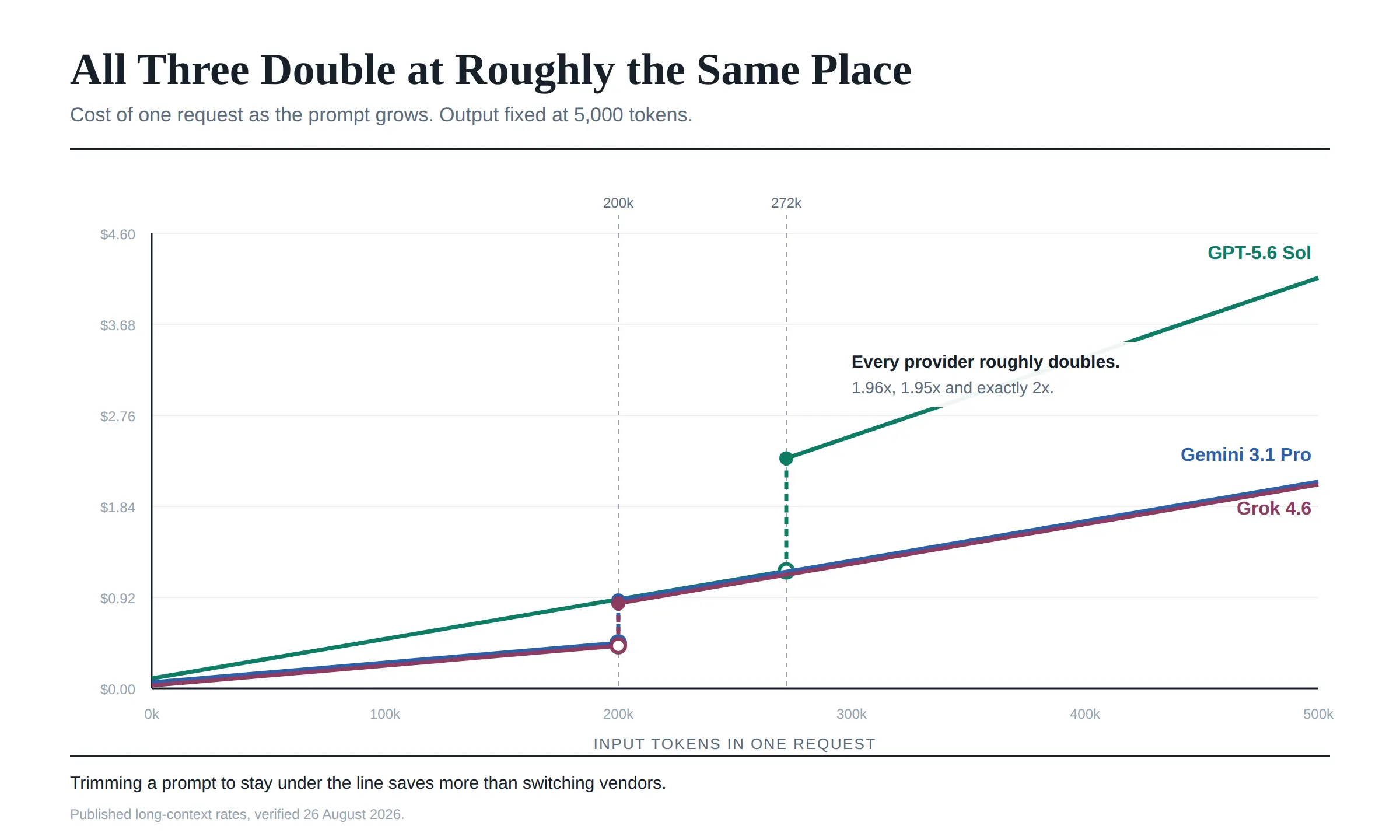 OpenAI's higher meter starts above about 272,000 input tokens. Google's starts above 200,000. xAI's starts at 200,000.
Price a single request with 300,000 tokens of input and 5,000 of output and the effect is stark. On GPT-5.6 Sol it costs 2.55 dollars instead of the 1.30 you would calculate from the headline rate. On Gemini 3.1 Pro, 1.29 instead of 0.66. On Grok 4.6, 1.26 instead of 0.63.
That is 1.96 times, 1.95 times and exactly 2 times respectively.
If you are feeding these models long documents, a chat history that keeps growing, or a large retrieval context, you are probably paying roughly double what your spreadsheet says. Trimming a prompt to stay under the line is worth more than switching vendors.
We priced this out in more detail in our DeepSeek vs ChatGPT vs Gemini comparison, where the same rule doubled a monthly bill.
Grok's Second Hidden Cost
There is a second one specific to Grok, and it undercuts the round it won.
xAI bills server-side tools separately from tokens. Web search and X search run 5 dollars per thousand calls. Code execution is the same. File attachments are 10 dollars per thousand, and collections search 2.50.
So the live X access that makes Grok worth using is metered on top of the token price. An agent making one search per request costs half a cent per call before it has generated a single token.
For a chat subscriber this is invisible and irrelevant. For anyone building on the API, it changes the arithmetic of Grok's cheap token rates considerably.
Worth knowing too: xAI offers a 20 percent batch discount, but not on its flagship. Cached input is the bigger lever, at 0.50 dollars per million on Grok 4.6 against a 2 dollar standard rate.
If You Are Paying by the Token
Consumer plans are one bill. Developers pay a completely separate one, and the ranking changes.
Per million tokens, input then output, as published on 26 August 2026: GPT-5.6 Sol runs 4 and 20 dollars, Terra 2 and 12, Luna 0.20 and 1.20. Gemini 3.1 Pro is 2 and 12, Gemini 3.7 Flash 0.75 and 3.75. Grok 4.6 is 2 and 6, Grok 4.3 is 1.25 and 2.50.
Take a moderate month of 20 million input and 3 million output tokens. GPT-5.6 Sol costs 140 dollars. Grok 4.6 costs 58. Gemini 3.1 Pro costs 76. Grok 4.3 costs 32.50, and Gemini 3.7 Flash costs 26.25.
Two footnotes matter. OpenAI describes Sol's rate as promotional following an August 2026 cut. Google's Flash rates are introductory and double on 1 January 2027. You can verify current OpenAI rates on its API pricing page.
Winner on API cost: Grok, on flagship pricing. Gemini, once you drop to the workhorse tier.
The Scorecard
Six rounds, tallied.
Gemini takes four: free plans, price laddering, long documents and multimodal input. ChatGPT takes coding at the top end and image generation quality. Grok takes live information outright and shares the coding round on budget.
But a scorecard is a blunt instrument here, because these three are no longer competing for the same person.
ChatGPT is the generalist. Gemini is the value and document tool. Grok is a specialist that happens to also answer general questions.
What We Could Not Verify
Three honest gaps.
The app share figures are reported, not audited. The 69 to 45 percent shift is widely circulated but we could not trace it to a primary source we would stake a procurement decision on. Treat it as directional evidence of a trend rather than a precise measurement.
Google AI Plus has been quoted at two prices. Sources from May 2026 put it at 7.99 dollars following the I/O restructure, while August 2026 sources put it at 4.99. We used the more recent figure. Google's top Ultra tier is also quoted at both 199.99 and 249.99 depending on source and date.
Grok's plan access is staged. Reporting indicates newer Grok flagships roll out to consumer tiers in stages rather than all at once, so which model your SuperGrok subscription actually runs may lag the announcement. Check before you subscribe on the strength of a specific model.
Frequently Asked Questions
What is better, Grok, Gemini, or ChatGPT?
ChatGPT for breadth and general use. Gemini for value, long documents and multimodal work. Grok for live information from X and cheap API tokens.
Which AI is best in 2026?
For most people, Gemini or ChatGPT at the 20 dollar tier. They are within a cent of each other, so pick on whether you live in Google Workspace or not.
Is Grok better than ChatGPT?
Not as a general assistant. It is better at live social data and cheaper per token at the flagship level.
Is Gemini better than ChatGPT?
On value, free tier and document work, yes. On breadth of ecosystem and image generation, no.
Which AI is cheapest?
On subscriptions, Gemini, with a capable tier at 4.99 dollars. On API tokens, Grok at the flagship level and Gemini once you drop to Flash.
Which AI has the best free plan?
Gemini, because the free tier carries a one million token context window. ChatGPT's unlimited text chat on Luna is a close second.
Which AI has the longest context window?
Gemini, at one million tokens on every tier. Grok's cheaper models also reach a million, but its flagship is capped at 500,000.
Which AI is best for coding?
ChatGPT for the hardest problems. Grok 4.6 and Grok Build for agentic coding, since both were trained on real Cursor sessions. Gemini Flash for the best result per dollar.
Which AI has the best web search?
Grok, if live social data counts. It reads X directly, which neither competitor can do at any price.
Which AI is best for students?
Gemini. The free tier is the strongest and the first paid step is the cheapest.
Which AI is best for developers?
Depends on the workload. Grok has the cheapest flagship tokens, Gemini the cheapest workhorse, ChatGPT the most mature agent tooling. All three penalise long prompts, so measure before committing.
The Verdict
If you want one subscription and no further thought, ChatGPT Plus at 20 dollars is still the safe answer.
If you want the better deal, Google AI Pro costs a cent less, reads far longer documents, handles more file types, and has a 4.99 tier underneath it that neither competitor matches.
If you need to know what is happening on X right now, Grok is the only option, and nothing else in this comparison comes close.
The more useful conclusion is that the gap between these three has narrowed to the point where ecosystem matters more than capability. Pick the one that already sits inside the software you use.
And whichever you pick, check your prompt lengths. All three quietly double their rate at roughly the same place, and that will cost you more than choosing the wrong vendor ever will.
Prices and model details verified 26 August 2026 against OpenAI, Google and xAI published rates.