TwainGPT Review 2026: The Name Changed, and Two Different Sites Now Use It
TwainGPT is an AI humanizer, AI detector and writing generator. It rewrites text from ChatGPT, Claude or Gemini so it reads less like machine output and is less likely to be flagged by detection tools.
Two things you need to know before you search for it.
The product rebranded to Verva in August 2026. Same company, same team, same accounts and subscriptions. The twaingpt.com pages now redirect to verva.com.
And a separate website at twaingpt.ai uses the TwainGPT name, makes very different claims, and is not the product the reviews are about.
Almost nothing currently ranking for this search mentions either fact.
The Name Situation
Verva's own announcement is clear enough. The company says it founded TwainGPT in 2024, grew past 2.6 million users, and rebranded to give the platform a clearer identity. Existing accounts, subscriptions, saved documents, tools and plan limits carry over unchanged. You can read the rebrand announcement on Verva's blog.
The login page still shows a TwainGPT is now Verva banner, so the transition is recent and visible.
That matters for a practical reason. If you are reading a TwainGPT review from 2025, you are reading about a product that has since changed its name, and you have no easy way to tell whether the pricing and limits in that review still hold.
Two Sites, One Name
Here is the part that concerned me.
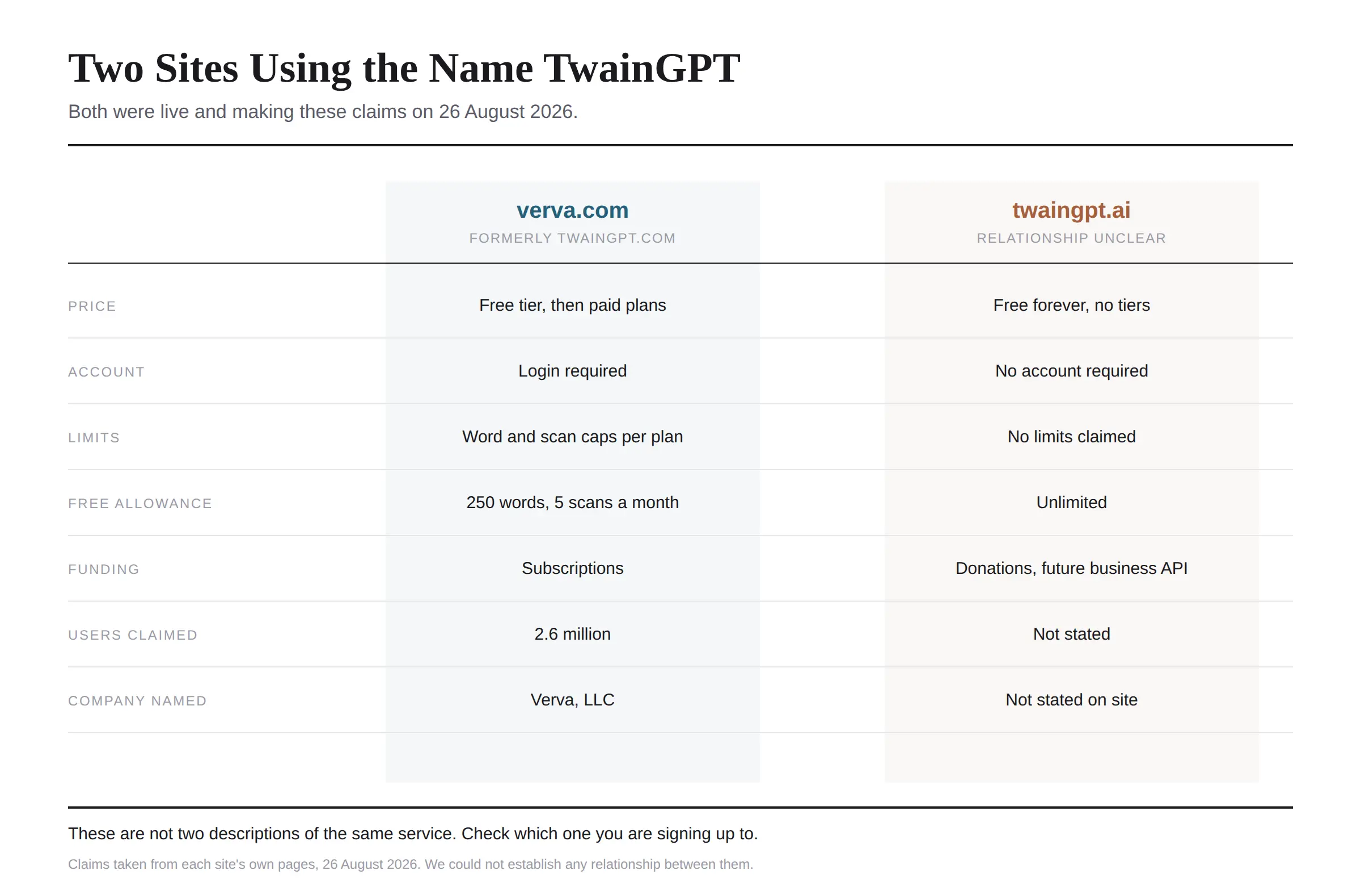 The rebranded product at verva.com is a paid platform with a limited free tier, tiered subscriptions and a login.
The site at twaingpt.ai advertises itself as one hundred percent free forever, with no account, no credit card, no word limits and unlimited humanizations. It says it is funded by donations and a future business API.
These are not descriptions of the same service.
I could not establish any relationship between them. What I can say is that twaingpt.ai carries a promotional banner announcing unlimited free access through April and May, which was still displayed when I checked on 26 August 2026. A stale banner is a small thing on its own. On a page whose entire argument is that the offer is permanent, it is worth noticing.
That site also publishes a table giving precise bypass rates for its competitors, 89 percent for one, 62 percent for another, against 99.8 percent for itself. No methodology is given for any of those numbers.
I am not accusing anyone of anything. I am saying that if you searched TwainGPT, landed on twaingpt.ai, and assumed you were using the tool with 2.6 million users and years of reviews behind it, you would be mistaken.
What the Tool Actually Does
Three things in one browser interface.
The humanizer rewrites text you paste in, altering sentence rhythm, vocabulary and structure to soften the statistical patterns detectors look for. Processing takes roughly ten to twenty seconds.
The AI detector returns a probability score and highlights which sentences look machine-written.
The writing generator drafts content that you can then pass straight into the humanizer.
The integrated loop is convenient. It is also a weak form of validation, because a humanizer being graded by a detector built by the same company is not independent evidence of anything. Treat a clean score inside the product as a starting point, not a result.
What It Costs, and Why Every Review Says Something Different
Reported prices for this tool are all over the place. I found Basic quoted at 8, 9.99 and 10 dollars. Premium at 20 and 25. Ultimate at 40 and 50. One review says plans start at 25 dollars. Another lists tiers called Basic, Pro and Enterprise, which do not match the tier names anywhere else.
Most of that reconciles once you notice the billing cycle.
The monthly ladder appears to be Free, then roughly 10, 25 and 50 dollars. Annual billing takes about 20 percent off, which lands at roughly 8, 20 and 40. Reviewers quoting one set or the other, without saying which, produced the apparent contradiction.
The free tier is genuinely small. Reported figures put it at 250 humanizer words and five detector scans a month. That is enough to test the tool and not enough to use it.
One detail worth more attention than the headline price. Paid credits are reported as non-rolling, so unused words expire at the end of the month rather than carrying forward. For anyone whose writing volume is uneven, that changes the real cost considerably.
The tier names on the current site are Basic, Premium and Ultimate. Anyone quoting different names is either describing an older structure or has not checked.
Does the Humanizer Work
The honest answer depends entirely on which detector you are worried about, and this is where most reviews are useless.
Against ZeroGPT and similar surface-level tools, reported results are consistently strong. Several testers report scores dropping from 100 percent AI to zero.
Against GPTZero, one test found something more interesting. The humanized text was not reclassified as human. GPTZero simply changed its label from AI generated to AI paraphrased, and reported 96 percent AI with 4 percent human. The category changed. The conclusion did not.
That distinction is the single most useful thing I found, and you should weigh it carefully, because the test came from Rephrasy, a competing humanizer that sells a product specifically marketed as beating GPTZero. Interested party, plausible finding. Treat it as a hypothesis to check yourself rather than a settled result.
Reviewers also broadly agree on one limitation. Technical and highly specialised writing tends to come out stiff regardless of settings, and long-form consistency is weaker than short rewrites.
Who Is Actually Writing These Reviews
I looked at every review ranking for this term. The pattern is worth showing.
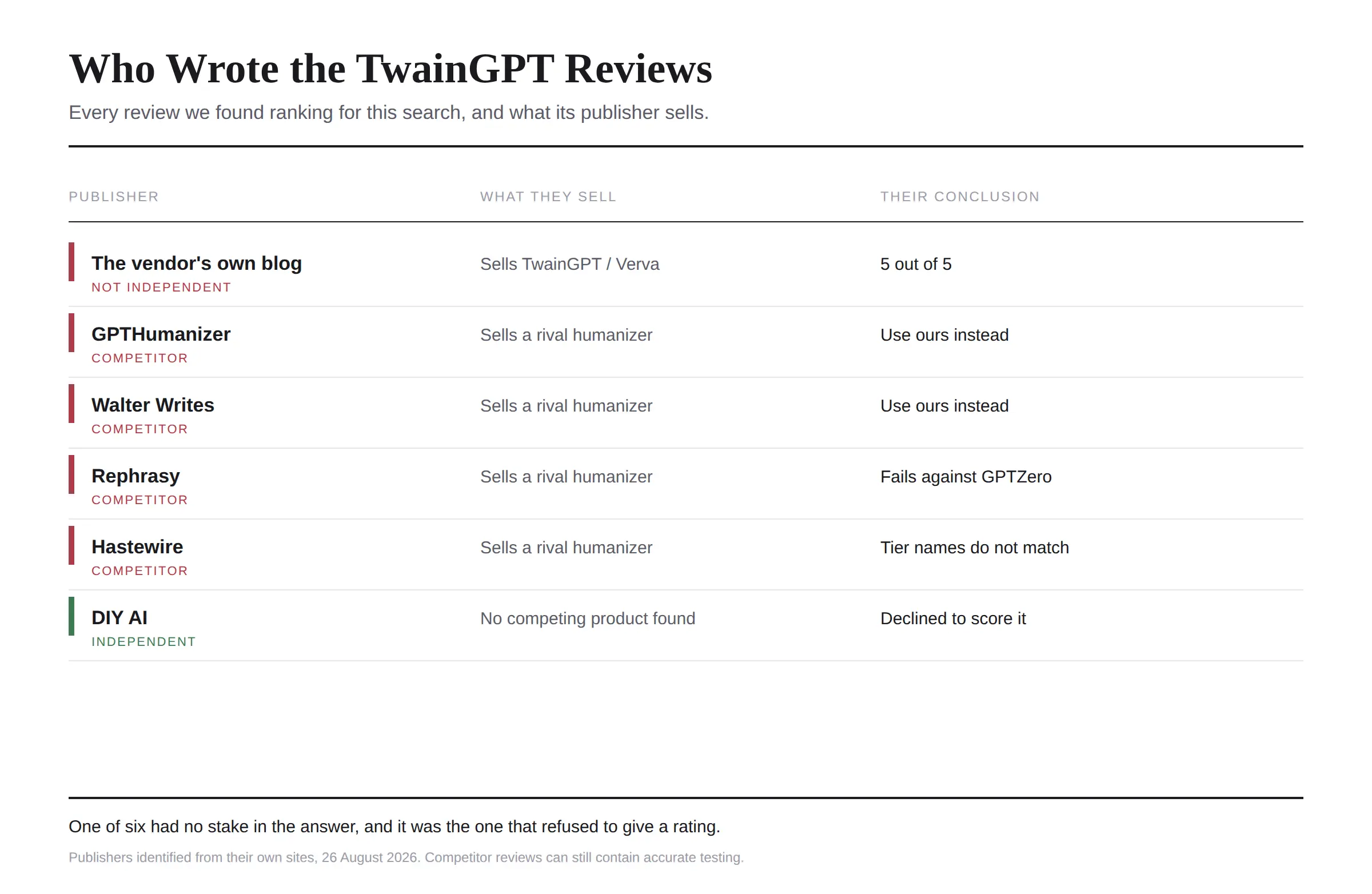 Several of the most prominent five-out-of-five reviews are published on the company's own blog. That is not hidden, but it is easy to miss when a result looks like an ordinary review site.
A larger group is published by competing humanizers. Each one follows the same arc: TwainGPT is decent, here is where it falls short, our tool handles that better. Those reviews are not worthless, and the technical observations in them are often specific enough to be useful. They are simply not disinterested.
Genuinely independent coverage is thin. The most credible piece I found openly declined to give the tool a score at all, on the grounds that a fair one would require identical source passages, repeated runs and external detector checks that the reviewer had not performed. That refusal tells you more about the state of this category than any five-star rating.
The Billing Complaints
One signal deserves flagging because it is the kind of thing that does not show up until you have paid.
A Trustpilot rating of 2.5 out of 5 has been reported for the platform, with billing complaints appearing in a large share of one-star reviews. Multiple reviewers independently note that subscriptions renew automatically and that refunds are limited.
I could not verify the current rating myself. If you subscribe, read the cancellation terms first and set a calendar reminder before the renewal date. That advice costs nothing and this category has a reputation.
The Part That Is Not a Technology Question
Almost every article on AI humanizers treats detector bypass as a purely technical problem. It is not, and skipping this does readers real harm.
If you are a student, using a tool to disguise AI-written work as your own is academic misconduct at most institutions, and it is misconduct whether or not the tool succeeds. Detection is the university's problem. Honesty is yours.
There is also a practical point that the humanizer marketing quietly avoids. When I reviewed Class Companion, the AI grading platform many schools now run, the integrity signals it uses turned out to be mostly behavioural rather than textual: pasted text, typing anomalies, how often a student copies the question and leaves the tab, and similarity across a class.
A rewriter does nothing about any of those. It changes the words in the box. It does not change the fact that they arrived there in one paste at 2am.
There is a genuinely defensible use case, and it is worth naming clearly. AI detectors produce false positives, and they fall disproportionately on non-native English speakers, whose writing patterns are statistically flatter. If you wrote something yourself and a detector flagged it, rewriting to avoid a false accusation is a reasonable thing to do.
For business use, the risk is different. Publishing humanized AI content at scale is legal, and Google's guidance targets low-value content rather than its method of production. The failure mode is not detection, it is that the content is thin and nobody reads it. A humanizer does not fix that.
Where It Genuinely Fits
Non-native English writers who keep getting falsely flagged on work they wrote themselves. This is the clearest legitimate case, and the multilingual support genuinely helps.
Content teams who draft with AI, edit heavily, and want a final pass that smooths out rhythm. Realistic, provided you are editing rather than pasting.
Anyone who wants to test whether their own writing trips a detector before submitting it somewhere that scans. The free detector allowance covers this.
Not a fit if you write technical or specialised content, where output quality drops. Not a fit if your volume is uneven, because credits expire monthly. And not a fit if you are hoping a tool will make dishonest work safe, because that is not a technology problem.
If You Want Something Else
The category is crowded and most of the comparisons you will read are written by the competitors themselves.
Undetectable AI and WriteHuman are the most established paid alternatives. QuillBot is the mainstream paraphrasing tool, weaker at bypass but far more useful as an actual writing aid. BypassGPT, Phrasly and Grubby appear repeatedly in the same audience space and are worth checking on price rather than claims.
For detection rather than rewriting, GPTZero and Copyleaks are the tools most institutions actually run, and testing against them directly is more informative than any vendor's own detector.
Frequently Asked Questions
What is TwainGPT?
An AI humanizer, AI detector and writing generator that rewrites AI-generated text so it reads more naturally. It rebranded to Verva in August 2026.
Is TwainGPT free?
The rebranded product has a small free tier, reported at 250 humanizer words and five detector scans a month. A separate site at twaingpt.ai claims to be entirely free with no limits, and it is not the same service.
How much does TwainGPT cost?
Monthly plans run roughly 10, 25 and 50 dollars for Basic, Premium and Ultimate, with about 20 percent off annual billing. Credits are reported as non-rolling.
Is TwainGPT legit?
The rebranded platform is a real product from a real company with a large user base. Billing complaints are the main recurring criticism, so read the cancellation terms before subscribing.
Does TwainGPT bypass AI detectors?
Reported results are strong against ZeroGPT and similar tools. Against GPTZero, one competitor test found it changed the classification to AI paraphrased rather than human. No humanizer can guarantee a result, and detectors update constantly.
Is TwainGPT safe to use?
Technically yes, though humanizers process whatever you paste in, so check retention terms before submitting confidential or client material. The bigger risk is contextual: using it to disguise authorship in academic work is misconduct regardless of the tool.
How does TwainGPT work?
It rewrites sentence rhythm, vocabulary and structure to reduce the statistical regularity that detectors score on. It does not change the underlying meaning of the text.
What are the best TwainGPT alternatives?
Undetectable AI and WriteHuman for paid humanizing, QuillBot for general paraphrasing, and GPTZero or Copyleaks if what you actually need is detection.
Is TwainGPT better than QuillBot?
For bypass, reportedly yes. For everyday paraphrasing and writing help, QuillBot is the more capable general tool.
Should You Use It
Judged as a product, TwainGPT is competent. It rewrites quickly, it preserves meaning better than most tools in the category, it supports a lot of languages, and bundling generation, rewriting and detection in one place is genuinely convenient.
Judged as a purchase, be careful. Search for it and you will find the vendor's own five-star reviews of itself, a wall of reviews from direct competitors, a name that changed this month, and a second site using the same name with entirely different terms.
None of that means the tool is bad. It means almost nothing you read about it, including the pricing, was written by someone with no stake in your decision.
So test it on the free tier with your own text, check it against a detector the vendor does not own, and read the cancellation terms before you enter a card.
And be honest with yourself about why you are using it. If the answer is that a detector wrongly flagged your own writing, this is a reasonable tool for a real problem. If the answer is something else, no rewriter solves that.
I verified these details against verva.com and twaingpt.ai on 26 August 2026. Pricing figures are drawn from the vendor and multiple third-party reviews and should be confirmed on the current site before purchase.