Macrohard: Elon Musk Announced It Twice, and It Nearly Died in Between
Macrohard is a project from Elon Musk's xAI, now built jointly with Tesla, that aims to perform the functions of a software company using AI agents rather than employees. Grok plans at a high level while a Tesla-built agent watches a screen and drives the keyboard and mouse. Musk announced it in August 2025 and unveiled it again in March 2026, this time calling it Digital Optimus.
Three corrections before anything else, because all three are common and all three matter.
Microsoft has nothing to do with it. The name mocks Microsoft. Satya Nadella is not involved.
There is no official Macrohard GitHub repository. The repositories under that name belong to other people.
It stalled badly between the two announcements. This is the part almost no coverage mentions, and it changes how you should read the March relaunch.
The Timeline Nobody Assembles
Put the events in order and a different story appears than the one in the headlines.
In August 2025 xAI filed a trademark for the name, on the first of the month, and Musk announced the project three weeks later while recruiting for it.
At the end of December 2025 he posted that xAI had bought a third building, named MACROHARDRR, near its Memphis power plant. As of reporting in July 2026 that site was still a warehouse rather than an operating data centre.
In February 2026 two Macrohard leaders left the company.
Then on 11 March 2026 Musk unveiled Macrohard as a joint Tesla and xAI system.
Those last two facts sit awkwardly together, and the reason is the part of the story that went largely unreported.
What Business Insider Found
On the morning of the March unveiling, Business Insider reported that the original Macrohard project had stalled.
The reporting, based on people familiar with the situation, describes leadership departures in February, the suspension of a data project involving roughly 600 contractors, and more than twenty engineers who had either left xAI or moved to other divisions. It also notes that xAI's careers page showed no active Macrohard positions that same morning.
Meanwhile Tesla had been ramping up its own agent effort, which Musk then presented as the joint project.
I want to be careful with the framing. This does not mean Macrohard is dead, and the March demonstration was real. But the honest reading is that xAI's standalone effort ran into trouble, and what was announced in March was a restructured project with Tesla supplying the execution layer and the silicon.
That is a materially different story from a triumphant product launch, and it is the single most useful thing to know about this project.
Sorting the Rest Into Three Piles
Everything else written about Macrohard falls into one of three categories, and most coverage mixes them.
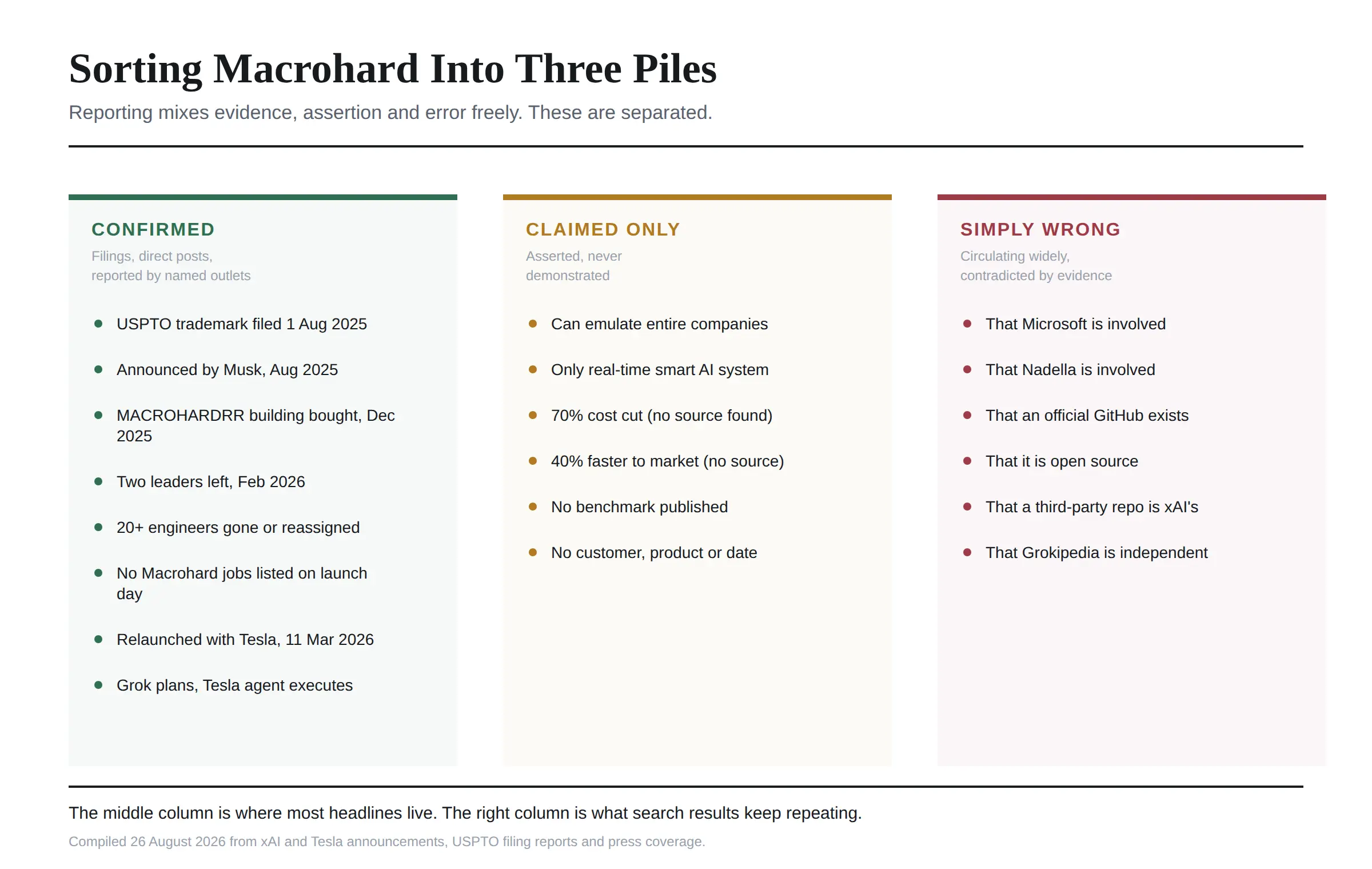 What is documented
The trademark filing with the United States Patent and Trademark Office on 1 August 2025, covering downloadable software. Musk's own recruiting post that August, in which he called the name tongue in cheek and the project real.
The March 2026 architecture, described consistently across outlets: Grok as the high-level navigator, a Tesla-built agent processing real-time screen video and issuing keyboard and mouse actions, running on Tesla's AI4 chip alongside xAI's Nvidia servers.
The MACROHARDRR building purchase. The February departures and the stalled data project, per Business Insider. And Tesla's share price dipping on the day of the March announcement rather than rising, which is not the usual response to a breakthrough.
What is asserted but not shown
That the system can emulate the function of entire companies. Musk said this carefully, as a statement about principle rather than a demonstration.
That it will be the only real-time smart AI system, which is a strong claim while computer-use agents already ship from other vendors.
Then the numbers circulating in AI newsletters, usually a 70 percent cost reduction and 40 percent faster time to market. I could not trace either to xAI, to a study, or to any methodology. They appear to originate in commentary. Treat them as invented until someone shows their working.
Also unshown: any benchmark, any independent evaluation, any customer, any pricing, any launch date.
What is simply wrong
That Microsoft is involved. That Satya Nadella is involved. That an official repository exists. That the code is open source.
And that a third-party project is xAI's code. A group unconnected to xAI released a computer-use agent in late 2025 under a headline claiming they had open-sourced Macrohard. They had not. They had built their own tool and borrowed the name. Search GitHub and you will also find a student class-project website and an old personal account with ActionScript utilities. None of the three contains xAI code.
One more caution. Grokipedia carries a detailed Macrohard entry, and it is worth knowing that Grokipedia is xAI's own encyclopedia project. On this particular subject it is not an independent source.
How the System Is Supposed to Work
Strip the branding away and it is a two-layer agent loop, which is a well established pattern.
A planning layer decides what should happen. An execution layer looks at the screen, decides where to click and what to type, acts, then looks again to see what changed.
What is distinctive is not the pattern but the ambition stacked on top. Rather than automating one task, the stated goal is to run enough coordinated agents to cover what an entire software organisation does.
That is a scale claim, not a technical one. The pattern demonstrably works for single tasks. Whether it composes into a company is the open question, and the February departures suggest it is a harder one than the announcements imply.
Reporting also references a feature called Grok Computer as an early implementation of agent-based computer use. As of March 2026 it was described as not yet publicly available.
Why Software Investors Paid Attention
The August announcement landed in an already nervous market.
Anthropic's Claude Cowork, which performs office-style computer tasks autonomously, had unsettled software investors, and commentary at the time was using the term SaaSpocalypse for the worry that agentic AI erodes per-seat pricing. If an agent operates the software, the customer needs fewer seats.
Macrohard pushed the argument further. Not fewer seats, but no employees at all.
Some perspective is warranted. The capability has been demonstrated at task level and asserted at company level, and the company-level version just lost most of its team.
You Can Test the Idea Yourself for Very Little
This is the part most coverage misses, and it is the most practically useful.
You do not need Macrohard to find out whether computer-using agents help your workflow. The capability already ships. Anthropic's computer-use tooling gives you the full screenshot, reasoning and input pipeline. OpenAI has shipped agents that operate a browser. Open-source browser automation paired with any capable model gets you a working agent for the cost of API calls.
One analyst who tested that route found the core interaction pattern entirely reproducible for tens of dollars a month, and was sceptical of speed claims, on the grounds that latency and inference put each step at a few seconds, which is not faster than a competent human at most tasks.
If you would rather run an agent on your own hardware than a vendor's, our guide to the OpenClaw repository covers the best-known open-source option.
The honest summary is that xAI's advantage here is not a technique nobody else has. It is capital, compute and operational data at a scale individuals cannot match, which is exactly why the staffing problems matter.
Follow the Ownership
Worth understanding who is paying for this, because the structure is unusual.
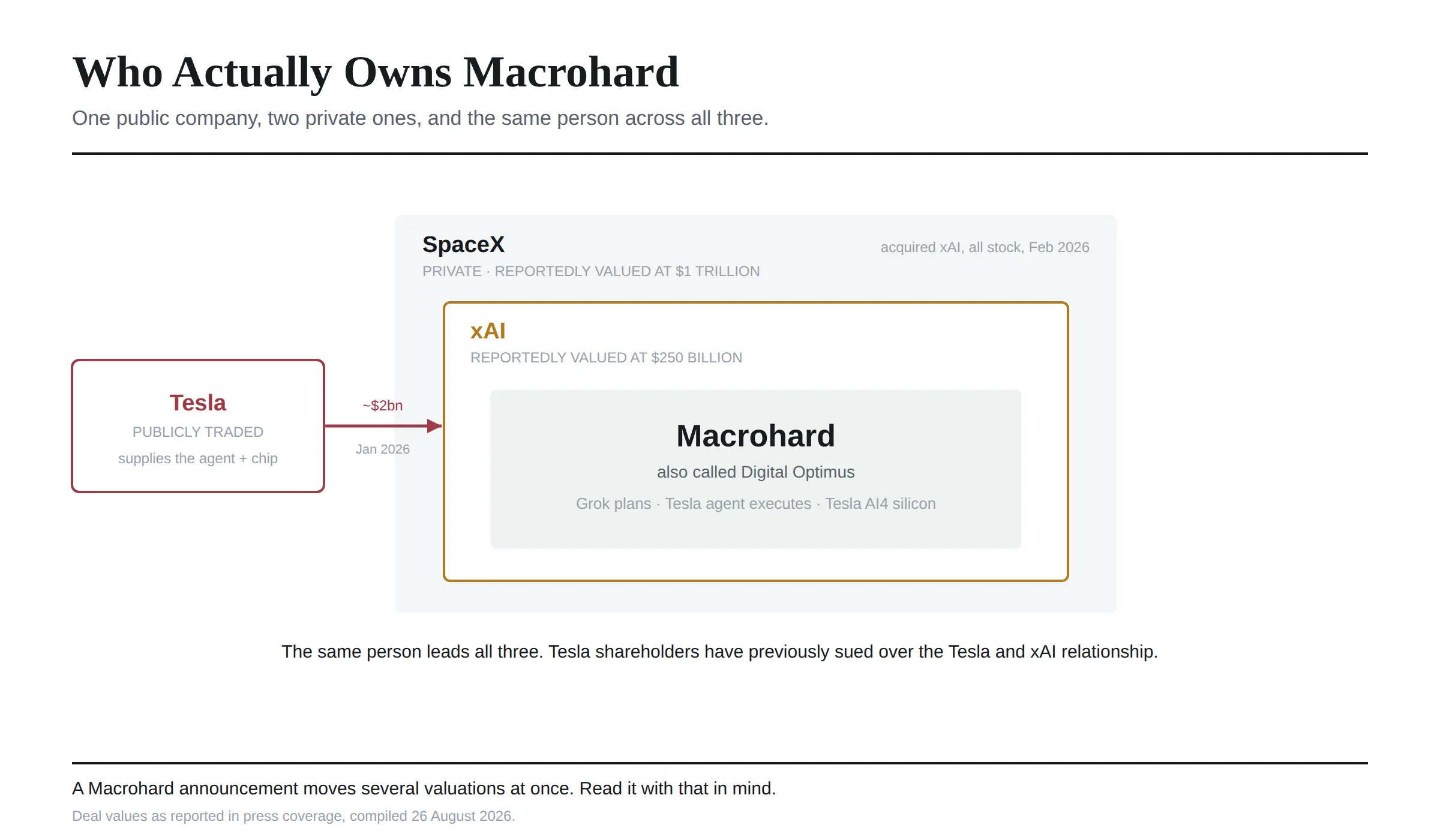 Tesla agreed in January 2026 to invest around 2 billion dollars into xAI. The following month SpaceX acquired xAI in an all-stock deal reportedly valuing SpaceX at 1 trillion dollars and xAI at 250 billion. Macrohard now runs as a joint Tesla and xAI project on Tesla silicon.
So a public company invested in a private company founded by its own chief executive, which was then absorbed by another private company he controls, and all three now collaborate on a project he announces personally.
I am not alleging anything. I am noting that Tesla shareholders have previously sued over the Tesla and xAI relationship, and that a Macrohard announcement moves several valuations at once. Read the announcements with that in mind.
Frequently Asked Questions
What is Macrohard?
An xAI project, now built with Tesla, aiming to reproduce the functions of a software company using AI agents rather than human employees. Grok plans and a Tesla-built agent operates the computer.
Is Macrohard a real company?
Not a trading company. It is a project with a filed trademark, a building, and two public announcements. There is no product to buy and no launch date.
Is Macrohard related to Microsoft?
No. The name is a competitor's joke about Microsoft. Microsoft and Satya Nadella have no involvement.
Is Macrohard cancelled or still active?
Still active, but not smoothly. Business Insider reported in March 2026 that the original xAI project had stalled, with leadership departures, a suspended data project and more than twenty engineers gone or reassigned. Musk relaunched it that same month as a joint effort with Tesla.
Does Macrohard have a GitHub repository?
No official one. Three unrelated repositories surface under the name, including a third-party agent that borrowed the branding. None contains xAI code.
Is Macrohard open source?
No. xAI has published no Macrohard source code, and the trademark covers proprietary downloadable software.
How does Macrohard AI work?
Two layers. Grok plans at a high level. A Tesla-built agent reads real-time screen video, executes keyboard and mouse actions, then observes the result and continues.
What are Macrohard digital employees?
AI agents performing roles a human employee would, such as writing code or managing projects. Currently a stated goal rather than a shipped product.
Is Macrohard the same as Digital Optimus?
Musk used both names at the March 2026 unveiling. Confusingly, Business Insider reported Digital Optimus as Tesla's own separate agent effort before the two were presented together.
Can I use Macrohard?
Not currently. No public access, no waitlist, no pricing. Computer-use agents from Anthropic, OpenAI and open-source projects are available today.
What Would Change My Mind
Three signals would tell you Macrohard is a product rather than a positioning exercise.
Job listings reappearing for a Macrohard team, since an empty careers page on the morning of your own launch is the clearest tell there is.
Any benchmark on real multi-step office work, rather than a demonstration video.
And the MACROHARDRR site becoming an operating data centre rather than a warehouse.
Until those happen, my read is that the underlying technology is real and already reproducible by anyone with an API key, the company-scale ambition remains unproven, and the March announcement did more to reassure investors than to ship anything.
Checked on 26 August 2026 against xAI and Tesla announcements, USPTO filing reports, Business Insider's reporting on the project's status, and coverage from CNBC, eWeek and Data Center Dynamics. Where I could not verify a claim, I have said so in the text rather than in a footnote.