AI Contextual Organizational Knowledge: The 5 Stages, and Why Most Companies Stall at Stage 2
AI contextual organizational knowledge is the capability of an AI system to answer from your organisation's own accumulated record, its documents, decisions and institutional judgement, rather than from general knowledge, with each claim traceable back to a specific internal source.
The test is simple. Ask your AI system a question only your company can answer, such as why a particular customer escalation was handled the way it was in 2023. If the answer is a fluent, textbook description of how companies in general handle escalations, you do not have it. You have a language model with a search box.
Most explanations of this term stay abstract because abstraction is cheap. I want to do the opposite, so this article is built around five concrete stages, and the numbers at each one are not encouraging.
Pulling the Three Words Apart
The phrase is doing three jobs at once, and separating them makes it usable.
Organizational knowledge is what your firm has accumulated. Contracts, policies, post-incident reviews, approved procedures, board minutes, the worked reasoning behind past decisions. Most of it already exists. Almost none of it is in a form a machine can use.
Contextual means the system knows which parts apply right now. Not just that a parental leave policy exists, but that this version supersedes the one from last year, applies to this jurisdiction, and that the person asking is entitled to see it.
AI is the layer that reads a question, finds the applicable material, and answers in a way you can check.
The middle word is where everything fails. Retrieval is a solved-enough problem. Knowing which of nine overlapping documents is the current one is not.
Why the Term Exists Now: The Numbers
This is the part the vendor explainers leave out, and it is the most useful thing here.
Reported figures for 2026 put the share of enterprise retrieval projects that never reach production at somewhere between 70 and 80 percent. One analysis puts it more precisely: around 30 percent of pilots reach production, and of those, only 10 to 20 percent show measurable return.
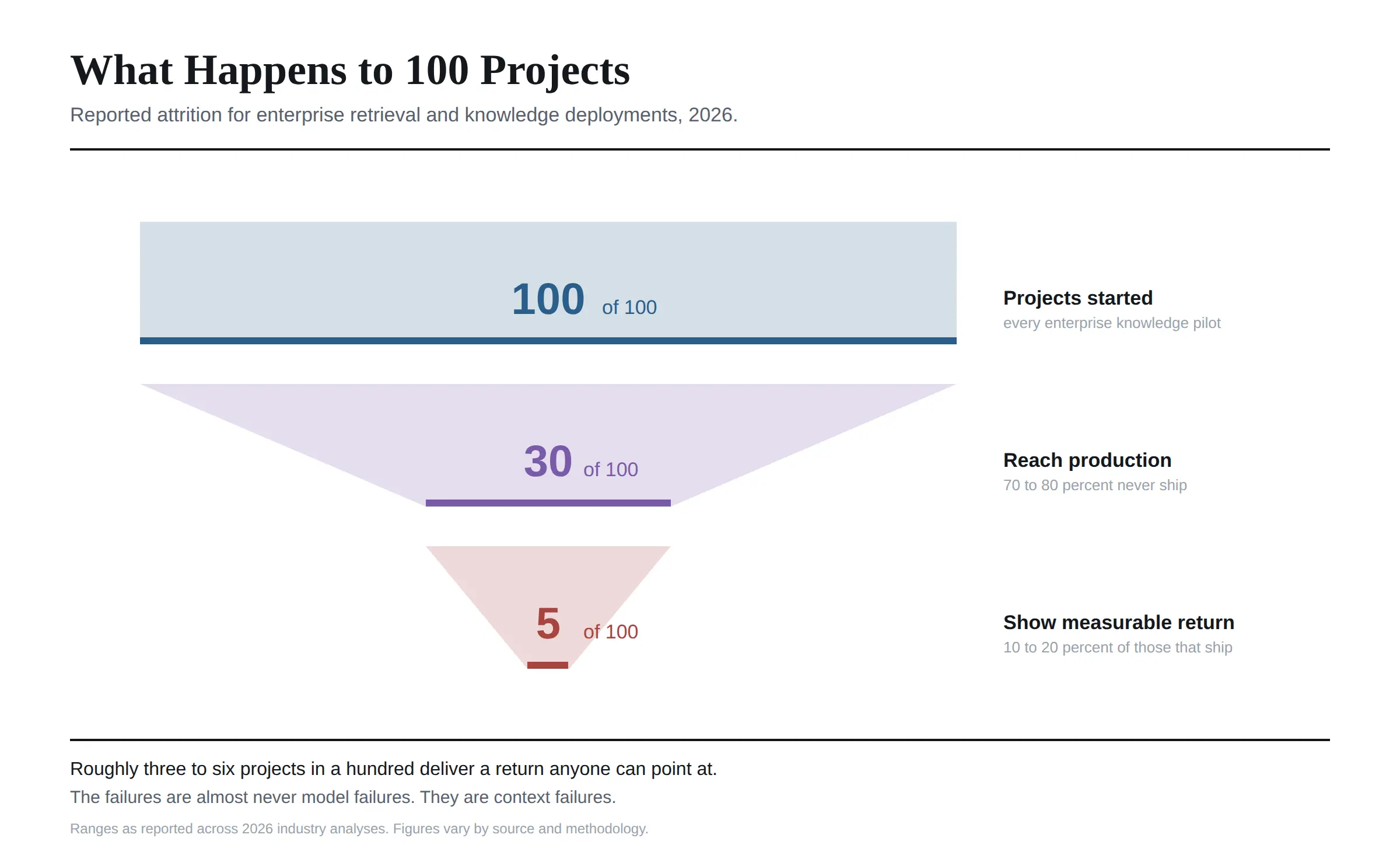 Run those together and roughly three to six projects in a hundred deliver value you can point at.
Gartner has reported that up to 60 to 63 percent of organisations lack AI-ready data practices, and has predicted that 60 percent of AI projects would be abandoned by 2026 because of weak data foundations. McKinsey's 2025 work found 71 percent of organisations using generative AI regularly while only 17 percent attributed more than 5 percent of earnings to it.
The consistent finding across all of this is that the failures are not model failures. The models are fine. What breaks is the quality of the context assembled for them.
One 2026 survey found roughly 70 percent of teams running retrieval in production had no systematic evaluation of retrieval quality at all. They measured whether the answer sounded good. Not whether the right document was found.
The Five Stages
Here is the ladder. Most organisations I read about are somewhere on the second rung and believe they are on the fourth.
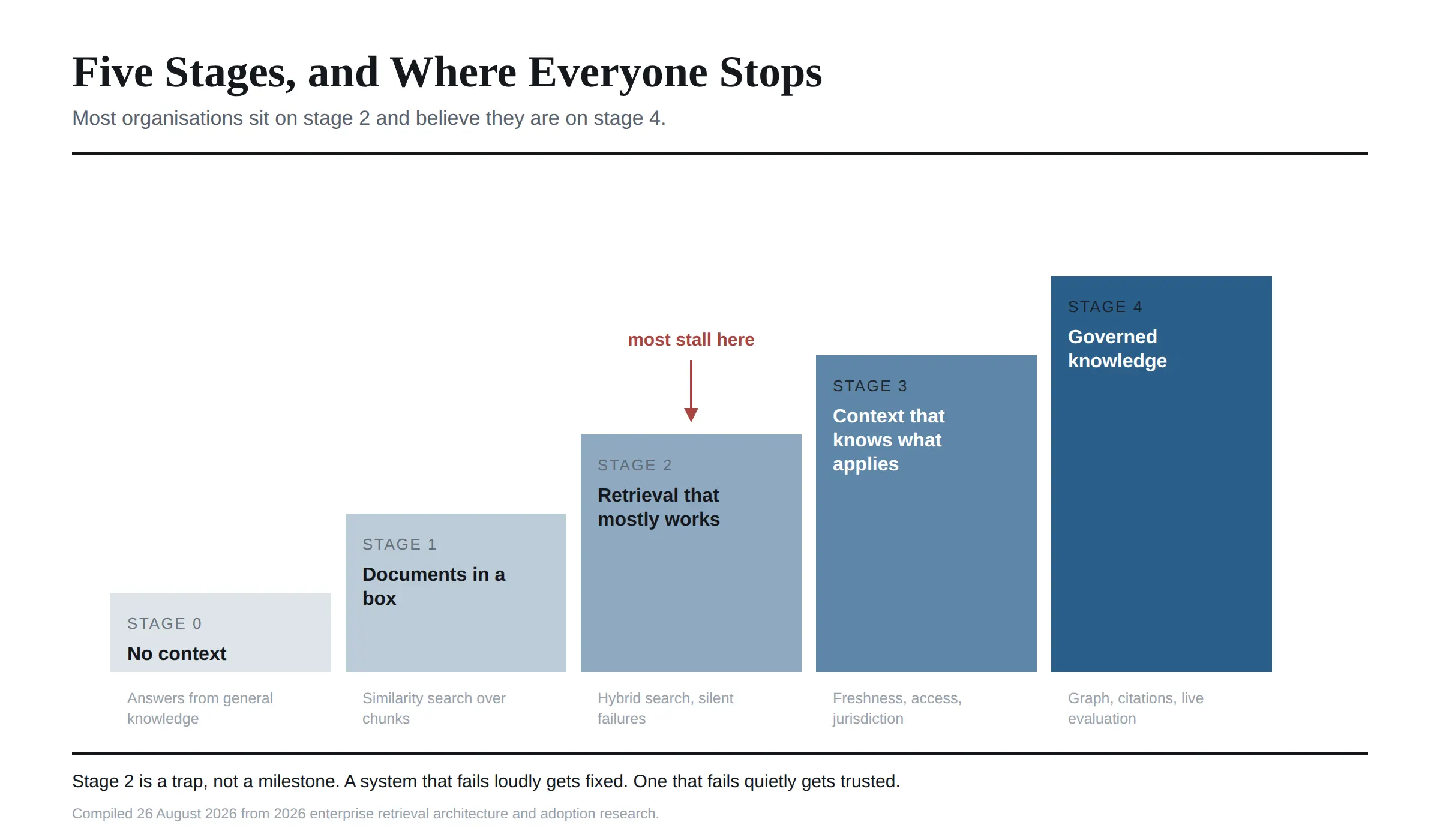 Stage 0: No context
The model answers from general knowledge. Useful for drafting, useless for anything specific to you. Everyone starts here and some tools never leave.
What it can answer: how companies generally handle X. Where it breaks: the moment the question is about your company.
Stage 1: Documents in a box
Someone connects a folder. The system does basic similarity search over chunks of text and passes what it finds to the model.
This is where most pilots demo brilliantly. The corpus is small, curated and current, so retrieval looks solved.
What it can answer: questions where one obvious document contains the answer. Where it breaks: at scale, when nine documents partially match and none is marked as current.
Stage 2: Retrieval that mostly works
Hybrid search arrives, combining semantic similarity with keyword matching. Maybe a reranker. The system handles a real corpus.
This is where the majority stall, and the reason is subtle. The system now works well enough that failures become rare rather than absent, and rare failures are harder to notice than constant ones.
What it can answer: most questions, most of the time. Where it breaks: silently. It returns a plausible answer from a superseded document and nothing flags it.
Stage 3: Context that knows what applies
The jump from stage 2 is not better search. It is metadata and rules.
The system knows which version is current, which jurisdiction a policy covers, who is permitted to see what, and when a document was last reviewed. Freshness and access become filters on retrieval rather than afterthoughts.
What it can answer: questions where the right answer depends on time, role or jurisdiction. Where it breaks: on reasoning across relationships, such as which decisions depended on a policy you just changed.
Stage 4: Governed organizational knowledge
Structured relationships sit alongside retrieval, usually as a knowledge graph. Every answer carries citations. Evaluation runs continuously against production traffic rather than a test set from launch week. Access control is enforced at retrieval rather than at the interface.
What it can answer: why, not just what. Including questions about its own reasoning. Where it breaks: cost and maintenance. This is real infrastructure, not a feature.
The Seven Parts of a System That Works
Published 2026 architecture write-ups converge on a consistent list, and the interesting thing is how mundane it is.
A structured ingestion layer that preserves document structure rather than flattening it. A chunking layer that attaches metadata. A hybrid retriever combining dense vectors with keyword search. A reranker. A freshness and access filter. Generation that cites its sources. And an evaluation loop running asynchronously on real production traffic.
None is optional. All of them are what teams skip in the demo and pay for in week three.
If you want the single highest-value pair to add first, the reporting points at freshness-aware reranking and structure-aware extraction, on the grounds that they fix the most failures per unit of engineering effort.
The Failure That Explains All the Others
One example does more work than any diagram.
An internal HR assistant answers a question about parental leave by quoting a policy that was replaced months earlier. The current version has been on the intranet the whole time. The assistant never re-indexed it.
Nothing about this looks like a failure. The link resolves. The model answers confidently. The citation is real. The document it points to genuinely exists.
The number is simply wrong, and no dashboard tracked source freshness against retrieval, so nobody knew.
This is why stage 2 is a trap rather than a milestone. A system that fails loudly gets fixed. A system that fails quietly gets trusted.
AI Memory, Knowledge Base, RAG and Knowledge Graph
These four terms get used interchangeably and they are not the same thing.
A knowledge base is the stored material itself. Documents, records, structured data. It is a noun.
RAG, retrieval-augmented generation, is the technique of fetching relevant material at query time and putting it in front of the model. It is fast, flexible, and good with unstructured text. It is weak on explaining relationships.
A knowledge graph stores entities and the relationships between them. It is strong on explainability, reasoning and governance, and expensive to build. Industry writing through 2026 increasingly treats the hybrid of the two, sometimes called GraphRAG, as the practical default rather than an either-or choice.
AI memory is different from all three. A knowledge base is what the organisation knows. Memory is what the system remembers about an ongoing interaction or a particular user. Confusing the two produces systems that recall your last question but not your company's actual policy.
The Gap Nobody Budgets For
There is a governance problem sitting underneath all of this, and the numbers are stark.
A 2026 Deloitte study covering more than three thousand director and C-suite respondents across 24 countries found that 84 percent of companies had not redesigned roles around AI, and only 21 percent had a mature governance model for AI agents. Around 75 percent planned to deploy agentic AI within two years.
KPMG's 2026 work with large US enterprises found agent deployment rising from 11 percent to 42 percent across 2025, then falling back to 26 percent as organisations shifted from pilots to trying to scale properly. Average annual AI budgets reached 124 million dollars.
The academic framing I found most useful puts it this way: companies are deploying agents at speed but not managing what those agents see. Context is not designed, it forms spontaneously, out of haphazardly connected knowledge bases and unfiltered logs.
That is the whole problem in one sentence. Contextual organizational knowledge is the deliberate version of something that otherwise happens to you by accident.
This matters more as agents take on more autonomous work. An agent asked to run a process rather than answer a question compounds a stale policy across every step it takes. The most ambitious version of that claim is Elon Musk's Macrohard project, which proposes running whole company functions on agents, and which makes the context problem existential rather than annoying.
How to Work Out Which Stage You Are On
Four questions, in order. Each one is a stage boundary.
Can it answer a question about your company at all? If not, stage 0.
Ask it something where two documents conflict and one is outdated. Does it notice? If not, you are at stage 1 or 2, whatever your architecture diagram says.
Can it tell you who is allowed to see the answer it just gave? If access control lives in the interface rather than in retrieval, you are below stage 3.
Can you show, for a random production query from last Tuesday, which documents were retrieved and whether they were the right ones? If not, you have no evaluation loop, and you are not at stage 4 regardless of what you have built.
That last question is the one I would ask first if I were buying. Roughly 70 percent of production systems fail it.
Frequently Asked Questions
What is AI contextual organizational knowledge?
The capability of an AI system to answer using your organisation's own documents, decisions and institutional judgement, with each claim traceable to a specific internal source, rather than answering from general knowledge.
What is contextual AI?
AI that takes account of the situation surrounding a question, including who is asking, when, under which policy version and with what permissions, rather than treating every query identically.
How does AI use organizational knowledge?
Typically through retrieval. The system converts documents into searchable form, finds material relevant to the question at query time, and passes it to the model as context. Better systems filter that material by freshness and access rights before the model sees it.
How does RAG use organizational knowledge?
RAG fetches relevant chunks of your documents at the moment of the question and places them in the model's context window, so the answer is grounded in your material rather than the model's training data.
What is the difference between AI memory and a knowledge base?
A knowledge base is what your organisation knows and is shared. Memory is what the system retains about a particular user or conversation. You need both, and they solve different problems.
How do AI agents access company knowledge?
Through the same retrieval layer, usually exposed as tools the agent can call. The risk is higher than with chat, because an agent acts on what it retrieves rather than just displaying it.
Why do most enterprise AI knowledge projects fail?
Reported figures put the share of retrieval projects that never reach production at 70 to 80 percent, and the causes are consistently data and context problems rather than model limitations. Poor freshness handling, no access filtering and no retrieval evaluation are the recurring culprits.
How do you give AI access to internal knowledge safely?
Enforce permissions at the retrieval layer rather than the interface, so the model never sees material the user could not open themselves. Filter by document currency, require citations, and evaluate retrieval quality on real traffic.
What is enterprise AI knowledge management?
The practice of organising company knowledge so AI systems can retrieve and reason over it reliably, including ingestion, structuring, access control, freshness and evaluation.
Is a knowledge graph better than RAG?
They solve different problems. RAG gives coverage and speed over unstructured text. A graph gives explainability and relationship reasoning. Most 2026 enterprise writing recommends combining them.
What I Would Do on Monday
If you are starting, do not start with a vector database.
Start by writing down what your organisation actually knows and where it lives, then classify it by sensitivity, business unit and freshness, and decide explicitly what must never be retrievable. That mapping exercise is unglamorous and it is the step whose absence explains most of the failure rate above.
Then build the evaluation loop before the chatbot. If you cannot measure whether retrieval found the right document, every improvement after that is guesswork, and you will not notice the day it starts quoting last year's policy.
The organisations that get this right treat context as designed infrastructure. The ones that stall treat it as a feature they can add to a model.
Figures cited here are as reported in 2026 industry research and analyst coverage, compiled on 26 August 2026. Percentages in this field vary considerably by source and methodology, so treat them as consistent directional evidence rather than precise measurements.