How We Saved 500+ Engineering Hours per Month by Migrating to a Self-Hosted n8n Workflow
AI automation is easy to justify when a workflow runs a few dozen times a day. The economics change when automation becomes part of a production environment, and that is what pushed us toward self-hosted n8n.
As our workload increased, we found that our costs were coming from more than API calls. We were paying for commercial automation platforms, LLM usage, workflow execution, infrastructure, and engineering time spent maintaining an increasingly fragmented automation stack.
Our four-person engineering team was spending a significant amount of time on repetitive workflow operations and maintenance rather than new development.
We eventually consolidated our automation infrastructure around self-hosted n8n and introduced intelligent LLM routing. Our goal was straightforward: reduce recurring infrastructure and AI costs while eliminating as much repetitive manual and engineering work as possible.
The result was a modeled reduction in monthly operating costs from $4,000 to $1,350 and approximately 520 hours of recovered manual and engineering workload every month.
The important part was how we got there.
Our Baseline Before the Migration
Before changing the architecture, we documented where our money and engineering time were going.
Our four-person engineering team supported workflows that depended on several commercial automation platforms. The setup was convenient, but execution charges and growing complexity became increasingly difficult to manage.
Baseline Before Migration
Metric | Before Migration |
|---|---|
Engineering team | 4 people |
Automation environment | Multiple commercial platforms |
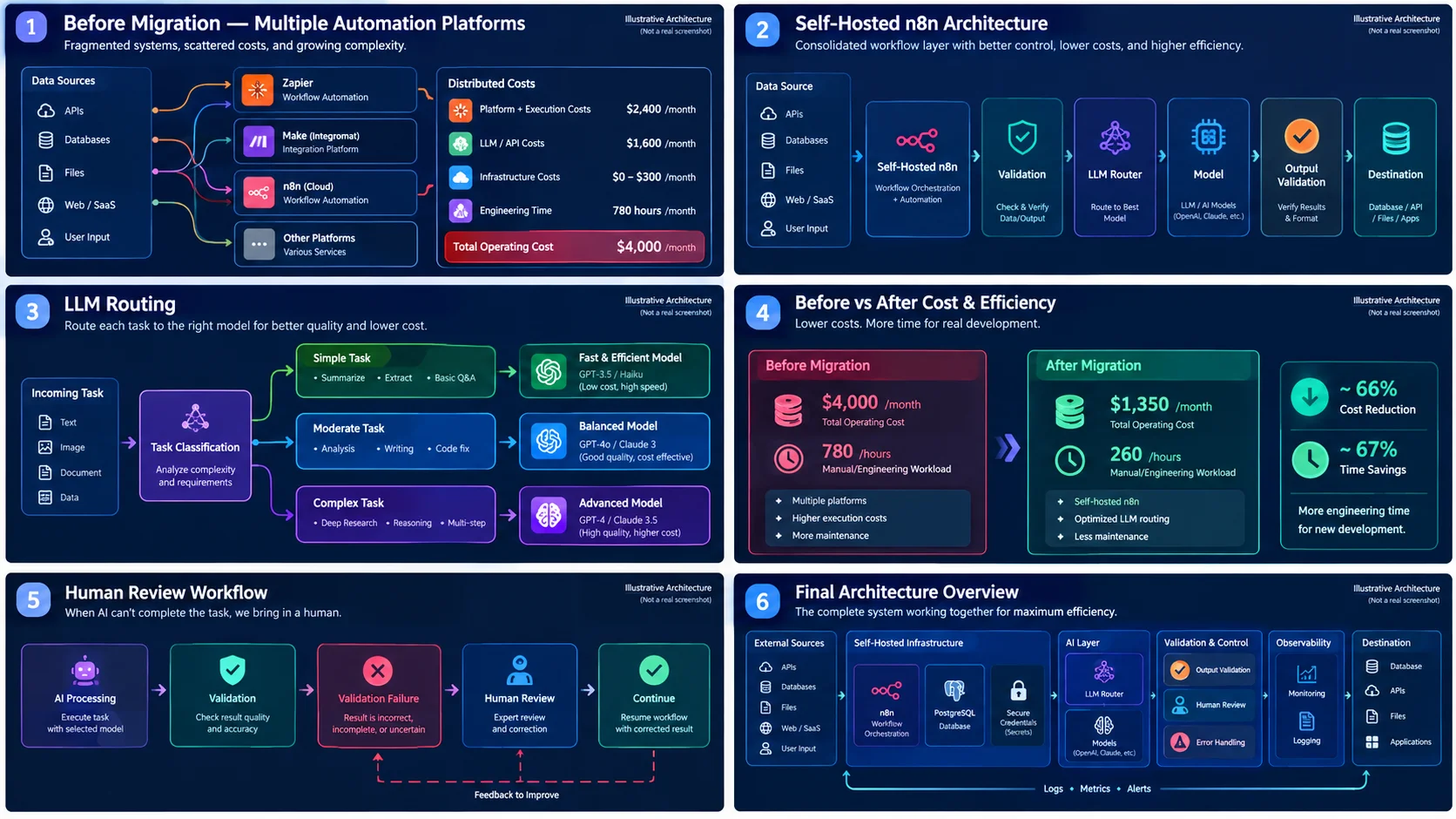
Platform + execution costs | $2,400/month |
LLM/API costs | $1,600/month |
Total operating cost | $4,000/month |
Manual/engineering workload | 780 hours/month |
The 780 hours represented approximate monthly workload associated with manual processing, workflow maintenance, troubleshooting, data handling, repetitive engineering tasks, and related activities.
Why the Existing Automation Stack Became a Bottleneck
Our original architecture had grown incrementally. One platform solved one problem, another service handled a different integration, and additional workflows were added as requirements appeared.
Each decision made sense individually, but the overall environment became increasingly expensive and difficult to maintain.
As workflow volume increased, execution-based pricing became more significant. Workflow logic was distributed across systems, and LLM requests were not always routed according to task complexity. Simple extraction could consume resources intended for more demanding tasks.
Engineers also spent time maintaining workflows and recovering failed operations instead of building new capabilities.
We therefore decided that the solution was not another automation service. We needed greater control over the automation layer itself.
Moving the Workflow Layer to Self-Hosted n8n
We moved the core workflow orchestration layer to a self-hosted n8n deployment.
The objective was not simply to recreate our old workflows one by one. We used the migration to consolidate workflow logic and redesign how AI tasks were processed.
Components of the New Environment
The new environment included:
Self-hosted n8n
PostgreSQL
Secure API credentials
LLM integrations
LLM routing layer
Validation
Error handling
Human-review paths
Monitoring
Logging
Self-hosting gave us greater control over deployment and infrastructure, but it also transferred responsibility to our team for maintenance, security, backups, updates, and availability.
That trade-off was acceptable because we already had engineering resources capable of managing the infrastructure.
The Architecture We Built
The simplified architecture looked like this:
Data Source
→ n8n
→ Validation
→ Task Classification
→ LLM Router
→ Appropriate Model
→ Output Validation
→ Destination
Exception Handling Path
A second path handled exceptions:
Validation Failure
→ Human Review
→ Correction
→ Workflow Continuation
n8n controlled workflow orchestration, the routing layer selected the model, validation checked the result, and human review handled uncertain cases.
Why We Introduced LLM Routing
One of the biggest sources of unnecessary AI spending was treating every task as if it required the same model.
We divided our workload into categories.
Simple Tasks
Simple tasks included:
Classification
Basic extraction
Formatting
Short transformations
Straightforward categorization
Complex Tasks
More complex tasks included:
Multi-step reasoning
Ambiguous information analysis
Long-context processing
Tasks where output quality had a significant downstream impact
Our Simplified Routing Logic
Simple Task
→ Local or Lower-Cost Model

Moderate Task
→ Standard Commercial Model

Complex Task
→ Higher-Capability Commercial Model
This did not eliminate premium LLMs. It made their use more selective.
The question changed from:
"Which model should we use for everything?"
to:
"What is the least expensive model that can reliably complete this task?"
The Financial Results
After migrating the workflow infrastructure and implementing LLM routing, our modeled monthly costs changed as follows:
Before vs. After
Metric | Before | After |
|---|---|---|
Engineering team | 4 people | 4 people |
Automation platform | Multiple commercial services | Self-hosted n8n |
Platform + execution | $2,400/month | Not applicable |
Self-hosted infrastructure | Not applicable | $450/month |
LLM/API usage | $1,600/month | $900/month |
Total operating cost | $4,000/month | $1,350/month |
Manual/engineering workload | 780 hrs/month | 260 hrs/month |
Monthly Cost Reduction
Before: $4,000/month
After: $1,350/month

Monthly Difference:
$4,000 − $1,350 = $2,650

Modeled Reduction:
$2,650 ÷ $4,000 × 100 = 66.25%
That represents a 66.25% reduction in modeled operating costs.
The saving came from two major changes.
First, we replaced a significant portion of commercial automation-platform costs with our own infrastructure.
Second, model routing reduced unnecessary premium LLM usage, bringing LLM/API costs from approximately $1,600 to $900 per month.
The 500+ Hours We Recovered
The other side of the equation was human workload.
Before the migration, the combined workload associated with our automation processes was estimated at approximately 780 hours per month.
After automation and workflow consolidation, approximately 260 hours remained.
How We Calculated the Recovered Capacity
780 − 260 = 520 hoursThis gave us approximately 520 hours of recovered capacity per month, which is the basis for our claim of saving more than 500 hours.
The figure does not mean that 520 hours were simply removed from four engineers' schedules. It represents aggregate work that no longer required the same level of direct human involvement.
Where the Recovered Time Came From
The workload included:
Manual processing
Classification
Extraction
Data movement
Workflow maintenance
Failed-operation recovery
Troubleshooting
Quality checks
Some work disappeared completely, while other work became short review tasks.
Processes could run automatically and send only exceptions for review.
Good automation does not necessarily eliminate a business process. It changes how much human effort that process requires.
What Did Not Work
The migration was not successful from day one.
Some early workflows were too optimistic about how predictable AI-generated outputs would be.
A workflow might expect a specific JSON structure while the model returned information that was semantically correct but formatted differently.
Other failures came from external APIs, including changed responses, downtime, incomplete information, and edge cases missed during testing.
How We Improved Reliability
We responded by adding validation and fallback mechanisms.
Structured outputs were checked for required fields before the workflow continued.
Temporary API failures triggered retries where appropriate, while ambiguous AI results were routed to human review.
This created an important principle:
Automation should know when it does not know.
A short human review is often cheaper than downstream cleanup caused by an uncertain automated decision.
Self-Hosting Was Not Free
It would be a mistake to describe the migration as moving from an expensive platform to "free automation."
Self-hosting reduced our platform expenditure, but it also transferred responsibility to our team.
Responsibilities We Took On
We became responsible for:
Availability
Database management
Backups
Security
Updates
Monitoring
Network configuration
Disaster recovery
For a company with limited technical resources, that administrative burden may outweigh the savings.
Our situation was different. We already had a four-person engineering team and enough workflow volume to justify taking greater control over the infrastructure.
Self-hosting therefore became an economic decision rather than simply a technology preference.
What We Would Do Differently
If we were rebuilding the system today, we would begin with measurement rather than technology selection.
Metrics We Would Measure First
We would document:
Workflow executions
Cost per execution
LLM usage by task type
Engineering hours
Manual processing hours
Failure rates
Human-review rates
Infrastructure costs
We would then decide which workloads should be self-hosted and which should remain managed.
We would also introduce LLM routing earlier because model selection should be based on measured workload requirements rather than developer preference.
The Final Lesson
The headline result is straightforward:
$4,000/month → $1,350/month
66.25% lower modeled operating cost
780 hours/month → 260 hours/month
520 hours of recovered capacity
But the more important lesson is architectural.
Self-hosted n8n gave us greater control over workflow execution.
LLM routing gave us control over model costs.
Validation reduced the number of failures reaching downstream systems, while human-review paths prevented automation from becoming unnecessarily rigid.
None of these components solved the problem independently. Together, they changed the economics of the environment.
The Questions That Matter
For organizations dealing with growing AI automation costs, the answer may not be simply finding a cheaper automation platform or a cheaper LLM.
The better questions are:
Which tasks need expensive infrastructure?
Which tasks need expensive models?
Which tasks should not require a human at all?
Once those questions are answered using real workload data, the path toward meaningful cost and productivity improvements becomes much clearer.