Inkling Pricing in 2026: Two Products Share the Name, and Only One Publishes a Number
Before you read a price, check which Inkling you mean. Two unrelated products carry the name, and the pricing answers are nothing like each other.
Inkling the AI model, released by Thinking Machines Lab in July 2026, costs 1 dollar per million input tokens and 4.05 dollars per million output tokens on the company's own API. Open weights, Apache 2.0 licensed, so you can also self-host it and pay nothing per token.
Inkling the workforce training platform, used by companies like McDonald's for frontline and deskless staff, publishes no price at all. Not on its own site, not on any software directory I checked. Every route ends in a demo request.
I went looking for a real number for both. One search took ten minutes. The other took an afternoon and produced nothing, which is itself the finding.
The Thirty-Second Test
If you arrived here after reading about mixture-of-experts models, token costs or open weights, you want the AI model. Skip to the next section.
If you arrived after reading about employee onboarding, standard operating procedures, mobile learning or frontline training, you want the training platform. Skip two sections down.
If you are not sure, the giveaway is the unit. The AI model is priced per million tokens. The training platform is priced per user, per year, and only after a sales call.
Inkling the AI Model: The Published Price, and Why It Varies
Thinking Machines Lab released Inkling on 15 July 2026. It is a mixture-of-experts model with 975 billion total parameters and 41 billion active per token, a one million token context window, and Apache 2.0 licensing that permits commercial use.
The headline rate on the company's own API is 1 dollar per million input tokens and 4.05 dollars per million output.
That is the number I would use. But four sources report it four ways, and the spread is worth understanding before you budget.
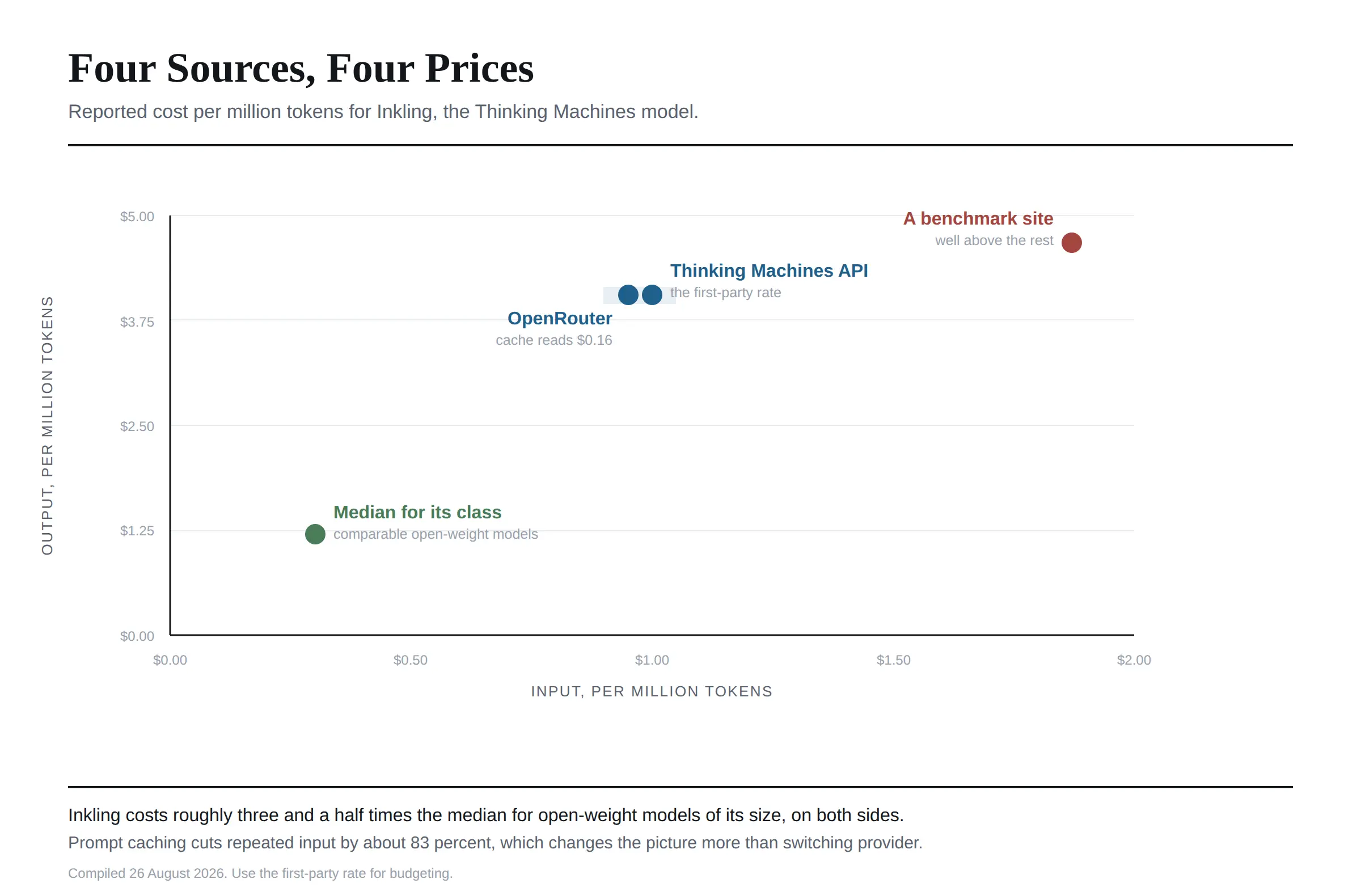 Artificial Analysis lists 1.00 and 4.05 dollars based on the first-party API. OpenRouter lists 0.95 and 4.05, with cache reads at 0.16. One benchmark site reported 1.87 and 4.68 in early August, which is well above everyone else and is most likely a different provider or a blended figure rather than the first-party rate.
Sources also disagree on the basics. Release dates of 15 and 17 July both appear. One pricing calculator lists the context window as 524,000 tokens when Thinking Machines and Artificial Analysis both put it at one million.
My advice is to price against the first-party rate, treat aggregator figures as approximate, and remember that Inkling runs through five API providers, so what you pay depends on which one you route through.
What Inkling Actually Costs to Run
Rate cards are not bills, so here is the comparison that matters.
The median open-weight model in Inkling's size class costs 0.30 dollars per million input and 1.20 per million output, according to Artificial Analysis. Inkling costs roughly three and a half times that on both sides.
Artificial Analysis puts it plainly: Inkling is among the leading models in intelligence but particularly expensive compared with other open-weight models of similar size. It scores 42 on their Intelligence Index against a median of 29 for its class, ranking 17th of 111.
Two further costs are easy to miss.
It is verbose. Running the Intelligence Index, Inkling generated 130 million output tokens against a median of 110 million for comparable models. Since output costs four times input, roughly 18 percent extra verbosity on the expensive side of the meter is a real line item.
And caching changes the picture substantially. The cache discount runs around 83 percent, which drops repeated context to well under a fifth of the standard rate. Artificial Analysis calculates a blended rate of 0.72 dollars per million tokens at a typical cache-heavy usage ratio, which is a very different number from 4.05.
For the full evaluation suite, they spent 698.28 dollars running Inkling. That is a useful sanity check on what serious usage costs.
The free option nobody mentions. The weights are on Hugging Face under Apache 2.0. If you have the hardware, the per-token price is zero. For a 975 billion parameter model that is a substantial if, but it is a genuine option and no pricing page mentions it.
Inkling the Training Platform: The Price Does Not Exist
Now the other product, and the afternoon that produced nothing.
Inkling is a mobile enablement and knowledge platform for deskless and frontline workers. It handles standard operating procedures, onboarding, in-the-flow training, collaborative authoring, group messaging and reporting. It has joined forces with Echo360. McDonald's is among its named customers.
What it costs is not published anywhere.
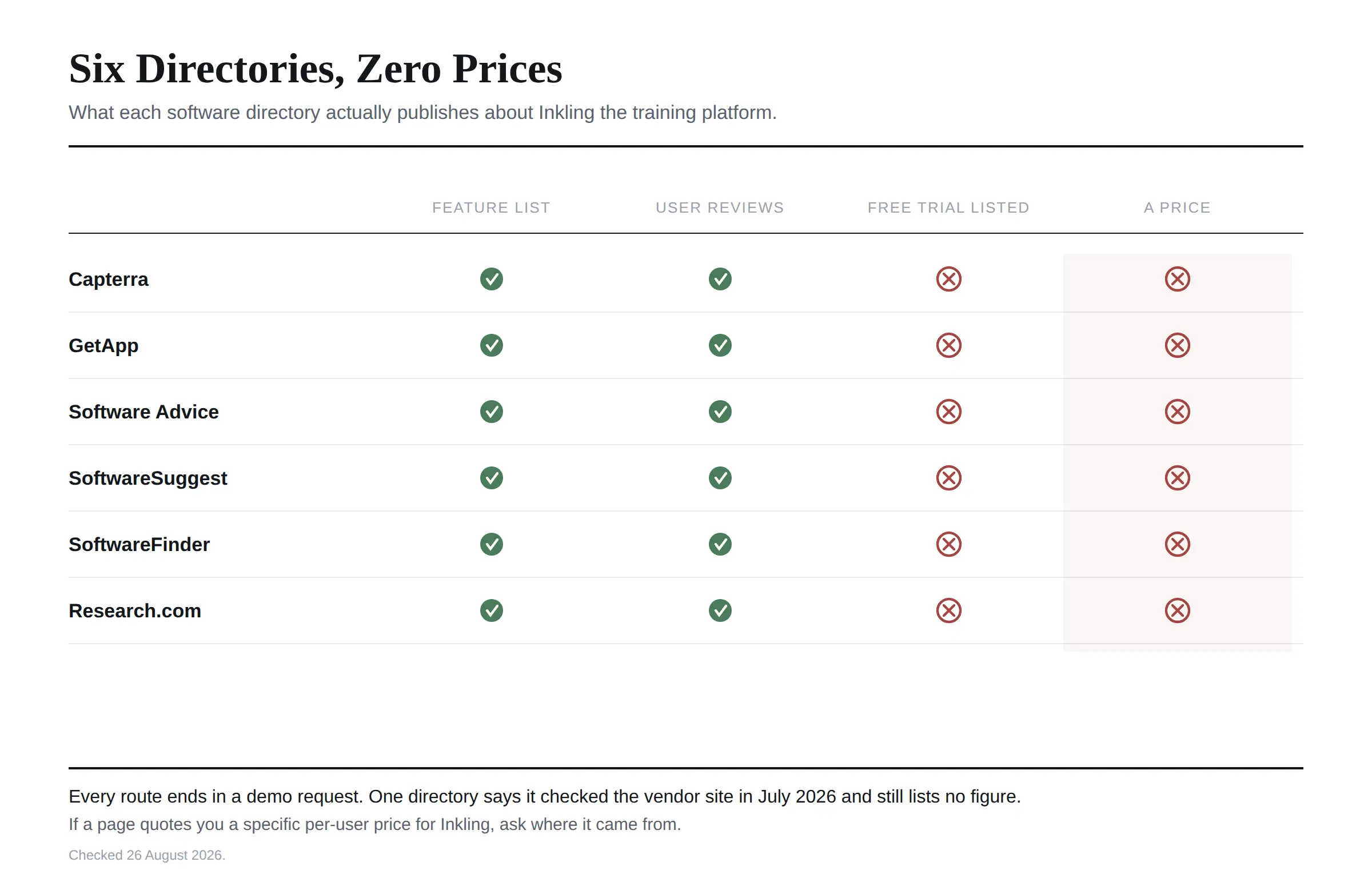 I checked Capterra, GetApp, Software Advice, SoftwareSuggest, SoftwareFinder and Research.com. Every one carries a detailed feature list. Not one carries a number. The pattern is uniform: custom pricing, contact for a quote, book a demo.
One directory states its pricing details were last updated from the vendor's website in July 2026, then presents no figure, which tells you the vendor's site had none either.
There is also no published free tier and no self-serve trial. What exists is a demo request.
Why It Has No Price, and What That Means for You
This is normal for enterprise workforce software rather than evasive, and it is worth understanding why.
Platforms sold to large frontline employers price on headcount, and headcount varies from a few hundred to a few hundred thousand. A restaurant chain with 90,000 hourly staff and a regional utility with 800 field engineers are not the same customer, and a public per-seat rate would either scare off the first or undersell the second.
The practical consequence for you is that Inkling cannot be compared on price against alternatives without entering a sales process for each one. That is a real cost in time before you have spent anything.
If a competing directory or blog quotes you a specific per-user figure for Inkling, treat it with suspicion. I could not find a sourced one anywhere, and invented pricing is common in this category because the pages rank.
How to Get a Real Number Out of Them
Since a quote is the only route, go in prepared. Four things determine the figure you get.
Headcount, and how you count it. Ask whether you pay for named users, active users, or total employees. On a frontline workforce with high turnover, that distinction can double or halve the bill.
Contract length. Annual and multi-year commitments are where discounting lives in this category.
Content migration. Moving existing manuals and SOPs into the platform is often a separate professional services line, and it is the most common budget surprise.
Which modules. Authoring, analytics, messaging and integrations are not always in the base price.
Ask for the total first-year cost including onboarding and migration, not the per-seat rate. The per-seat rate is the number sales wants to discuss and the least useful one.
Which Inkling Should You Care About
Depends entirely on what you do.
If you are building software, the AI model is the relevant one, and the honest summary is that it is a capable reasoning model priced above its open-weight peers. You are paying a premium for intelligence in a class where cheaper options exist. Whether that is worth it depends on whether the quality gap shows up in your workload, which is a test you should run rather than a claim you should accept.
If you are running training for a frontline workforce, the platform is the relevant one, and the pricing opacity is the thing to plan around rather than object to. Budget time for three parallel sales conversations, and compare on total first-year cost.
If you are weighing per-token AI spend against subscription tools more generally, the calculation is different again, and I worked through it in our guide to whether ChatGPT is free.
Frequently Asked Questions
How much does Inkling cost?
The AI model from Thinking Machines costs 1 dollar per million input tokens and 4.05 dollars per million output tokens on the first-party API. The training platform does not publish a price and quotes by demo.
Does Inkling have a free trial or free plan?
The AI model has open weights under Apache 2.0, so self-hosting is free of per-token charges. The training platform offers a demo rather than a free trial, and I found no free tier.
Does Inkling charge per user?
The training platform prices on headcount, which is why it quotes rather than publishes. The AI model charges per token, not per user.
Is Inkling expensive?
For the AI model, yes relative to its peers. Artificial Analysis rates it particularly expensive among open-weight models of similar size, at roughly three and a half times the median rate on both input and output.
What is Inkling pricing per user for the training platform?
Not published. No directory I checked lists a figure, and I would not trust any source that quotes one without naming where it came from.
Is Inkling a learning management system?
The platform is closer to a mobile knowledge and enablement tool than a traditional LMS. It focuses on SOPs, in-the-flow training and real-time updates for deskless workers rather than course catalogues and compliance tracking.
Who is Inkling best for?
The platform suits large frontline employers in retail, hospitality and field services. The AI model suits developers who want a strong open-weight reasoning model and can either pay a premium per token or self-host.
Is Inkling worth the price?
For the model, only if the intelligence gain over cheaper open-weight options shows up in your actual workload. For the platform, that question cannot be answered until you have a quote, which is the problem.
How does Inkling pricing work for enterprises?
Through negotiated annual contracts based on headcount, contract length, modules and migration work. Ask for total first-year cost rather than a per-seat rate.
Does Inkling publish its API pricing?
Thinking Machines publishes rates for the model, and it is also available through five API providers whose prices differ. Check the specific provider you plan to route through.
What I Would Do Next
If you want the model, run it on your own workload before committing. It is genuinely strong and genuinely priced above its class, and the only way to know whether that trade is worth it is to measure it against a cheaper open-weight alternative on the same task. Turn on prompt caching first, because at an 83 percent discount it changes the arithmetic more than switching models would.
If you want the platform, accept that you cannot shortlist on price and shortlist on fit instead. Then ask all your candidates for total first-year cost in writing, including migration, and compare those.
And whichever you meant, be careful what you read. A search for this term returns two products, several stale figures, and at least one context window that is off by half.
Model specifications and pricing verified against Artificial Analysis on 26 August 2026. Platform pricing was checked against six software directories on the same date, none of which published a figure.