Haime Pricing 2026: What Each Tier Really Costs a Team
The three prices: Haime pricing starts at 15 euros per seat per month for Single, rises to 23 euros for Teams, and reaches 39 euros for Enterprise. All figures exclude VAT, and annual billing saves the equivalent of two months on every tier.
There is also a free two week trial with no credit card required.
Credit where it is due, publishing those numbers at all puts Haime ahead of almost every competitor in its category, where the standard answer is a sales call.
What the pricing page does not tell you is what happens when you multiply those numbers by a real headcount. So I did. There is a floor at 20 seats, a ceiling at 100, and one number missing that could matter more than any of the others.
What Haime Charges
Here is the published structure, taken from Haime's own pricing page. I covered what the platform actually does in our full Haime review, so this piece stays on the money.
Plan | Monthly per seat | Annual per seat | Built for |
|---|---|---|---|
Free trial | 0 | 0 | Two weeks, one user, no card |
Single | 15 | 150 | One person |
Teams | 23 | 230 | Small groups |
Enterprise | 39 | 390 | 20 seats and up |
All figures in euros, excluding VAT.
The annual column is a yearly price, not a monthly one. So Single at 150 euros a year works out to 12.50 a month against 15 on monthly billing, which is the two month saving Haime advertises.
Every tier includes access to ChatGPT, Claude, Gemini and Mistral through one interface. I would say that twice, because the price difference between tiers does not buy you more models. It buys governance.
The Bill at Six Team Sizes
This is the part I could not find anywhere, so I worked it out.
 One person. Single at 15 euros a month, or 150 for the year. This is the individual professional case, and it is also the sensible way to evaluate the platform properly after the trial ends.
Five people. Teams at 115 euros a month, or 1,150 a year on annual billing. For a small agency or a department trying AI properly, this is a modest line item.
Twenty people. Teams comes to 460 euros a month, or 4,600 a year. This is also the first point where Enterprise becomes available, at 780 euros a month or 7,800 a year.
Fifty people. Teams reaches 1,150 euros a month, or 11,500 a year. Enterprise at the same headcount is 1,950 a month, or 19,500 a year.
One hundred people. Teams lands at 2,300 euros a month, or 23,000 a year. Enterprise is 3,900 a month, or 39,000 a year.
More than one hundred. There is no published price. Haime asks you to talk to them.
The shape of that list is the useful part. Nothing surprising happens between one seat and nineteen. The interesting behaviour is at the two ends.
The 20 Seat Floor Nobody Mentions
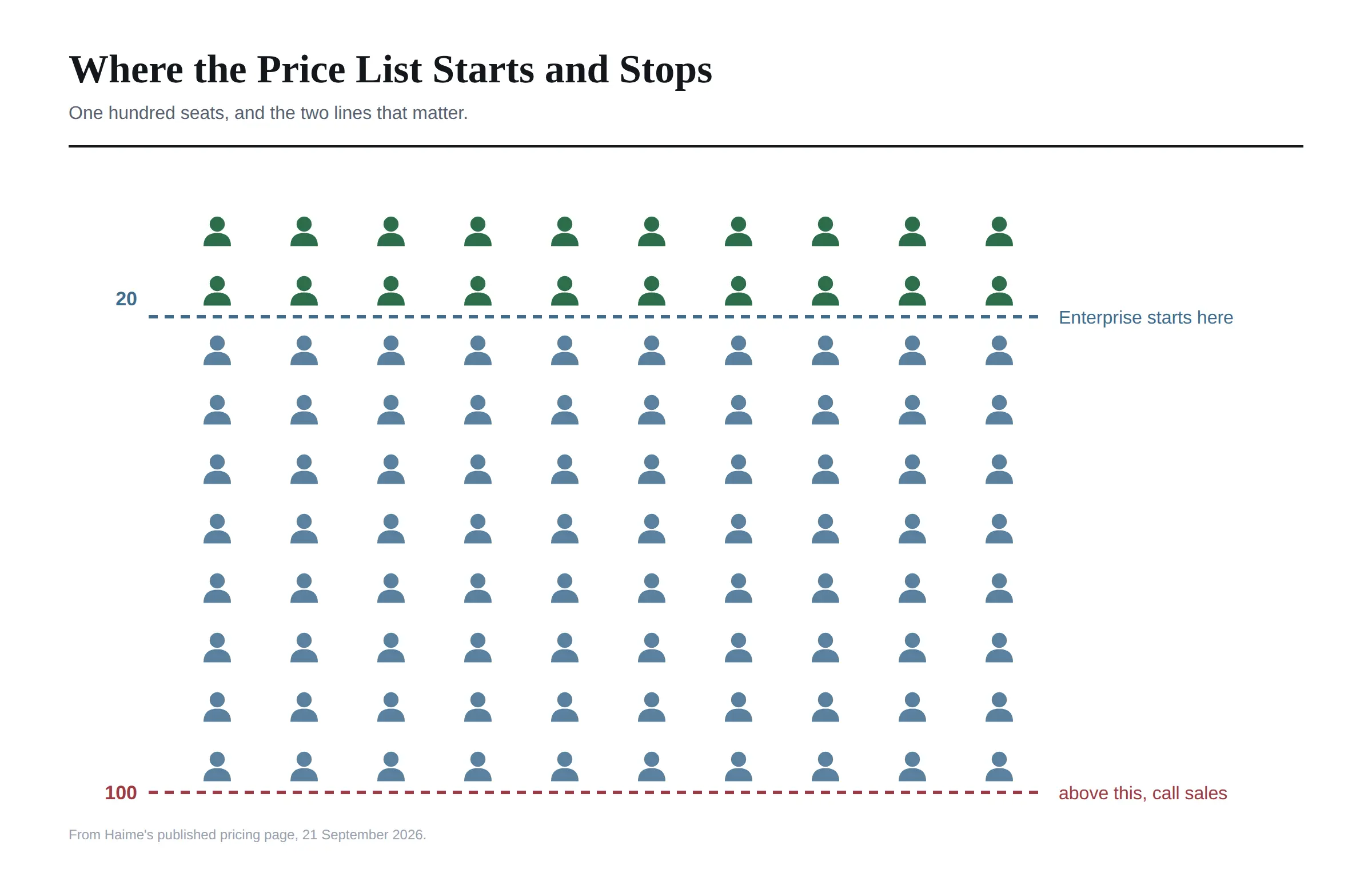
Enterprise carries a minimum of 20 seats, and this is the detail most likely to catch out a buyer reading the headline number.
The page says 39 euros. What that actually means is that the cheapest possible Enterprise contract costs 780 euros a month, or 7,800 a year on annual billing. If you have twelve people and you want the Enterprise features, you are still paying for twenty.
I think that matters because the Enterprise tier is where the compliance features live. The Data Processing Agreement is included for all Enterprise customers. The admin dashboard, the per team policies, the risk tolerance settings and the audit exports are Enterprise features too.
So a fifteen person company with a serious data protection officer is in an awkward position. The plan that solves their problem has a floor priced for a bigger organisation.
To be fair to Haime, it is not unusual here. Claude Enterprise carries a 20 seat minimum on its self serve path, and ChatGPT Enterprise has been reported at around 150 seats. Against that, 20 is at the friendly end. But a floor is still a floor.
The step up cost. Moving 20 people from Teams to Enterprise adds 320 euros a month, or 3,200 a year on annual billing. That is the price of the compliance layer, and I find it a fair way to think about the decision. You are not buying better AI. You are buying evidence for your auditor.
The 100 Seat Ceiling
At the other end, Haime stops selling to you directly.
Above 100 seats, or for any custom setup, the pricing page sends you to sales. So the published price list covers organisations from one to one hundred people, and everything larger is a negotiation.
I read that as a small company being honest about its size rather than as a warning. But it does mean that if you are a 300 person business, none of the numbers on this page are your numbers, and you should treat the published rates as a rough anchor for a quote rather than a price you will pay.
Fair Use, and the Number That Is Not Published
Here is the gap I would want closed before signing anything.
Single and Teams are sold under a fair use policy. Haime defines it as AI usage appropriate for a normal working individual at that plan level, covering daily prompts, documents and analysis, and says it monitors for usage that becomes extraordinary relative to one person's work.
Enterprise uses what Haime calls Fair use plus, which pools usage across the whole organisation instead of measuring it per person. That is genuinely useful, because real teams are uneven. Two heavy users and twenty light ones is normal, and a pooled allowance handles that where a per person cap does not.
What nobody publishes is a number. There is no token count, no message cap, no documented threshold at which usage becomes extraordinary.
For most teams this will never come up. For a team with three power users running long documents through Claude all day, it might. I would ask for the actual ceiling in writing before rolling it out, and I would ask what happens when you cross it: a conversation, a throttle, or an upgrade demand.
This is the one respect in which a per token platform is easier to reason about, since you can at least calculate the bill. I worked through what that looks like in our guide to Gemini API pricing, where the cost is fully predictable and the complexity sits somewhere else entirely.
Monthly, Annual, and the VAT Line
Three practical details that change the number on the invoice.
Annual billing saves two months. On Teams that is 46 euros per seat per year. On a 50 person deployment, I make that 2,300 euros a year.
Monthly plans have no minimum term. Annual plans commit you for twelve months. Haime also lets you upgrade or downgrade at any time, with changes applying at the start of the next billing cycle, which is more flexible than most annual contracts.
All prices exclude VAT. For a Danish company that is 25 percent on top. A 50 seat Teams deployment at 11,500 euros a year is 14,375 with VAT included. If you are quoting a budget to a finance team, quote the VAT inclusive figure, because that is the one that leaves the bank account.
What Each Tier Actually Adds
Since the models are the same across all three plans, the question is what the extra euros buy.
Single gives one person managed access to the four model families, basic prompt assistance and basic usage visibility.
Teams adds the things that make it a shared tool: role based access control, proper usage analytics, and shared conversation projects so people can collaborate on work with AI rather than each keeping their own private chats.
Enterprise adds the compliance and rollout layer. The DPA, the admin dashboard showing who is using which model and how, per team policies, configurable risk tolerance, audit exports, adoption metrics by department, and dedicated onboarding where Haime works with your IT team and data protection officer directly.
Reading that list, I would say the split is sensible. Teams is a productivity purchase. Enterprise is a governance purchase, and it is priced accordingly.
Haime Pricing Against Buying the Models Separately
This is the comparison that decides whether any of it is good value, and it is the strongest argument in Haime's favour.
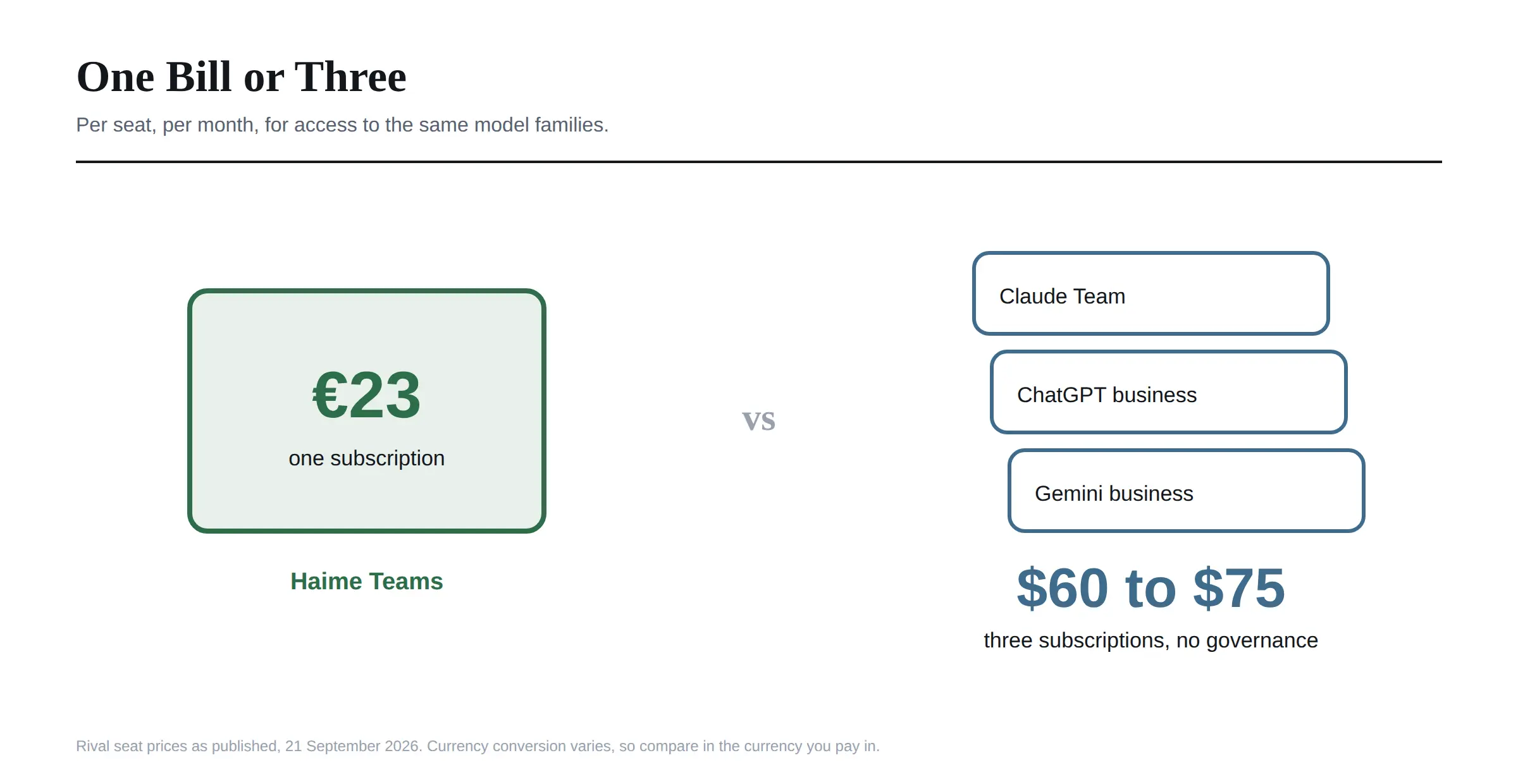 Buying business seats for the models individually means three subscriptions. Claude Team is 20 dollars per seat per month on annual billing, or 25 monthly. ChatGPT business seats sit in a similar range. A Gemini business seat adds roughly 14 to 20 dollars depending on the Workspace plan underneath it.
Adding those up, I get somewhere around 60 to 75 dollars per seat per month for genuine access to all three, before anyone has built any governance on top.
Haime Teams is 23 euros. Even Enterprise at 39 euros undercuts the stack comfortably, and it includes the admin and compliance layer that the three separate subscriptions do not give you at all.
Two honest caveats. Currency conversion moves, so compare in the currency you actually pay in. And the comparison only holds if your team genuinely uses more than one model family. If everyone is happy inside ChatGPT alone, a single business subscription beats every option here, and the governance argument has to carry the whole decision on its own.
The Discounts That Are Not on the Page
Three ways the published price is not the final price.
Volume and term length discounts are mentioned on the pricing page without any figures attached. If you are near either end of a tier, ask.
Non-profit and public sector discounts exist. Haime says it works with Danish public institutions and offers tailored terms, including a DPA suited to public sector requirements.
Custom setups above 100 seats are negotiated entirely.
None of those are advertised as percentages, so I would treat the published rates as a starting position rather than a fixed price, particularly on annual Enterprise.
Three Things Still Unclear
I want to be straight about what I could not establish.
The fair use ceiling. No number, anywhere, on any tier.
What happens at renewal. Nothing published about price protection on annual contracts, so a renewal could come back higher.
Whether the rates hold outside Denmark. All prices are in euros with Danish VAT as the obvious reference. I could not confirm whether pricing differs for customers elsewhere in the EU or outside it.
For a company this size, none of those omissions strike me as evasive. They are the sort of thing a fifteen minute demo call would answer, and Haime says its demos run about that long.
Frequently Asked Questions
How much does Haime cost?
Single is 15 euros per seat per month, Teams is 23, and Enterprise is 39, all excluding VAT. Annual billing saves the equivalent of two months on each tier, and Enterprise requires a minimum of 20 seats.
Does Haime have a free plan?
There is no permanent free plan. Haime offers a two week free trial with full Single plan features, started from the pricing page, with no credit card required.
Does Haime have a seat minimum?
Enterprise requires at least 20 seats, which makes the real minimum Enterprise cost 780 euros a month rather than 39. Single and Teams have no minimum.
What is the most Haime will sell you directly?
One hundred seats. Above that, or for any custom setup, Haime asks you to contact them for a quote rather than buying from the published price list.
What does Haime fair use actually mean?
Haime defines it as AI usage appropriate for one working person at that plan level, and says it monitors for usage that becomes extraordinary relative to that. Enterprise uses Fair use plus, which pools usage across the organisation. No numeric limit is published, so I would ask for it in writing.
Is Haime cheaper than buying ChatGPT and Claude separately?
Usually yes, if you need more than one model family. Separate business seats for Claude, ChatGPT and Gemini come to roughly 60 to 75 dollars per seat per month combined, while Haime Teams is 23 euros and includes the governance layer.
Does Haime pricing include VAT?
No. All published prices exclude VAT, so budget the VAT inclusive figure. At Danish VAT of 25 percent, a 50 seat Teams deployment moves from 11,500 to 14,375 euros a year.
Can you cancel a Haime plan?
Monthly plans have no minimum term. Annual plans commit for twelve months in exchange for the two month saving. You can upgrade or downgrade at any time, with changes taking effect at the start of the next billing cycle.
Does Haime offer non-profit or public sector discounts?
Yes. Haime says it works with Danish public institutions and offers tailored terms and a public sector appropriate DPA for qualifying organisations, though no discount percentage is published.
Is the Data Processing Agreement included?
The DPA is included for all Enterprise customers. On Single and Teams it is not part of the published package, which is worth knowing if your legal team requires one.
Who Should Buy Which Plan
If you are one person testing whether this is worth rolling out, take the trial and then Single. Fifteen euros is a cheap way to find out.
If you are a team under twenty and nobody is asking you for a DPA, Teams at 23 euros is the obvious choice, and the multi model access alone justifies it against buying separate subscriptions.
If you have a data protection officer, a compliance requirement, or a board that wants to see who is using AI and how, you need Enterprise, and you should budget the 20 seat minimum whether or not you have twenty people.
And if you are over a hundred people, ignore every number on this page except as an anchor. Your price is whatever you negotiate, and with volume discounts mentioned but unquantified, there is more room in that conversation than the published rates suggest.
I checked every figure here against Haime's pricing, enterprise and FAQ pages on 21 September 2026. Haime is a small company and can change its plans without much notice, so confirm the current rates before committing a budget.